
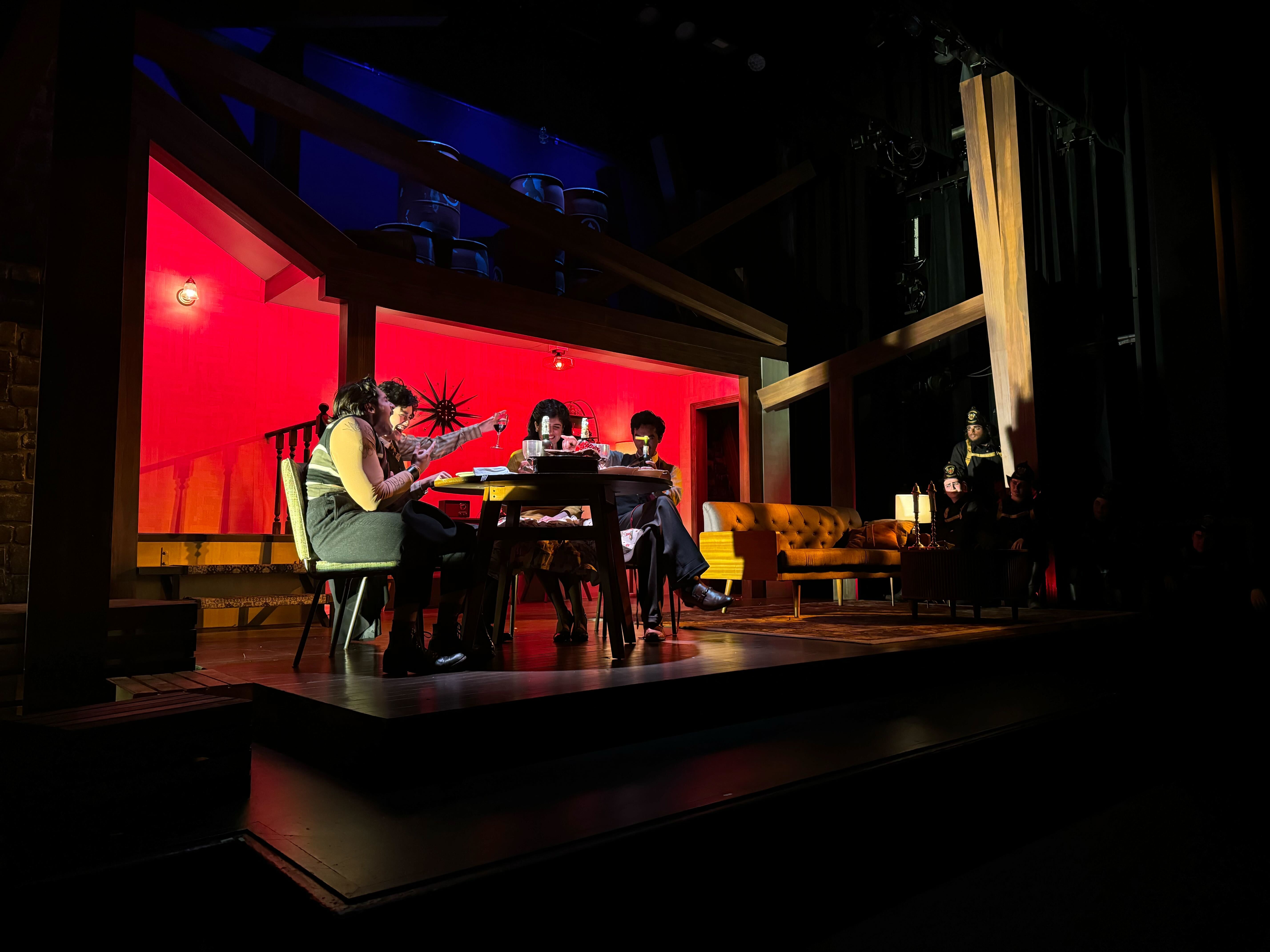
Twelve hours before Jewish students at Stanford received emails threatening a “Holocaust 2.0,” the university staged the closing performance of “The Arsonists,” Max Frisch’s post-Holocaust parable about a man who watches arsonists move into his home and frames his accommodation as decency.
By Monday, the metaphor turned literal: Vice Provost Patrick Dunkley emailed the Stanford community that Jewish students had been targeted in a coordinated antisemitic email campaign, including explicit threats of violence, genocidal language and attempts to intimidate organizations to “stop Jewish infiltration” across campus. Shortly thereafter, Stanford’s Chabad on Campus received a thinly veiled threat, which warned that “‘antizionist’ is becoming a real convenient costume for plain old Jew-hate.” Stanford published a warning, then left the enabling conditions for these threats intact.
Anonymously and with chilling precision, members of the Stanford community are being targeted because they are Jews. If Stanford wants to understand what an incendiary idea looks like, it can reread its own inbox.
“The Arsonists” opens with a chorus of firefighters circling the house, warning of the impending danger, before moving aside to watch. They confess to their own impotence, calling themselves guardians “watching, listening, always well-disposed… yet never thinking the worst.”
Center stage is Mr. Biedermann — “Mr. Respectable” in German, the smugly upright bourgeois type —reading about arsons committed in a comically consistent way: two men charm their way into homes and then burn them down. Biedermann scoffs at the naïveté of others. Yet he is the same man: ruthless to the powerless, deferential to those who flatter him and obsequiously hospitable to men he suspects could destroy him.
The play’s genius is that it stages normalization, not sudden invasion. Gasoline barrels are hauled in loudly into the attic, waking up a fuming Mr. Biedermann and his wife. When confronted, the arsonists don’t hide their identities; Biedermann reads their honesty as humor, hoping his politeness can substitute for a boundary. As the arsonists tell Mr. Biedermann, the most effective tactic for getting away with arson is the naked truth, because believing it would demand action. He chooses the performance of tolerance more than the burden of refusal. Of course, they burn his house and the rest of the town down.
It’s tempting, leaving the theater, to think of the arsonists as “them,” a metaphor for fascism, for Nazism. That reading isn’t wrong, but it can flatter the audience into thinking we are the firefighters. For all their haunting warnings, knowledge and tools to stop the fire, the problem is that the firefighters never act.
Universities have perfected this same choreography of vigilance for years: aware, prepared, still not acting.
In February 2019, the Stanford Daily reported a guest lecturer suggested that fewer than 6 million Jews died in the Holocaust. In March 2023, The Daily reported swastikas and a drawing resembling Hitler left on a Jewish student’s door.
The Oct. 7 Hamas attacks on Israel further tested universities’ enforcement of boundaries during pro-Palestinian demonstrations: protecting students’ right to protest while refusing to normalize rhetoric or conduct that functions as intimidation, dehumanization or endorsement of violence for Jewish students. At Stanford, campus life became a laboratory for that boundary.
To many on Stanford’s campus, pro-Palestinian protesters were not arsonists, but temporary guests with whom the problem was managing space instead of enforcing norms. Like Mr. Biedermann’s failed appeasement, Stanford initially took a conciliatory approach to pro-Palestinian encampments on White Plaza. An official statement read that Stanford “[understood] and appreciate[d] the passionately held beliefs” of pro-Palestinian advocates, framing encampments through the dual lens of supporting free speech and preserving safety of the campus community.
Stanford’s May 31, 2024 report titled, “It’s in The Air: Antisemitism and Anti-Israel Bias at Stanford and How to Address It,” documented what this permissive climate produced: calls for violence (“Death 2 Settler Colonial Projects,” “Long Live Palestine, Die Israel”), antisemitic blood libel reminiscent of Nazi propaganda and criminal vandalism of former University president Richard Saller’s office. Today’s arsonists rarely arrive shouting their intentions. Instead, as the report describes, they speak the campus’s moral language, reclassifying their Jewish targets with euphemisms like “Zionist” and “Zio” until harassment becomes legitimized.
This week, threats escalated again: “You want your host populations to accept you for who you are, we say: NEVER,” reads a second anonymous email sent to Stanford Chabad. The Chabad emails strip away the euphemisms and lay bare the underlying Jew hatred, endorsement of violence and antisemitic tropes.
Mr. Biedermann would recognize this university culture as a moral emergency, because he is well-practiced at explaining it away until it is too late. Mr. Biedermann’s tragedy isn’t that he doesn’t notice the arsonists. It’s that he notices them and chooses the smaller humiliations — appeasement, politeness, rationalization — over kicking them out of his home.
In the end, he hands the arsonists the matches.
Stanford has let the arsonists into the attic. The community has watched dangerous rhetoric find a home here. Kicking the arsonists out is and will always be socially uncomfortable. It provokes backlash, accusations of censorship, and reputational discomfort. But a university cannot outsource moral clarity to the students most endangered by its absence. If fear of conflict governs the house, the house becomes governable by those willing to threaten. That fear has transformed one of the smartest campuses in America into one of the easiest places to launder the deplorable into the debatable.
If universities want to gauge whether they have successfully extinguished the fire, the only measure of effectiveness is whether Jewish students still need to calculate their safety, their visibility, and their belonging.
I did not want to write another article about antisemitism, but the arsonists are in the attic with barrels of gasoline. The firefighters must act, “so the combustible threat hidden from sight is revealed before it is too late to put out the flames.” But firefighters cannot put out a fire alone.
What do we permit into the attic because confronting it would cost us social comfort?
The answer cannot be censorship and it cannot be selective empathy. Stanford’s own report explicitly rejects the idea that safety means insulating students from discomforting views; it insists instead on safety from bigotry and threat. Professors and administrators should question those motives, as shaping an intellectual environment free from such motives is the University’s job to enforce and the community’s job to defend. The arsonists don’t need us to love them. They need us to keep explaining why we can’t possibly be expected to stop them.
We’ve read many headlines of towns burning elsewhere, certain that the fires could not reach our roof. Stanford must now sit not with the spectacle of fire, but the humiliating intimacy of complicity.