
At Stanford, spring doesn’t arrive quietly. It comes with the crack of bats, the thud of spikes on the track and the steady rhythm of practices that have become traditions for generations of Cardinal athletes.
For athletes across Stanford’s women’s spring teams, those traditions — from meals to huddles to dances — are often the moments they remember most.
Fifth-year lacrosse midfielder Annabel Frist said traditions are some of the most meaningful parts of the sport.
“All the things that bring me the most joy are our traditions and the things that make us unique,” Frist said. “They’re honestly like an inside joke that carries between girls I played with five years ago and girls that will play here five years from now.”
Some traditions are designed to bring new players into the fold.
“Our freshmen promote our games in Tresidder,” Frist said. “They dress up in costumes, have posters and play loud music. Whether it actually gets a lot of fans or not, it’s a fun way for them to get excited about their first experience playing inside Cagan.”
Across Stanford’s spring sports, however, one ritual stands out: food.
“There’s a famous clip of a Boston College basketball player who was asked in a press conference, ‘What are you going to miss most about your team?’” Frist said. “He said, ‘eating meals together.’ It’s really the smaller moments, the behind-the-scenes moments that make your sport so much fun.”
Track and field junior distance runner Sophia Kennedy echoed that sentiment.
“The night before races, we’ll all order food and eat together. It reminds me that I’m here to compete, but it also calms me down because I’m just having a good meal with my girls,” Kennedy said. “Weirdly, our team loves Thai food. That’s kind of our big pre-race dinner.”
Other traditions shape how teams prepare in the final moments before play.
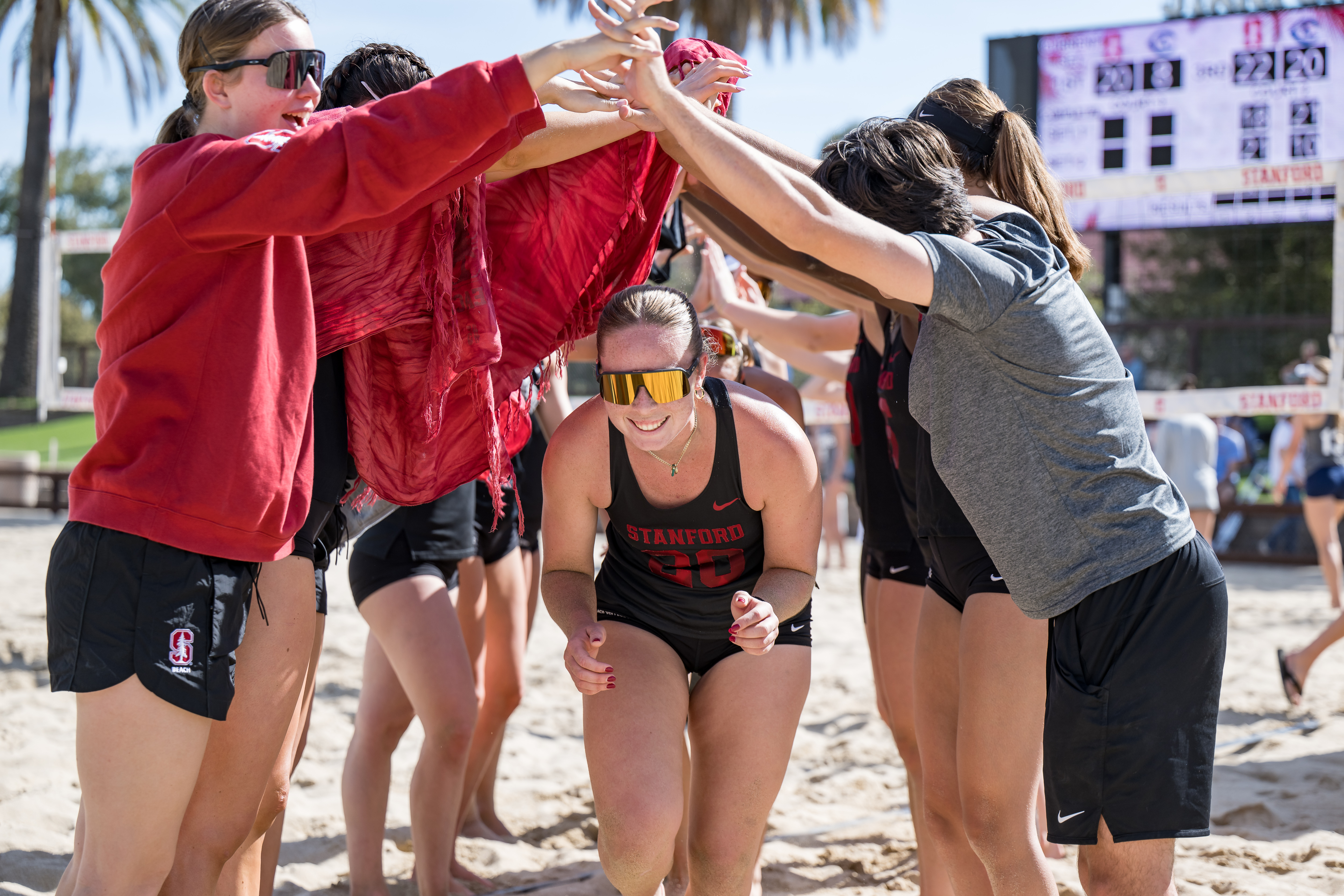
“When we warm up, the starting lineup is hitting, and everyone else stands on the sideline ready to throw balls,” beach volleyball senior Daria Gusarova said. “We call it ‘balls, balls, balls,’ because if someone shanks, you need balls flying right away. So everyone’s standing there with two balls ready.”
Rituals also help reinforce team culture.
“After every game or every practice, we huddle up without the coaches, just players only, and we go around, every person has to say something and shout out one or two people on the team,” Gusarova said.
Stanford Lacrosse has their own symbolic tradition during games.
“Our coach introduced something called ‘warm fuzzies,’” Frist said. “You have these little puff balls, and you take a few and put them in your pocket, your sock, whatever it might be before, and then at the end of the game, you shouldn’t have any of the warm fuzzies you started with. You give them to teammates… as a way to be like, ‘Hey, I believe in you, I trust in you.’”
Beach volleyball emphasizes a similar idea through a concept adopted this season.
“We started using the word ‘mudita,’” Gusarova said. “[It means] you’re still happy for everyone, and you really try to cheer them on, because if everyone does well, we all win… You can live such a happier life if you are also happy for the person right next to you.”
Some traditions also connect athletes across Stanford sports.
Stanford Athletics’ annual “Dancing with the Card” performance has become a highlight for many teams.
“We make our freshmen put on a full production dance,” Frist said. “We spend a week or two helping them come up with a routine and an outfit, and then they perform it. It’s honestly really impressive.”
The routine often leaves a lasting mark.
“Whatever song we choose ends up being our song for the whole next year,” said Frist. “Whenever it plays, everyone jumps in and does the dance.”
Beach volleyball shares a similar tradition.
“Our freshmen last year won ‘Dancing with the Card’ with ‘What You Know About Me’ by GloRilla,” Gusarova said. “They choreographed a whole dance, so now that’s kind of our hype song.”
Some athletes also rely on personal routines to get into a competition mindset.
“I fold my jersey [on the sideline] so just the number 33 is showing and line up my goggles and mouthguard evenly,” Frist said. “I take a lot of pride in representing Stanford and wearing that jersey, so it’s a way of giving it respect.”
On the track, traditions can take a playful form — especially during the Big Meet against California.
“The men’s team grows out mustaches, which is terrible. They should not keep doing that,” said Kennedy. “But we’ll do red eyeliner, red hair dye, temporary tattoos — it’s just really fun.”
For Kennedy, one tradition stands above the rest. At the end of the season, Stanford track and field holds a “willing ceremony.”
“Graduating seniors will pass down things that were willed to them or create something new,” Kennedy said. “Some of the items go back to 2005, which is when I was born.”
Holding those objects, she said, can feel surreal.
“Stanford track has had Olympians and national champions,” Kennedy said. “So it’s really cool to be part of that history and have something passed down.”
In the end, it’s not just wins or records that define Stanford’s spring sports — it’s the shared rituals and quiet traditions that athletes say make the season unforgettable.