
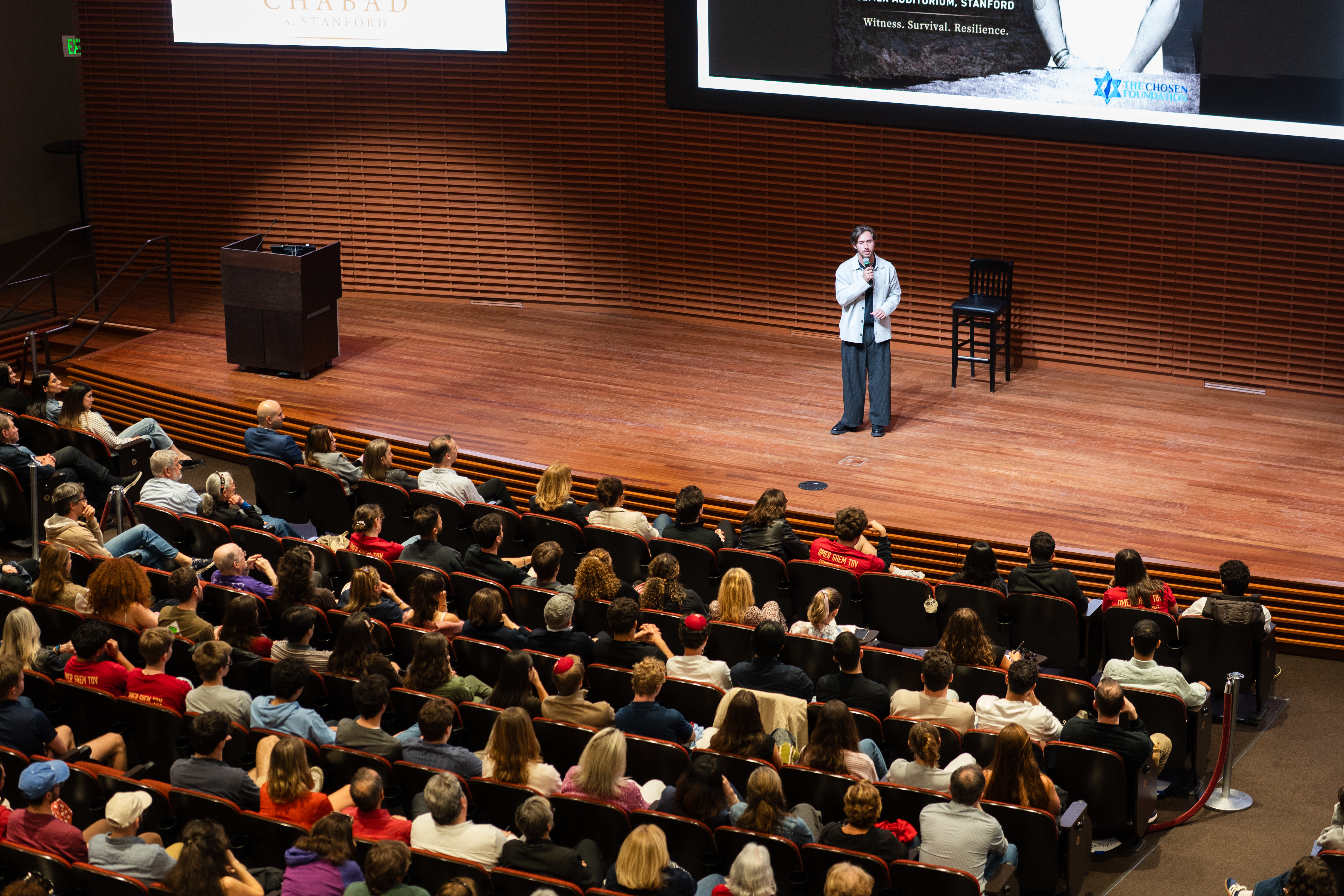
Omer Shem Tov described his capture by Hamas, life as a hostage and release at a Wednesday event hosted by Chabad at Stanford’s L’Chayim Club.
“I wake up in the morning and I’m so so grateful for life. You have no idea. You have no idea what it’s like to wake up and all of a sudden, it’s not complete darkness, all of a sudden, there is light,” Shem Tov said.
Shem Tov spoke in graphic detail of his experiences during 505 days in Hamas captivity. He described the starvation, physical and psychological abuse he endured as a hostage.
“I witnessed miracles. Really. I did really witness miracles, from small ones to great ones. I saw miracles, and my faith in God became very, very strong,” said Shem Tov.
Maurice Korish ’26 and Amalia Abecassis ’27, co-presidents of the L’Chayim Club and organizers of the event, explained that event planning began in September. It involved coordination with security, the Office of Student Engagement (OSE) and approval from a special committee to hold the event during Week 10, according to Korish.
Shem Tov opened and closed his speech with the same phrase: “I’m Omer Shem Tov and I’m a free man,” which was met by a standing ovation from the crowd both times. Students remained deeply attentive throughout the talk.
Shem Tov said positivity and faith were grounding points for him through the experience. He said he used these values to support other hostages while in captivity together.
“Omer Shem Tov, who endured 505 days in a dungeon in captivity, brings the campus the human voice behind the politics that people so often study and debate,” said Rabbi Dov Greenberg, founder and director of Chabad at Stanford. “And there’s a huge difference between discussing history, reading history abstractly and hearing it from a person who carried history on his back.”
Korish and Abecassis said one of the reasons for hosting the event was to provide a human face to discussions of Oct. 7 and the Israel-Hamas conflict.
“We’re at a moment everywhere around college campuses where what happened on Oct. 7 can sort of get lost in a lot of political noise,” said Abecassis. “And so I think what Maurice and I and the club wanted to do is very much to cut through that noise.”
Kathryn Stoner, a political science professor and the director of the Center on Democracy, Development and the Rule of Law (CDDRL), gave brief remarks at the beginning of the event, calling for “empathy as human beings” in response to stories of abduction like Shem Tov’s.
“Whatever your perspective is on the Israeli government, the war in Gaza, the seemingly endless conflicts or the current war with Iran, we can all likely agree that there has been far too much suffering, too much hate, too much death and far too much shouting about these topics and not enough listening and understanding of the experiences of real people living through terrible situations,” Stoner said.
The night also included a short film before Shem Tov’s testimony, which depicted the events of Oct. 7 from the perspective of attendees who witnessed Hamas’ attack at the Nova music festival. The film detailed the struggle to return the 251 hostages in Israel and across the globe.
Shem Tov began to choke up on stage when he replayed a friend’s voice memo from Oct. 7. On the phone, his friend was calling her dad saying “I love you. I love you. I am about to die. I’m sorry” in Hebrew.
The talk was interspersed with light moments as well, such as when Shem Tov mentioned that one of his earliest requests upon return to Israel was a burger, which garnered laughter from the crowd.
Shem Tov briefly mentioned more recent violence in the Middle East at the end of his talk, saying, “A big, big thank you to the IDF soldiers, and to the American soldiers who are now fighting together, and I wish them to succeed and luck.”
“God gives you sometimes a smack in the face. I love it. I really do. It just keeps me going. Another challenge and another challenge, and it’s just, wow, I love it. I love it. I love life. Just love life. That’s it,” Shem Tov said.