
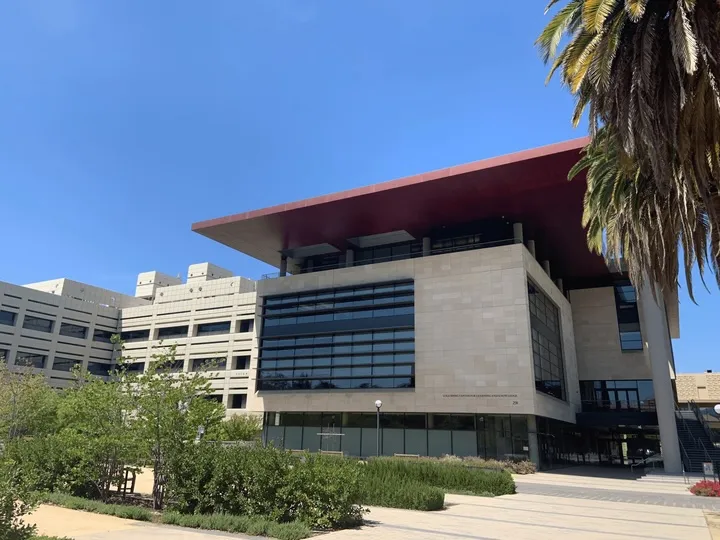
The Trump Administration opened investigations into admissions policies at the medical schools of Stanford University, Ohio State University (OSU) and the University of California, San Diego (UCSD) on March 25, noting possible race discrimination.
In letters sent to the three schools, the Department of Justice (DOJ) requested data on the last seven years of admitted classes at the medical schools, threatening to withhold federal funding if the schools do not comply by turning over the data requested by April 24. The investigation is part of a larger crackdown on higher education, as the DOJ has launched dozens of investigations into universities during Trump’s second term.
“At this time, our investigation will focus on possible race discrimination in medical school admissions,” DOJ Assistant Attorney General for Civil Rights Harmeet Dhillon wrote in each of the letters, according to reporting by The New York Times. The investigation seeks documents related to the “use or lack of use of race” in evaluating applicants, as reported by KQED.
Stanford, OSU and UCSD have each acknowledged receiving the DOJ’s letter.
Stanford School of Medicine spokesperson Cecilia Arradaza told CNN that the medical school was reviewing the letter and that it “prohibits unlawful discrimination on the basis of race, color, national or ethnic origin or any other characteristic protected by applicable law.”
Current medical students at Stanford voiced support for the school’s admissions team and leadership.
“I stand staunchly with the Stanford Medicine admissions team,” Brian Zhang, a first-year M.D. student, wrote in an email to The Daily. “In my experience communicating with the team before, during, and after matriculation, I can attest they are compliant with the law in every way and do not discriminate based on race, color, sexual orientation, national or ethnic origin, or any other protected characteristic in their selection of students.”
Sarah Rockwood, a fourth-year M.D.-Ph.D. student, noted some hesitancy with how this will affect the school’s operations.
“I think there is a general sentiment of concern that this could impact Stanford School of Medicine’s ability to carry out its normal duties in the future, but most students (including me) are not sure what the tangible impact of this investigation will be,” Rockwood wrote to The Daily. “We trust that our school leadership is handling it appropriately.”
The DOJ also sent a five-page document to the schools detailing the specific admissions data the government is seeking, which dates back to students who entered in 2019.
In addition to race and ethnicity, the requested records include applicants’ residence, standardized test scores, disclosures of familial relationships to alumni and ties to university donors. The Trump Administration also requested any internal messages within the universities about diversity, equity and inclusion, as well as correspondence between the universities and pharmaceutical companies about admissions policies.
If turned over, the admissions data would be “maintained in accordance with applicable federal confidentiality requirements,” Dhillon wrote in the letters.
“Admissions files contain identifying information, and this request… is a gross violation of student privacy,” Zhang wrote. “I hope that, and am confident that, Stanford’s commitment to students of all backgrounds, including those who are international, undocumented or from underrepresented communities, will not waver in these coming weeks.”
The request for admissions records is “not only an invasion of privacy, but also creates grounds for further discrimination against minority students… another opportunity to introduce bias and discrimination against already marginalized groups in medicine,” a Stanford medical student who wished to remain anonymous due to immigration status wrote to The Daily.
“Since the removal of race-based admissions, I, as a Black medical student, continue to receive comments implying that I was a ‘DEI admit,’” the anonymous source wrote. “The assumption that underrepresented students in medicine, especially at a place like Stanford, are admitted solely on this basis is discriminatory, to say the least.”
Last August, Stanford Medical School’s newest entering class welcomed a class of 119 students. OSU welcomed 211, and UCSD welcomed 140.
Compared to national percentages — 42% White, 28% Asian, 8% Black and 7% Latino — published by the Association of American Medical Colleges, the two California-based medical schools had higher Latino and Asian student enrollment, while having half as many White students. At Stanford, Black students accounted for 12% of enrollment compared to 6% at UCSD. OSU’s medical school enrollment matched the national percentages but lagged behind in Latino student enrollment.
“With such a small class size, the data the administration is requesting is uniquely identifying to every student who has matriculated over the past seven years,” first-year M.D. student Elise Clapacs wrote to The Daily.
“It is no stretch of the imagination that an administration that has already facilitated extensive improper access to sensitive personal information and singled out individual students for persecution might do the same to my classmates if given the opportunity,” Clapacs wrote. “We don’t need to pretend we don’t know what’s going on.”
The triad of new medical school investigations signifies an expansion of the Trump administration’s targets to graduate education, following the 2023 Supreme Court ruling that banned the use of affirmative action in college admissions.
In March 2025, the DOJ launched an investigation to examine Stanford’s undergraduate admissions policies. Stanford spokesperson Luisa Rapport wrote in a statement to The Daily that following the Supreme Court decision, “the University immediately engaged in a comprehensive and rigorous review to ensure compliance in our admissions processes.”
Data from Stanford’s undergraduate class of 2028 and 2029, the first and second classes enrolled, respectively, after the Supreme Court decision, showed decreases in Black or African American student enrollment and decreases in Hispanic or Latino student enrollment, while Asian and White student enrollment increased.
Earlier this month, in response to federal mandates on college admissions data, a group of 17 states, including California, filed a lawsuit against the U.S. Department of Education. Led by Massachusetts Attorney General Andrew Joy Campbell, the states argued that the Trump administration’s actions were an attempt to turn the National Center for Education Statistics into a “mechanism for law enforcement and the furthering of partisan policy aims.”
During a press release for the lawsuit on March 11, California Attorney General Bonta said, “The Trump Administration is on a fishing expedition — demanding unprecedented amounts of data from our colleges and universities under the guise of enforcing civil rights law.”
Many students have voiced their opposition to such rulings and investigations.
“Every one of my classmates who has been admitted deserves to be here, and it has been a privilege to be in an environment so conducive to learning and collective winning. The heart and talent of the student body, academic or otherwise, are unparalleled,” Zhang wrote. “I am disappointed in the distractive questioning of an institution and student body that continues to lead America in research, academics, cultural competency, and service to diverse patient populations everywhere.”