
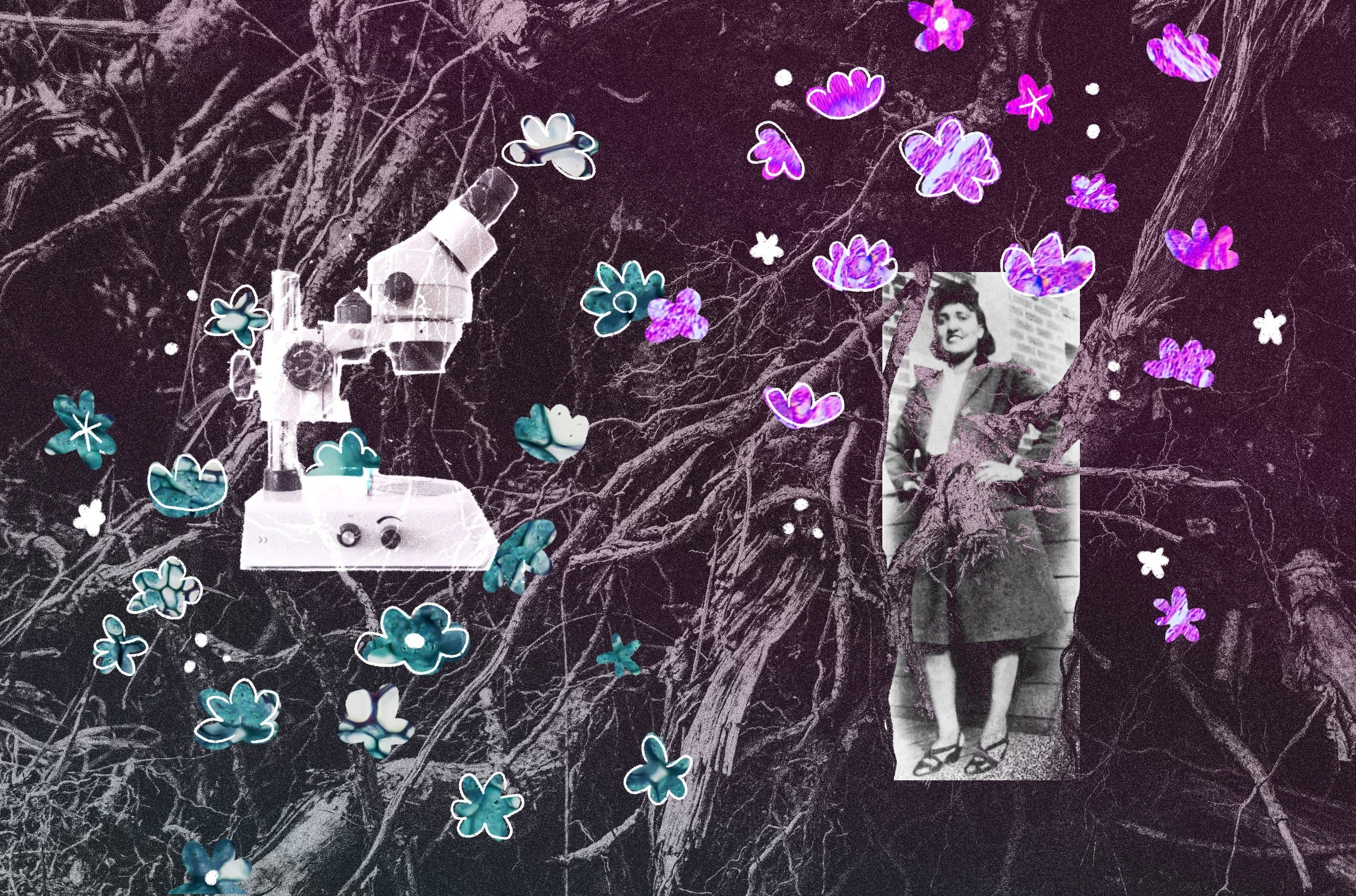
In “The Hidden Garden,” Ruby Honjol ’29 examines how groundbreaking medical discoveries can flourish while the humanity of the patients behind them remains unseen.
Editor’s Note: This article is a book review and includes subjective thoughts, opinions and critiques.
Imagine a garden growing beneath your feet. Roots twist through soil, blossoms reach for light and seeds multiply in secret. Passersby pause to admire the flowers, marveling at their beauty and abundance. But what happens when they only celebrate the blossoms while forgetting the roots that nourish them, the soil that sustains them and the hands that first planted them? This is precisely what happened to Henrietta Lacks.
In her non-fiction book “The Immortal Life of Henrietta Lacks,” Rebecca Skloot tells the story of an ordinary African-American mother and cervical cancer patient in Baltimore whose cells were taken without her knowledge or consent during treatment in 1951. These cells became the first immortal human cell line, later known as HeLa, capable of dividing forever due to a rare mutation that activates the enzyme telomerase. Most human cells can only divide a certain number of times before they die, like a clock running out. Telomerase stops that clock, allowing cells to divide again and again without aging, winning them the “immortal” title.
HeLa cells transformed biomedical research, allowing scientists to test polio vaccines, map human genes, develop chemotherapy and even study the effects of zero gravity. For decades, while her cells grew like a hidden garden, powering a multi‑billion‑dollar industry in biotechnology, Henrietta’s story (and family) remained invisible. And for more than 25 years, her contributions went unrecognized by the public and scientific community.
Through Skloot’s nonfiction narrative, we meet Henrietta’s five children, including Deborah Lacks, who spent decades wrestling with confusion, grief and anger after discovering how her mother’s cells had been used without their family’s knowledge. “If our mother is so important to science, why can’t we get health insurance?” Deborah asked in an interview with Skloot. While Henrietta’s cells were bought and sold by laboratories generating immense profits, her family lived in poverty.
Skloot also describes how the rise of HeLa cells occurred alongside the Tuskegee Syphilis study, a government experiment from 1932 to 1972 that enrolled 600 impoverished Black men, 399 of whom had syphilis, to observe the disease’s natural progression without their informed consent. Participants were misled into thinking they were being treated for “bad blood.” Even after penicillin became the standard cure in the 1940s, researchers deliberately withheld treatment so they could continue studying the effects of untreated syphilis.
Like the men in Tuskegee, Lacks was used as a source of scientific material without her knowledge or consent, showing how Black bodies were historically exploited to advance medicine while the people themselves remained invisible and unprotected. Beyond her immortal cells, Lacks’ story is a lens through which we must examine medicine’s moral blind spots and the enduring consequences of historical exploitation.
Reflecting on Lacks’ legacy forces us to confront the structural inequities that persist in healthcare today. Her family’s poverty, the lack of access to basic care and the historical exploitation of Black patients highlight how the benefits of science are often unevenly distributed. Over the past several decades, medical ethics have improved significantly: laws and regulations now require informed consent, institutional review boards oversee human research and healthcare has achieved greater awareness of racial disparities.
Still, recent events show these ethical questions remain far from settled. In 2026, a National Institutes of Health brain development project involving more than 20,000 children was found to have improperly released genetic data that fringe researchers later used to promote discredited “race science.” Although participants had been assured their information would remain secure, the data was accessed and repurposed to argue for racial hierarchies in intelligence. The case illustrates that even today, scientific institutions struggle to safeguard biological data and ensure that research involving human participants is used responsibly.
“The Immortal Life of Henrietta Lacks” reminds us that progress doesn’t erase the harm done, and that vigilance is needed to ensure that innovation is accompanied by empathy, curiosity is guided by moral accountability and ambition is tempered by humility.
The story raises a fundamental question for all who practice medicine: how do we honor the human lives that make scientific progress possible? How do we ensure that the drive to cure does not eclipse the duty to respect, listen and care? Just as Henrietta’s cells live on, we’re reminded that the lessons of her life must live on too. Science without conscience is incomplete, every advancement carries responsibility,and medicine’s ultimate work is not only to extend life but to honor it.
In tending the gardens of science, I urge us never to forget the roots, the soil and the hands that first nurtured them.