
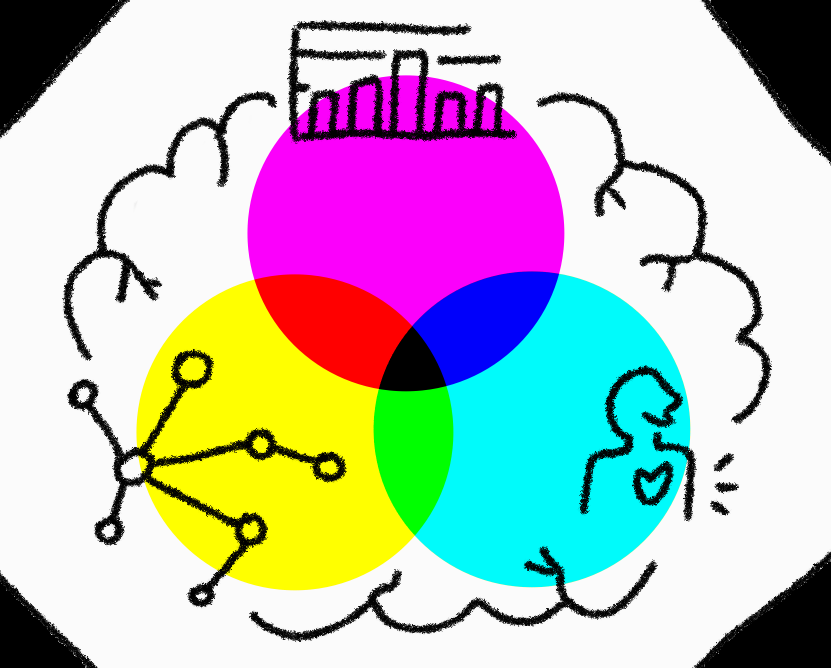
As an MCiM (Master of Clinical Informatics and Management) student with a strong interest in entrepreneurship, I’ve been drawn to courses that explore how to build products through design thinking. Over the past two quarters, that led me to courses across three of Stanford’s schools — the GSB, the d.school and the School of Medicine — each approaching the idea through its own lens. I expected the frameworks to have significant overlap. What I didn’t expect was how much they’d differ from and deepen each other.
The GSB: Who needs this most?
In both fall and winter quarter, I took Startup Garage, a GSB course where student teams identify real user needs, prototype solutions and build out a full business model. Known for its hands-on, lean startup approach, it has helped founders launch ventures like DoorDash.
Startup Garage gave me a breakdown of users I didn’t have before: extreme users, solution seekers, solution users, complainers and status quo. The first two groups — people who need a solution badly enough to build workarounds already — are your most valuable signal. They reveal both the depth of the problem and whether anyone will actually pay to solve it.
What I appreciate most about the GSB lens is that it doesn’t let you become attached to addressing a need without first asking: among these user segments, how many people have this problem and how do you reach them? Distribution channels in Startup Garage weren’t a go-to-market afterthought, but a needs-finding lens. The channel you choose reflects who you believe has the sharpest pain.
Biodesign: Who else is in the room?
Biodesign Innovation, a School of Medicine course focused on entrepreneurship in healthcare, pushed me to think about needs-finding in a way I hadn’t before: through stakeholder analysis. For any clinical need, the question isn’t simply “Does the patient want this?” Instead, it’s “What does this change for the physician, the hospital administrator, the payer, the caregiver?
The class made this concrete through stakeholder mapping — visually laying out who is affected, how each party’s needs relate to one another and where priorities conflict. A feature that’s convenient for one stakeholder can be a dealbreaker for another. What I love about this framework is that it treats needs-finding as a mapping exercise. You’re not just listening to one voice, you’re understanding a whole ecosystem of competing priorities before you become attached to a solution.
The d.school: Does it create real value for a real person?
Design for Healthy Behaviors brought me back to something simple. We started by testing behavior change on the most honest subject available — ourselves. I built two products: one to help me stop overthinking, and one to track my daily progress and give me small moments of positive reinforcement. Then we validated with a small group, even if that group was five people.
There’s something I deeply appreciate about this approach: it keeps you accountable to genuine human value, not just a compelling hypothesis. Market size and stakeholder alignment matter, but the d.school reminds you that none of it counts if a single real person isn’t genuinely better off.
As someone building in consumer health, I feel lucky to have had access to all three frameworks at once. The GSB sharpened how I think about who the problem affects badly enough to change their behavior. Biodesign opened my eyes to the stakeholder landscape that every consumer health product lives inside. And the d.school kept bringing me back to the most grounding question: is this actually useful to one human being, right now?
Each school is teaching design thinking from a different perspective. For anyone building in healthcare, each is easy to overlook in a different way: you can get excited about market size and forget the patient in front of you, or get lost in stakeholder complexity and lose sight of whether it’s actually worth building. Learning all three has elevated how I approach needs-finding and made me a better builder.