
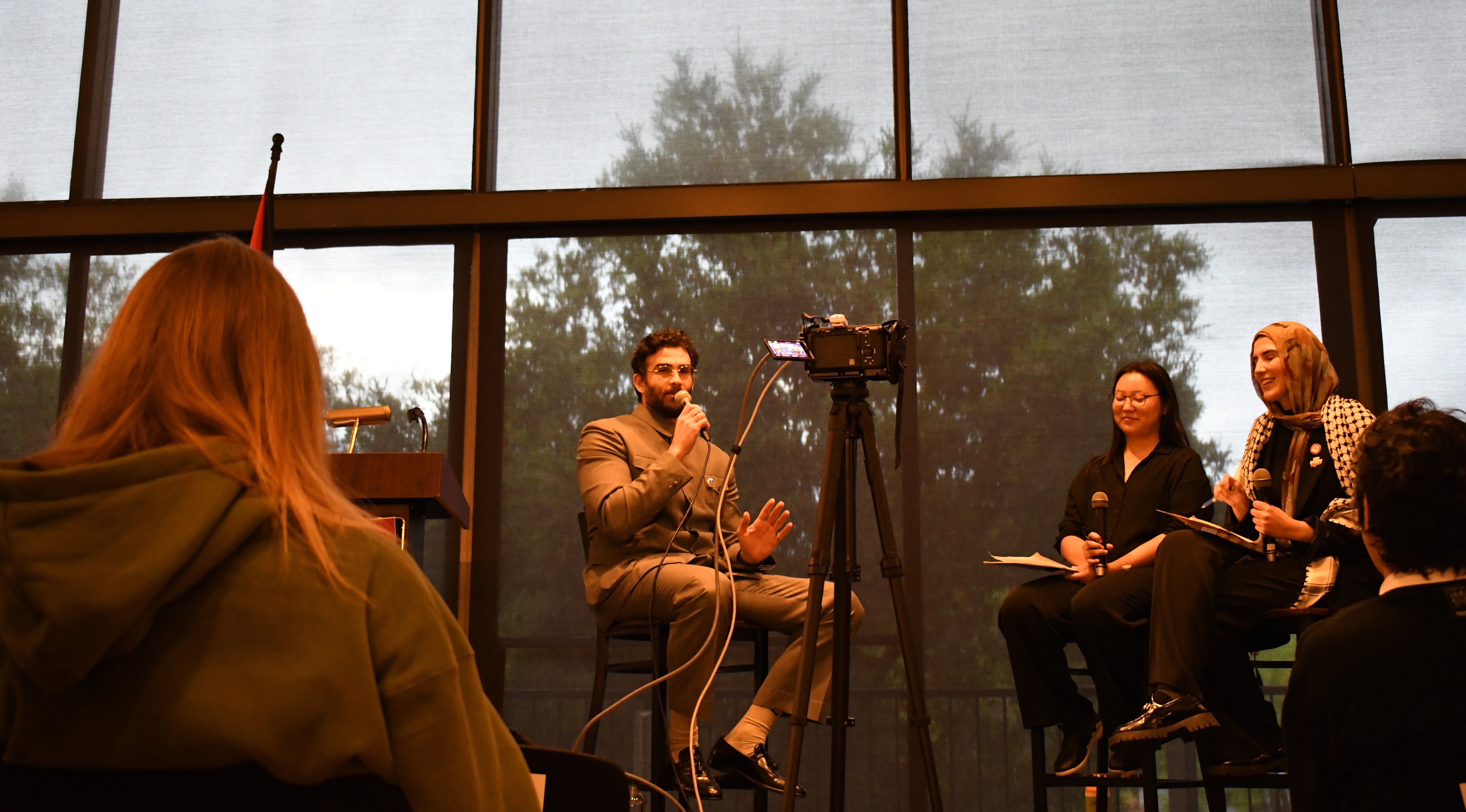
Twitch streamer and left-wing political commentator Hasan “HasanAbi” Piker condemned what he called ‘U.S. imperialism,’ and urged labor mobilization and political education in front of a packed crowd during a Wednesday talk at Tresidder Oak Lounge. Piker was in conversation with Stanford Asian American Action Committee (SAAC) organizer Juhae Song ’28 and Stanford Students for Justice in Palestine (SJP) organizer Iman Deriche ’27.
Piker, who boasts three million followers on Twitch, has become one of the most prominent political figures of the digital space. Hailed by many as a leading voice of the American left, Piker has faced criticism for his vocal support for Palestine and condemnation of Israel. He is a self-described socialist.
During his talk, Piker continuously referenced the growing popularity of anti-imperialist sentiment in the United States. “Our empire is coming to an end,” he said. “And to that I say, ‘Thank god.’” Piker attributed this change to the struggling American economy, but emphasized Americans’ need to build a longer-lasting political awareness.
“I believe what the masses need currently is class consciousness and political education first and foremost, because they don’t have it,” he said.
In particular, Piker honed in on Trump’s recent interventions in Venezuela and Cuba, and the ongoing war in Iran. He described the president as “the purest expression of American rage and American imperialism,” and critiqued him for using aggressive, violatory and — in Piker’s words — “rapist”-like language to push for American involvement in conflicts abroad.
“He is a representation of all the same exact capital forces that have dominated American politics on both sides of the political spectrum,” Piker said.
However, Piker also noted that Trump’s tendency to “say the quiet part out loud” helped dismantle the myth that the U.S. could serve as a “liberal, intellectual… world police.”
Piker also cited the war in Iran as a catalyst for social change. He claimed that the war and its “tremendous instability” had disrupted “Zionist operations,” collectively shifting American attitudes about conflicts in the Middle East and Beyond.
“Most people actually realized that all that was bullshit. That actually caused them to really reconsider what they thought of foreign adversaries [who] they learned are evil and barbaric and worthy of domination,” Piker said. “So I think in many respects, Palestine has been a formative part of saving the Western world as well.”
While he acknowledged the material benefits of intervention abroad, Piker warned about its costs.
“Our empire has a tax,” he said. “In reality, we send our own people off to other countries to die in a mission with no real strategic purposes. We have a limited and very expensive form of socialism for veterans, and even that is landluster. And our empire requires that its capital be invested in weapons of war, far beyond any rational need.”
Piker further highlighted the domestic costs of that military investment.
“After all, every dollar spent on a bomb that would go out and blow out of school overseas… is a dollar that could have been spent on a school here,” Piker said.
Piker used Cuba as a key example of how U.S. ‘imperialism’ “robbed this… beautiful people of its unlimited potential.”
Following a recent trip to the country, he described being “shocked” and “angry” at the country’s low standard of living on the U.S.’s ongoing “maximum pressure” campaign, a function of the “American-sanctioned regime.” He cited increases in energy prices that have upended Cuban hospitals as evidence of America’s moral failure.
“He’s clearly quite good at talking out at length on the issues with which he’s familiar,” said Darius Jonasch, a resident at Stanford Medicine and a casual viewer of Piker since 2018. “He’s a coherent and compelling speaker on things… and you can see that he does well with the crowd in person, too.”
Piker also criticized the Democratic Party for failing to combat authoritarianism, especially amidst concerns about ICE and democratic backsliding. He noted the unpopularity of Democrats despite their current position as the opposition party — a result of what Piker described as “consensus politics” between the two major parties.
“We have consensus politics in this country on a lot of issues that are plain to the day-to-day existence of ordinary Americans… [including] the privatization of healthcare,” Piker said. He raised government mismanagement of K-12 education and degradation of public utilities as evidence that the Democratic party had failed to improve the quality of life for ordinary Americans.
“The Democrats that don’t even choose to address [these] problem[s]… those Democrats are not going to be your allies. They are going to be your enemies, because they are going to be fascist collaborators,” said Piker.
“Hasan’s a comrade, at the end of the day,” said Song, one of the event moderators. “We knew he’d have sharp politics. We knew he shared our politics. And this was a really great time to amplify… [that] to the rest of campus.”
Moving beyond electoral politics, Piker tackled the issue of U.S. labor relations and the working class, describing Americans as lacking understanding of both labor history and relations.
While Piker acknowledged the utility of events like the No Kings protest, he stressed the need for more economically powerful forms of protest like general strikes and labor militancy.
“The only power that you have as a working class individual is your productive capabilities,” Piker said. “If you can organize and you can show your losses, [if] you can show capital owners that you can shut off those productive capabilities through work stoppages — then you become a much more powerful entity.”