
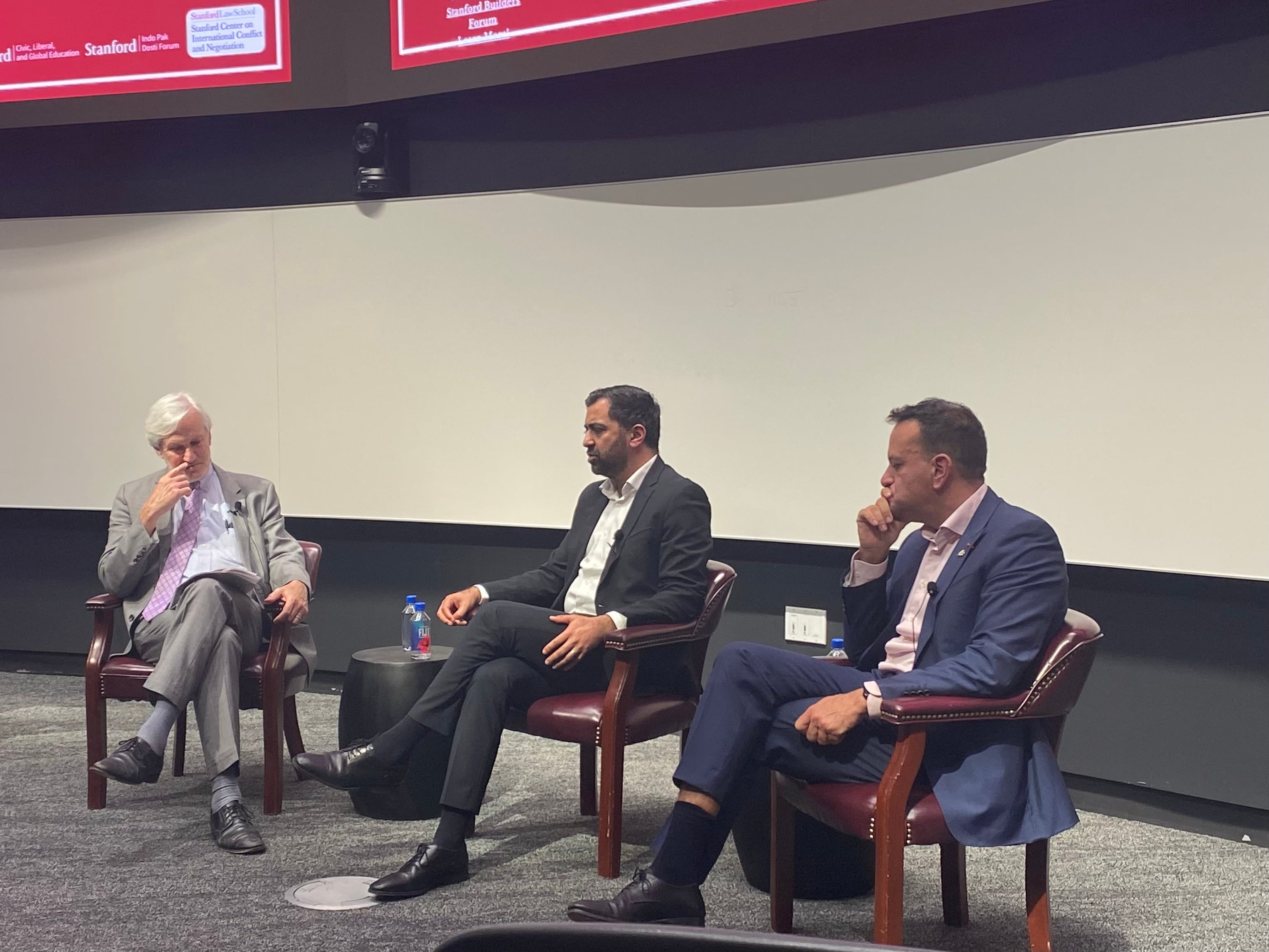
Former Taoiseach of Ireland Leo Varadkar and former First Minister of Scotland Humza Yousaf stressed the importance of civic engagement to conflict resolution during a Thursday talk hosted by Stanford ePluribus.
“It’s not about correcting [people] or giving them a lecture about history,” Valadkar said. “It’s about giving people space to listen to their views and make their case.”
In a conversation moderated by Allen Weiner, a lecturer at Stanford Law School and director of the Stanford Center on International Conflict and Negotiation, Yousaf and Varadkar shared advice from their firsthand experiences handling global conflict. The leaders detailed how their backgrounds have shaped how they handle policy making and governance to an audience of about 70 people.
According to ePluribus and Stanford Democracy Hub Executive Director Karina Kloos, the inspiration for the event came from Luv Jawahrani ’27, one of the student leaders of the Indo-Pak Dosti forum. Jawahrani approached Kloos after learning that Yousaf and Varadkar were interested in attending the forum, which ePluribus hosted as part of its quarterly Builders Forum.
“Both [ministers], the work that they’ve done both in navigating complex, pluralistic societies where they are, [and] especially the bridge-building work they are doing between India and Pakistan, fit nicely for the spirit of the Builders Forum,” Kloos said.
Yousaf and Varadkar wrote a joint letter advocating for peace and military de-escalation between India and Pakistan in May 2025. The letter called on Indian Prime Minister Narendra Modi and Pakistani Prime Minister Shehbaz Sharif to “resist the pull of conflict.”
Both ministers have navigated international crises during their time in office. Yousaf served as First Minister from 2023-2024 following his previous roles as Justice Secretary and Secretary of Health, a position he held from 2021-2023 during the COVID-19 pandemic.
Varadkar served as Taoiseach from 2017-2020 and again from 2022-2024, during which he navigated the pandemic and the withdrawal of the United Kingdom from the European Union in Brexit. Varadkar said his interest in politics began at a young age, when he engaged in political discussions at home and accompanied his parents to the voting booth.
“I was more interested in elections than football,” Varadkar said. “My parents would talk about politics at the dinner table and I would be allowed to stay up late to watch the news.”
As the first ethnic minority and openly gay person to serve as Taoiseach, Varadkar said he learned to see his overlapping identities as a political asset throughout his career. According to Varadkar, these traits allowed him to expand his worldview beyond a mostly homogenous Irish culture.
“Over time, I actually got to understand how my heritage and my upbringing were very relevant to my politics, because from day one, it gave me a very global view that there was a bigger world outside Ireland,” Varadkar said.
When Yousaf was appointed First Minister, he became the youngest person, the first Scottish Asian person and the first Muslim person to hold the position. Upon his appointment, Yousaf also became the first Muslim head of a Western democracy.
With deep experience in resolving global conflicts, both emphasized directing the public toward a common solution. “Sometimes you have to lead, not be led,” Yousaf said regarding discontent with government decisions during COVID-19. He noted that many citizens and businesses felt angry after multiple lockdowns, which created more need to help the public see the government’s end vision.
For Valadkar, civil dialogue is crucial in enabling the public to share their dissatisfaction with certain issues or decisions. “You need to allow people to set out their position and their grievances, and they also need to be heard,” he said, recounting Ireland’s history of large-scale demonstrations, protests and civic organizing.
Many attendants were drawn to understanding the role of public engagement in building bridges across nations. As a pediatric fellow at Stanford’s Lucile Packard Children’s Hospital, Shanika Palpola ’15, M.S. ’21, M.D. ’21 sought to learn more about the role of the workforce in global conflict.
“What I found interesting was trying to learn from leaders…when they’re thinking about addressing conflict at a very, very large scale,” she said. “The more we bury our heads in the sand, the harder it is to address these things.”