
My mother came to this country from England when she was eight. My father came from Jamaica when he was two. Their parents brought them here with nothing except the belief that America would let their children become something. It did. I grew up in a majority-immigrant community in South Florida surrounded by families who had made the same bet from every direction. All of our stories began the same way: someone crossed an ocean, a child was born on American soil and that child belonged.
On his first day back in office, President Trump signed an executive order denying birthright citizenship to children born in the United States if their mothers were undocumented or on temporary visas. Though courts blocked it immediately, the case ultimately reached the Supreme Court as Trump v. Barbara. Trump attended oral arguments in person, the first sitting president in history to do so, then left partway through and posted on Truth Social: “We are the only Country in the World STUPID enough to allow ‘Birthright’ Citizenship!”
He is right about that fact. Most of the world does not do this. He is wrong about the adjective.
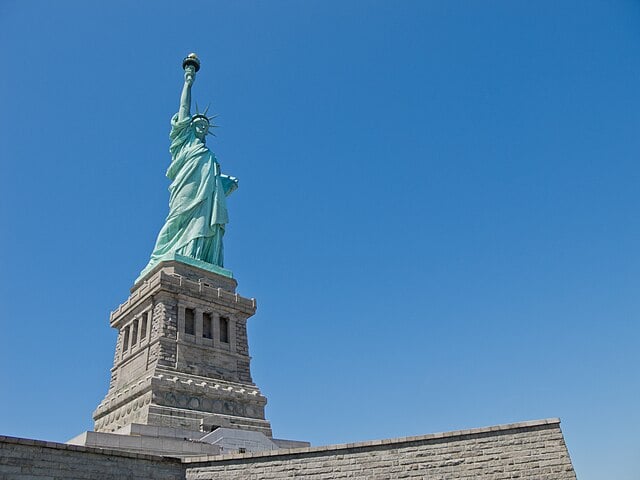
There is a statue in New York Harbor that faces outward, towards the ocean and towards the arriving. She does not ask where you came from. There is a bridge in San Francisco whose orange towers disappear into the fog each morning and reappear each afternoon, the city beneath built by the children of Chinese immigrants. There is a document in the National Archives that begins with a radical proposition: that those governed by a nation’s laws deserve equal standing within it. The men who signed it lived on this soil, were taxed by its British government and demanded independent governance accordingly. Most nations are founded on a tribe, a tongue or a territory held long enough to legitimize a claim of ownership. America was founded on the principle that location, not lineage, determines belonging. Birthright citizenship is what that principle looks like in law.
The United States has practiced jus soli, right of the soil, since 1868. Before that, the law was Dred Scott v. Sandford, in which Chief Justice Taney held that Black Americans could never be citizens regardless of where they were born. The men and women subject to that ruling had cleared the forests of Maryland and built the columns of the Capitol. They planted and harvested cotton, the foundation of the Southern economy, which in turn made Northern textile mills run. They nursed the children of the families who enslaved them, cooked the food those families ate and, when they died, were buried in the same soil they had spent their lives working. Yet the highest court in the land decided these contributions did not entitle them to citizenship — that they could build this country but never belong to it as equals. Today, many immigrants ask the same question: if we uphold this country, are we entitled to citizenship?
The Civil War was fought over the question of freedom and citizenship for Black Americans. 600,000 Americans died. In the Reconstruction that followed, the 14th Amendment established a new foundation for citizenship. “All persons born or naturalized in the United States, and subject to the jurisdiction thereof, are citizens of the United States.” It was decided, once and for all, that belonging in America would be a matter of soil, not of blood.
That has remained a national principle for 157 years. Last week, Solicitor General D. John Sauer argued that America is an “outlier among modern nations.” Justice Kavanaugh reminded the courtroom that “we try to interpret American law with American precedent based on American history.” We are not the United Kingdom or Germany, neither of which grants unrestricted birthright citizenship.
We have always been outliers. We were outliers when we built a republic on popular sovereignty while Europe bowed to kings. We were outliers when we constitutionalized free expression so broadly that it protects speech most democracies would criminalize. We are outliers in how aggressively we protect criminal defendants, in our refusal to establish a state church and in our insistence on people’s right to bear arms. The “American experiment” has never been about following the consensus of other nations. It tests whether a country organized around ideas instead of ancestry can endure. Jus soli is the constitutional expression of that test.
And like any experiment, it is imperfect. A child born on American soil to undocumented parents is a citizen entitled to public services, usually a fiscal weight borne by states rather than the federal government. The pull factor is real too: automatic citizenship for children born on American soil draws families across the border illegally or encourages them to overstay visas. Birth tourism, including operations tied to Chinese government officials and facilitated by an industry of maternity businesses, has produced hundreds of thousands of American citizens who have never lived here yet retain full voting and entitlement rights. These are legitimate concerns, and dismissing them as nativist chatter does nothing to solve them.
While ending birthright citizenship is an easy answer to these problems, it is the wrong one. Birth tourism ought to be treated as a visa enforcement failure; consular officers already have the legal authority to deny applications where it is the evident purpose. The costs to states are substantial, which obliges the federal government to fund these services and streamline the immigration system to hold residents accountable based on their status in a timely manner.
None of this is simple or easy to fix. Congress has failed to pass comprehensive bipartisan immigration reform since Ronald Reagan’s presidency. But the difficulty of this solution does not justify gutting a constitutional principle. We do not rewrite the First Amendment because someone abuses free speech. We do not abolish the Fourth Amendment because it sometimes lets a guilty person walk. And we must not dismantle the Fourteenth Amendment because our immigration system is broken.
America has never been a country that does things because they are easy. The correct path is enforcement reform, congressional action and the slow, unglamorous work of building an immigration system worthy of the country it serves. It is worth taking the harder course to preserve what makes this nation unlike any other.
The President calls birthright citizenship stupid. Lady Liberty, standing watch over New York, carries an inscription that cries out: “Give me your tired, your poor, your huddled masses yearning to breathe free.” She was not built to welcome the well-documented. She was built to welcome all who arrived. For over a century and a half, the 14th Amendment has done just that. America is not foolish for honoring birthright citizenship. America is America because of it.