
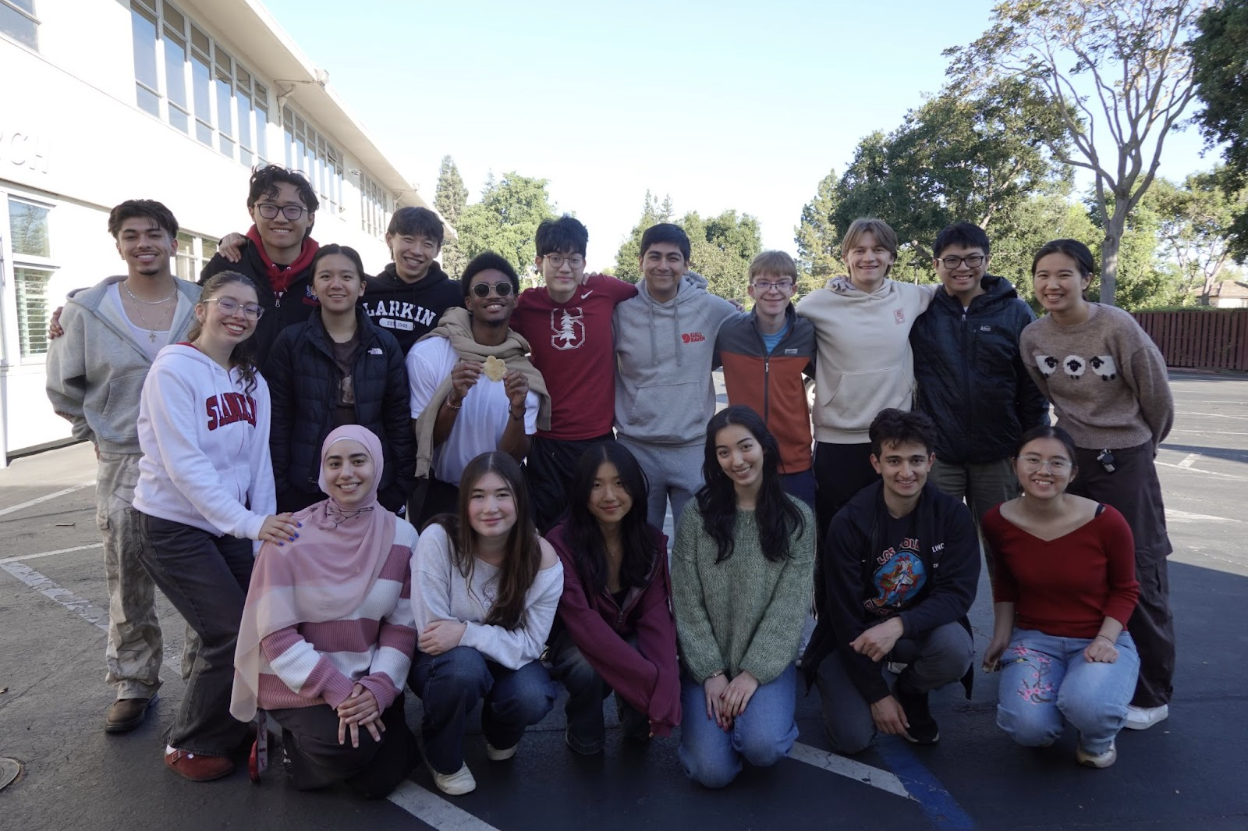
Waking up at 6 a.m. on Friday was not in the cards for Felicity Chang ’27 and Roberto Andrade ’27 when they first arrived at Stanford. But these days, early mornings are routine for the pair, who lead the Stanford Breakfast Club (SBC).
Every Friday, SBC cooks and serves warm meals to local populations facing food insecurity. The group of early-rising volunteers prepares about 100 meals, serving roughly 3,000 breakfasts annually to individuals in need. A volunteer student organization, SBC is affiliated with Stanford’s Haas Center For Public Service.
Chang and Andrade, this year’s co-presidents, said the club began as a one-man show, run by a compassionate student who cooked meals at a local church on his own dime. A group of friends and eventually the University would step in to support his efforts, forming a club called “Stanford Servant Breakfast.”
The exact year the club was founded remains a mystery, but it was at least 15 years ago, according to Matthew Onadeko ’26, the club’s former president. Stanford Servant Breakfast operated until former president Emily Wong ’22 renamed the club to “The Stanford Breakfast Club,” said Onadeko.
The club’s GroupMe boasts 1,229 members, but the weekly breakfast program is supported by around two dozen dedicated regulars and first-timers.
Last Friday, SBC’s fleet of vehicles set out from campus at 6:45 a.m. on the dot. A few lucky volunteers rode in Andrade’s sleek white Dodge, while the rest loaded into the Haas Center van and other volunteers’ cars.
Upon arriving at the Presbyterian Menlo Church, volunteers gathered to hear Chang and Andrade’s instructions. Within minutes, a mass production line took shape — flipping pancakes, slicing fruit and assembling sandwiches.
Andrade said his first time volunteering with SBC was daunting. He was thrown into the fire, literally, after an older volunteer accidentally burned him with a biscuit tin. “No one gets burnt anymore… [and] a first aid kit is available on site,” Chang quickly clarified.
In the kitchen, Zainab Al-Atya ’28’s laughter could be heard from the frying station as Esmeralda Mejia ’29 cracked eggs — and jokes. While Christopher Ward ’27 hummed along to a Kali Uchis song emanating from Andrade’s speaker, Chang and Alex Kang ’29 concentrated on carving their pineapple sculptures.
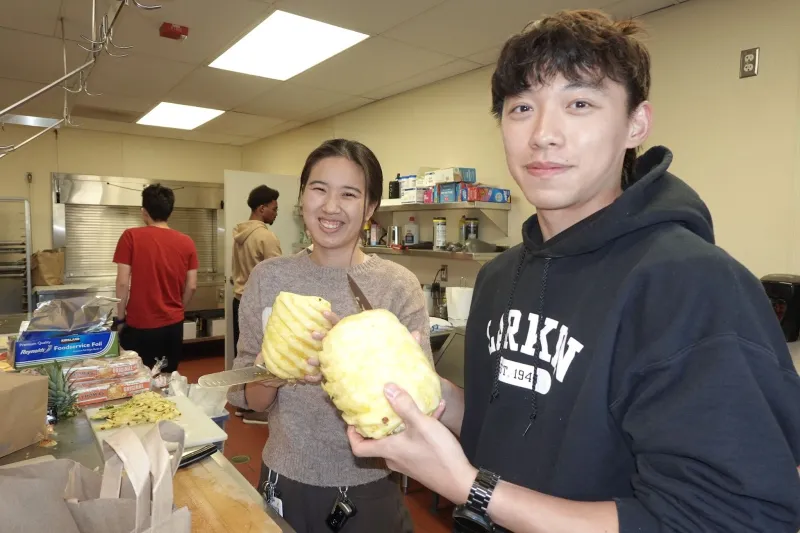
“I learned how to [cut pineapple] working in food service growing up. I never knew that I would use that for any other purpose, but I showed up… I could contribute,” said Chang. The pineapple’s sweetness was mellowed by a subtle note of onion from a well-used cutting board.
The sound of sizzling pancakes was a backdrop to clanging and banging from the isolated dishwashing area — perhaps a distress signal from those banished to dishwashing duty.
When asked how she decides who’s on dish duty, Chang said: “If you make a mess, you clean up the mess.”
After cooking and cleaning, the volunteers gather together in a circle and answer the day’s check-in question: “Would you rather have a cat-sized dinosaur or a dinosaur-sized cat?” Andrade said the closing meeting and question of the day are important club traditions.
“The question of the day just gets me going… it’s such a silly part of my life that always brings me more than anybody could expect,” said Andrade.
Wrapping up the group meeting, a dozen volunteers headed to the Palo Alto Opportunity Center, located outside Palo Alto’s Town & Country plaza, to serve the food. After setting up, the volunteers began serving the meals at around 9:00 a.m. to a consistent stream of “clients.”
Volunteers refer to the individuals they serve meals to as “clients” to “be very active and intentional about respecting them as human beings,” Andrade told The Daily.
From bacon biscuits to fresh berries, SBC’s menu rivaled that of the famed Florence Moore’s weekend breakfast. Volunteers and Opportunity Center staff agreed that the meals SBC serves are the best breakfasts clients eat each week.
Juse Reyes, a retired local, joked that Stanford’s Breakfast Club should monetize their cooking skills. “You all should sell it on Stanford’s campus!” he said, laughing.
After every client has received a first and second meal, Breakfast Club members are allowed to eat the remaining food on one condition: they must eat with the clients.
“I don’t think there should ever be an us-versus-them mentality when we’re engaging in acts of service. By sitting with the clients while eating, we get to know them beyond the brief interactions at the serving window,” Chang said.
Mejia, a regular volunteer, enjoys talking to clients, especially those who only speak Spanish. “I’m able to communicate with them in Spanish — I think that’s really beautiful, because being able to talk to someone in their native language is more comfortable.”
With a bacon, egg and cheese in hand, Kang immediately walked over to one of the center’s main dining tables, catching up with Reyes, who has been waiting for housing support.
Reyes explained that in Palo Alto, it’s hard for the average worker to get by. Having worked multiple jobs throughout his life, Reyes said he has struggled to find independent housing in the area, so he has looked to the Opportunity Center for meals and support.
“You never know — look at me, I’m retired. I got two grandkids. I went to the Air Force, I was an UPS driver, I used to work for Atari,” he said.
“I’ve known [Stanford Breakfast Club] for months, but I feel like I’ve known them for 20 years. They’re good people,” he said, smiling.
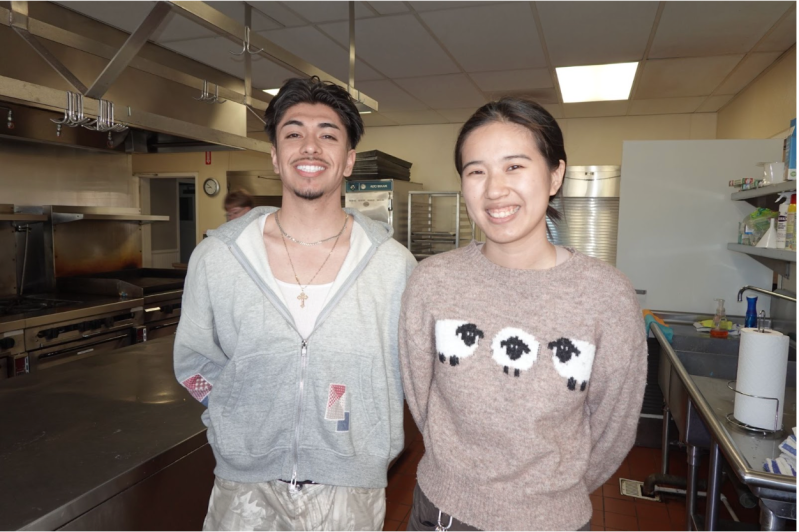
Reyes’ experience isn’t unique. Food insecurity and housing affordability issues have persisted in Palo Alto. In 2025, the number of homeless individuals in Santa Clara County reached an all-time high of 10,711.
“It grounds me — like, this is reality. People can’t afford the housing here because it is so expensive,” Mejia said.
Al-Atya agreed. “At Stanford, we talk a lot of talk, and we’re always talking about doing good for the community, but it’s really nice to actually do that in person and see the effects of it,” she said.
Various SBC volunteers reported a drop in the number of clients showing up — from around 100 last year to 40 on average this year — despite rising homelessness in the wider county.
The Opportunity Center’s program director, Stephanie Settoe, noted that though a drop in clients might mean fewer meals served on paper, the decline is evidence that a local housing project, Homekey Palo Alto, is working.
“It’s positive… a lot of the folks that used to come here have entered into an interim supportive housing space,” explained Settoe.
Andrade affirmed that it’s important that the Stanford Breakfast Club’s work continues. “It’s not about filling the chairs, it’s about providing the room,” he said.
Chang recounted an encounter with a first-time client named Christie. “She seemed very overwhelmed… it [was] her first week being unhoused,” Chang said. “I remember at the end of our conversation, she said ‘I would love to see you guys again next week because this interaction made me feel human, but if you don’t see me next week, it means I got temporary housing.’”
Chang didn’t see Christie the following week.