
At its Wednesday meeting, the Undergraduate Senate (UGS) passed the Joint Resolution to Oppose Housing Room Selection Changes For Students With Documented Office of Accessible Education (OAE) Accommodations.
The bill calls on Residential Education (ResEd) to reverse their new policy prohibiting students with OAE housing accommodations from forming housing groups, and to improve communication timelines for major housing changes in the future.
Chair of Administration and Rules Dan Kubota ’27 said that the timing of the new housing policy announcement was one of the UGS’ major issues with the policy. It was announced via email three days before the deadline for the Housing Accommodation Request Form (HARF), which is submitted to the OAE office, and ten days before the deadline for students with OAE accommodations to submit a housing application to ResEd for an accessible housing assignment.
Kubota added that she believes this policy is ineffective at solving the issue it aims to address — people taking advantage of OAE housing accommodations for preferred assignments. Instead, she said, it mostly incentivizes students with OAE accommodations to get singles, and prevents students with documented disabilities from having the same access to services as students without disabilities.
“Hopefully [this bill] sparks conversation with the faculty senate and other people with Residential & Dining Enterprises (R&DE) to get talking about other solutions in conversation with students, both those who have accommodations and those who do not,” said Kubota.
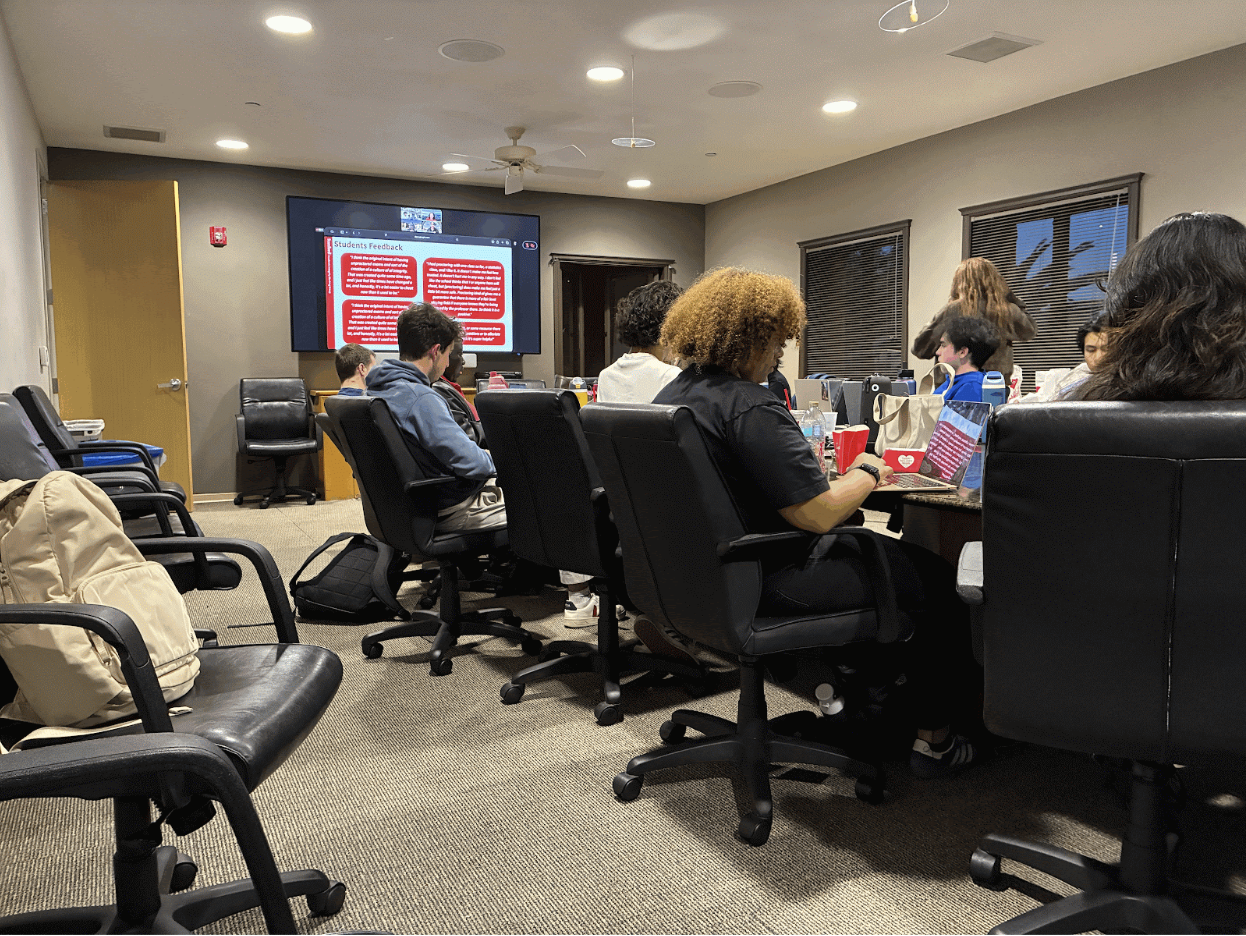
The UGS also heard a presentation from the Academic Integrity Working Group (AIWG) on their work for the past two and a half academic years, including their main findings and their requests from the UGS. Xavier Arturo Millan ’26, student co-chair of the AIWG and one of the presenters, explained that one of the group’s main goals was to carry out a multi-year study to determine fair and effective exam proctoring practices.
Jennifer Schwartz Poehlmann Ph.D. ’08, faculty co-chair of the AIWG, said one of the main takeaways of the study was that both students and faculty believe proctoring is helpful in creating a more fair assessment environment. Poehlmann added that many students even wanted to extend proctoring to classes that weren’t within the pilot program, showing how “really open to [proctoring]” students are.
Citing faculty feedback, Poehlmann said that some who participated in the pilot found proctoring “an absolute necessity to achieving learning goals in their classes.” Millan also added that the AIWG has been working on developing proctoring guidelines with feedback from instructors, teaching assistants and students, which will be incorporated into the potential expansion of the proctoring process. These guidelines include adding proctoring to alternative exams administrations and a proctor training course.
Poehlmann said that she believes now is an appropriate time for the pilot proctoring program to be expanded, adding that the AIWG will continue for another year to aid with the transition. The presenters requested the UGS’ support for measures to formalize the University’s proctoring policy, which will allow proctoring in any in-person assessment, and to provide the Board on Conduct Affairs (BCA) the power to establish and oversee proctoring policy.
“I think we are all very aware that technology, AI, access to screens during exams is quite tempting without a proctor present — because this policy is not mandating proctoring, but creating best practices for proctoring… to me this is a common sense move,” said UGS Chair David Sengthay ’26.
The UGS also passed the Joint Bill to Recommend a Nominee to Fill a Vacancy on the Board of Conduct Affairs, Spring 2026 and the Joint Bill to Reform the Nominations Commission and Adopt the Nominations Commission Guidelines.
These bills, which were already passed by the Graduate Student Council (GSC), confirm undergraduate senator Yohanna Hoskins ’27 to the Board on Conduct Affairs (BCA) and reform the bylaws of the Nominations Commission respectively.
The senate introduced the Joint Bill to Establish the ASSU Red Shepards. This bill seeks to create an agency within the Associated Students of Stanford University (ASSU) to provide trained student advocates for students going through the Office of Community Standards (OCS) process.
“The difference between winning and losing a case can be as easy as just having a competent advocate,” said GSC Chair and sixth-year Ph.D. student Rory O’Dwyer, who was one of the bill’s co-authors.