
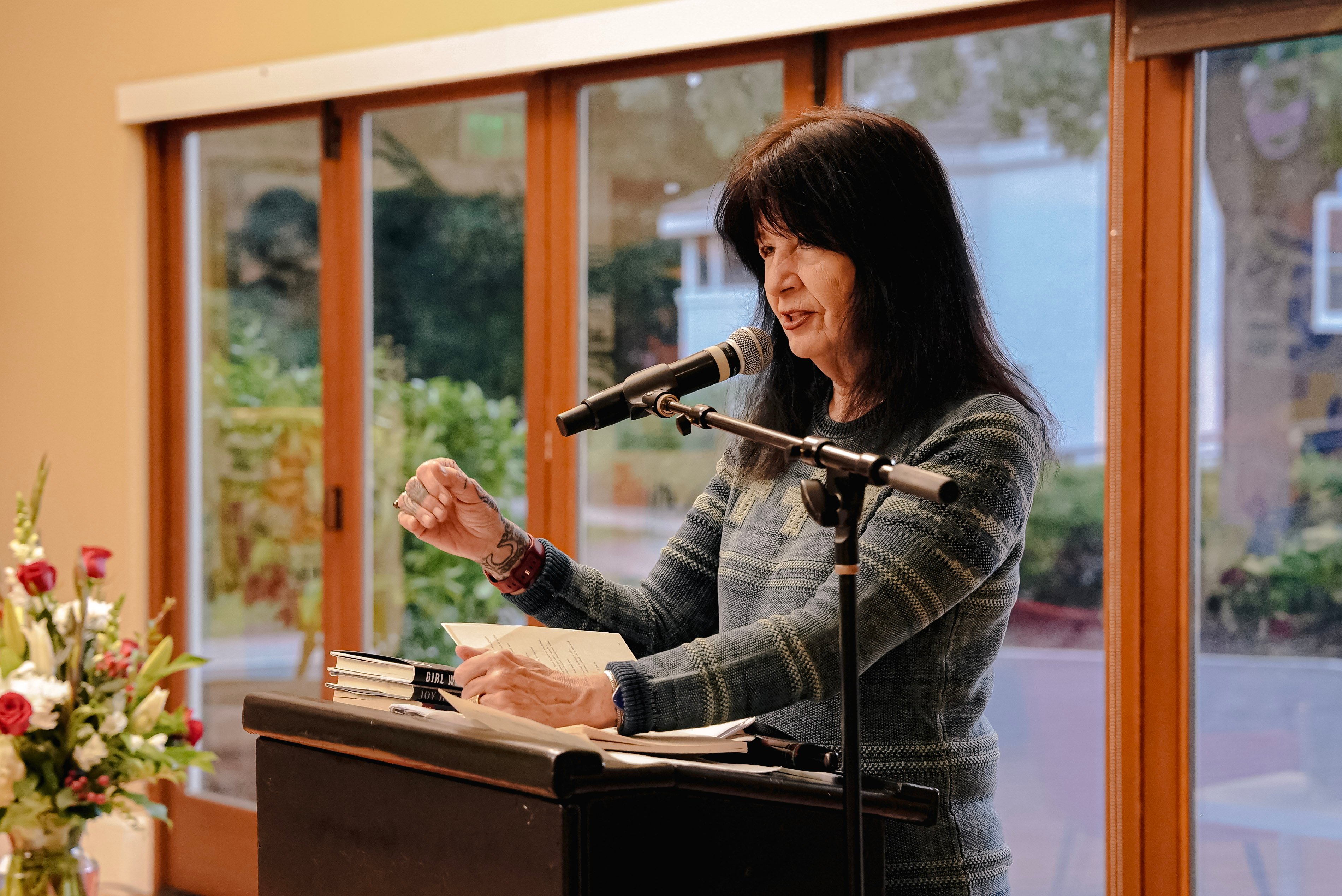
Joy Harjo, the 23rd Poet Laureate of the U.S. and a member of the Muscogee Nation, reflected on her coming of age at a Women’s Community Center (WCC) event on Thursday. Through poetry and prose, she showed how storytelling can offer guidance, make political statements and remind us of our shared humanity.
“I’ve often wondered what use human beings are to earth,” she said at the event. “And the only conclusion I’ve come to… is that we’re here to keep stories.”
The event, titled “A Conversation with Joy Harjo,” brought the three-term Poet Laureate to Stanford to speak about her new book, “Girl Warrior: On Coming of Age.” Harjo read selected works, answered questions from event moderators and closed with a book signing.
Harjo said she wrote “Girl Warrior: On Coming of Age” for young people — especially native youth — in their journey of “becoming.” Recognizing their struggle as the same one her generation went through, she intended for the memoir to be helpful.
For event moderator Zola Ortiz ’27, a member of the Comanche Nation and also of the Kiowa, Caddo, Acoma and Diné nations, Harjo’s book “not only speaks to native girls and women, but to the lived experiences and realities of us all.” Ortiz currently serves as feminist discussions coordinator at the WCC.
Harjo opened the event by reading the poem “For Calling the Spirit Back from Wandering the Earth in Its Human Feet,” which also opens “Girl Warrior: On Coming of Age.”
In her prelude, Harjo described the present as “complicated,” mentioning that it is now illegal to talk about native history in schools in Oklahoma. “We’ve seen all of this before,” Harjo said, assuring her audience that “this will all go away.” She also acknowledged that, sometimes, we have to step back and take care of ourselves.
“Call your spirit back,” she read from her poem. “It may be caught in corners and creases of shame, judgment, and human abuse. / You must call in a way that your spirit will want to return. / Speak to it as you would to a beloved child.”
For Harjo, poetry is like a “ritual.”
“It’s the title that might call you to its door, and then you go in,” she said. “What does the first line do? It brings you in a certain way, and then it builds and builds, and by the time you can walk out of the poem, you’re changed. It changes you.”
WCC Assistant Director Dejah Carter expressed that she felt changed after hearing Harjo’s poetry, and came away from the event with a renewed appreciation for using one’s voice — something she struggles with as a self-described quieter person.
“[Harjo] talked about how when you’re trying to decide whether or not to stay silent or to use your voice, you’re going to have that anxiety either way,” Carter said. “So it’s best to just speak up and make your voice heard.”
Throughout the event, Harjo merged poetry with political activism. She said she has been repeatedly struck by the question of why so many unqualified people are in power as she watches recent elections and midterm predictions.
In her poem, “For Those Who Would Govern,” Harjo presented a list of critical questions for leaders, including “Can you first govern yourself?,” “Do you… look for fresh vision to lift all the inhabitants of the land?” and “Are you owned by lawyers, bankers, insurance agents, lobbyists, or other politicians?”
Harjo also read from her new manuscript, “Cloud Runner.” She said this collection came from a place of grief: in the last couple of years, she lost two brothers and a daughter.
“I wasn’t trying to write a poem,” she said about a piece she wrote four days after her daughter died. “I was just trying to survive.”
“We are in the embrace of unspeakable love,” she read from her poem “Lullaby,” which is centered around her daughter. “This world is full of everything good, everything beautiful. That’s all I want for you… We stay there for a while until we are full, then leave to return to the story, knowing we will make a mess of it, knowing we will lose everything, then find it again.”
Overall, Carter described the event with Harjo as “powerful.” “I laughed, cried and had all the emotions in between,” Carter said.
Ortiz echoed this sentiment, adding that Harjo’s message about the power of storytelling especially resonated with her.
“I think one of the most important aspects of this event was that we all have stories to share,” Ortiz said. “It’s important to… extend empathy and patience and love to one another, and listen to those stories.”
Harjo expressed gratitude to the WCC for hosting the event and to the audience members for attending, saying these kinds of gatherings are very important and cannot be replaced by technology.
“We’re human beings, and this is part of nourishment,” she said. “We need to feed our souls.”
For Harjo, poetry comes most alive when it is heard aloud rather than read. The poet recalled her first time hearing Audre Lorde read, experiencing the art as it is traditionally meant to be experienced.
“You feel it breathe and experience how it travels out dynamically to become part of the wind skirting the earth, even as we inhale and take the words into our bloodstream,” Harjo said.