
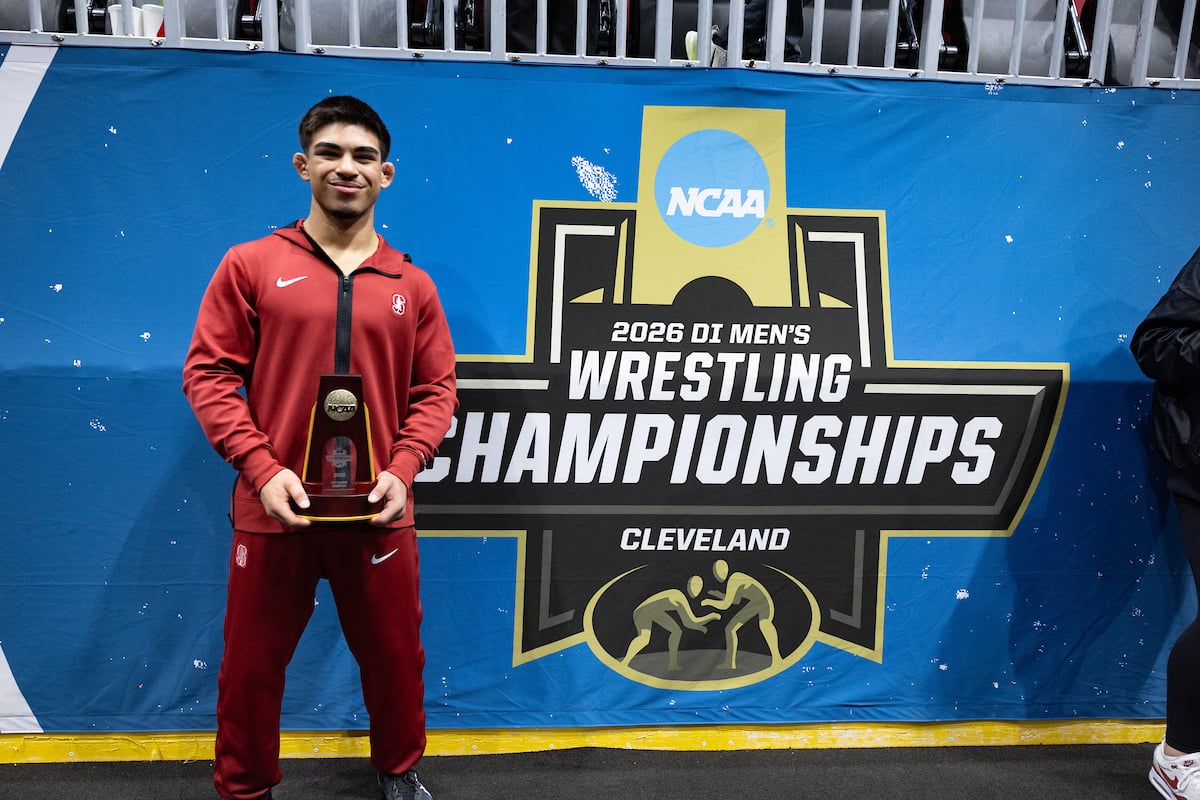
Rocket Arena in Cleveland belonged to Penn State. The Nittany Lions had already clinched the team title, with six wrestlers in championship matches. They moved on to their next goal: a new scoring record. At 149 pounds, their guy was Shayne Van Ness, the No. 1 seed who had gone undefeated all season. Across the mat stood the 10-seed from Stanford with seven losses and nothing to lose. The coronation was supposed to be a formality.
Then Aden Valencia shot.
In sudden victory overtime, with the score knotted at 5-5 after seven minutes of the most technically violent wrestling of the tournament, Stanford’s redshirt freshman drove through Van Ness’s hips, wrapped his arms and finished a takedown that turned Rocket Arena inside out: 8-5. The 10-seed from Morgan Hill, Calif. was a national champion.
The first word that came to Valencia’s mind wasn’t “joy” or “pride,” he said, but “relief.” That word only makes sense if you know how long he had been waiting.
Valencia started wrestling at three and a half years old in Morgan Hill, a quiet city in the southern Santa Clara Valley, close enough to Stanford that the university was never a far-off dream. He trained in judo on Stanford’s mats as a kid, long before he understood what an NCAA tournament was. By his sophomore year of high school, Valencia was working out at the Regional Training Center alongside college wrestlers, learning the rhythms of a program he would eventually join.
His older sister Nyla shaped him as much as any coach. She wrestles at Iowa now, but for most of their lives she was there, every day, on the mat in their family’s home, drilling and scrapping with her younger brother the way only siblings can. They built each other into wrestlers that neither could have become alone. When one competed, the other cared like it was their own match.
By his mid-teens, Aden’s résumé read like it belonged to someone twice his age. A freestyle world champion and Greco-Roman world champion at the cadet level. Three Pan-American gold medals in judo. A Fargo finalist. A Super 32 finalist. In 2021, he and Nyla were invited to the U.S. Olympic Wrestling Trials in Fort Worth, Texas, not as spectators, but as warm-up partners for athletes trying to make the Tokyo Games. They were two teenagers on the mat alongside the best in the country.
But the defining pattern of Valencia’s career, which gave Cleveland its meaning, has been how close he always was without quite breaking through. Third at the California State Championship as a sophomore. A Fargo and Super 32 finalist, but not a champion. Sixth at the Senior U.S. Open. Sixth at World Trials. Valencia could beat anyone on any given night — he just hadn’t won the bouts that mattered most.
He chose Stanford’s underdog program over powerhouses like Penn State, because he believed in what head coach Chris Ayres was building. It was not the safe pick. Stanford wrestling had produced two individual national champions in its history. Valencia bet he could be the third.
His first year on The Farm suggested the bet might not pay off. He redshirted, went 3-3 in open tournaments and watched the gap between potential and results — the same that trailed him through every almost-title of his career — follow him to college.
This season was better but still uneven. Aden moved up to 149 pounds, finished the regular season 22-7 and earned a 10-seed at nationals. In a bracket headlined by the unbeaten Van Ness and No. 2 Jaxson Joy of Cornell, he barely registered in the previews.
Before the tournament started, Valencia wrote a story about himself competing in the NCAA finals at this weight, in this exact scenario, for a class at Stanford. He already saw the ending. He just had to live it.
Even before the finals, the quarterfinals explain what ultimately happened in Cleveland.
Valencia, who until this point had beaten his opponents soundly, was wrestling Joy, who was taking him apart. Going into the third period, Valencia was down 8-1. Against the second-best wrestler in the country with that kind of deficit, the math is nearly impossible. Valencia knew it.
“To be honest, the guy was really good, and he was kind of picking me apart,” Valencia said after the tournament. “I wasn’t sure how I was gonna make up that lead.”
But he could feel Joy starting to tire — the arms loosening, the grip fading. And when Valencia couldn’t summon it for himself, and the lights were too bright, he reached for the person who had been on the mat with him since before either of them could remember.
“I remember having this vivid recollection: if I can’t do this for myself, I gotta do it for my sister.”
What followed was the most extraordinary sequence of the entire tournament. Valencia started hunting: One takedown, then another, then a third. He stopped watching the scoreboard. He entered what he described as a flow state, not counting but simply moving forward. He needed three takedowns to come back from the dead. He found every single one.
The final score was 12-9, Valencia. It might have been the best match of his life, and it was only a quarterfinal. The semifinal over Michigan’s Lachlan McNeil went 9-5. Valencia wrestled with the controlled, relentless aggression that once made people call him a generational talent when he was 12 years old. The kid who had always been close was not falling short anymore.
Then came Van Ness.
Valencia had lost to him months earlier, 10-4, in a match that felt worse than the score. But walking into Rocket Arena for the finals, he felt a new certainty.
“I had a different level of clarity that I’ve never had going into any other match,” Valencia said. “It was almost like I knew I was gonna win. I wasn’t really sure how.”
He thought about the story he’d written and about Nyla. “I had a lot of reasons to win. Belief in my training, belief in the people behind me, the process it took to get here. I just knew I could do it.”
Valencia struck first. Takedown. 3-1 after the first period. Van Ness clawed back in the second, tying it at 4-4 before Valencia escaped to retake the lead, 5-4. Van Ness escaped to open the third and knotted it at five. For the final minutes of regulation, neither wrestler could score. The crowd was on its feet — sudden victory, first to score wins.
Valencia shot, then locked on and finished the takedown. 8-5.
Aden Valencia was a national champion.
He now stands as the third national champion in Stanford wrestling history, joining Matt Gentry ‘04 in 2004 and Shane Griffith ‘23 in 2021. He is also the first Cardinal freshman to ever win a wrestling title, and the first double-digit seed to take a championship since 2016.
Stanford sent four wrestlers to the All-America podium in Cleveland, the most in the program’s history, and finished sixth as a team with a record 67.5 points. Chris Ayres accepted the national Coach of the Year award.
Six years ago, Stanford attempted to cut wrestling. In Cleveland, the program announced itself as a national power.
Valencia is not slowing down. He has three years of eligibility remaining and is already eyeing a repeat. The 2028 Olympics are in Los Angeles, on home soil. He intends to be there.
Above the wrestling mat in his house in Morgan Hill a sign reads: “Rule Number One: Attack.” Valencia followed that rule all the way to a national title. And when the stakes were highest, down seven points in the quarterfinals with nothing left to give, he did it for Nyla.