
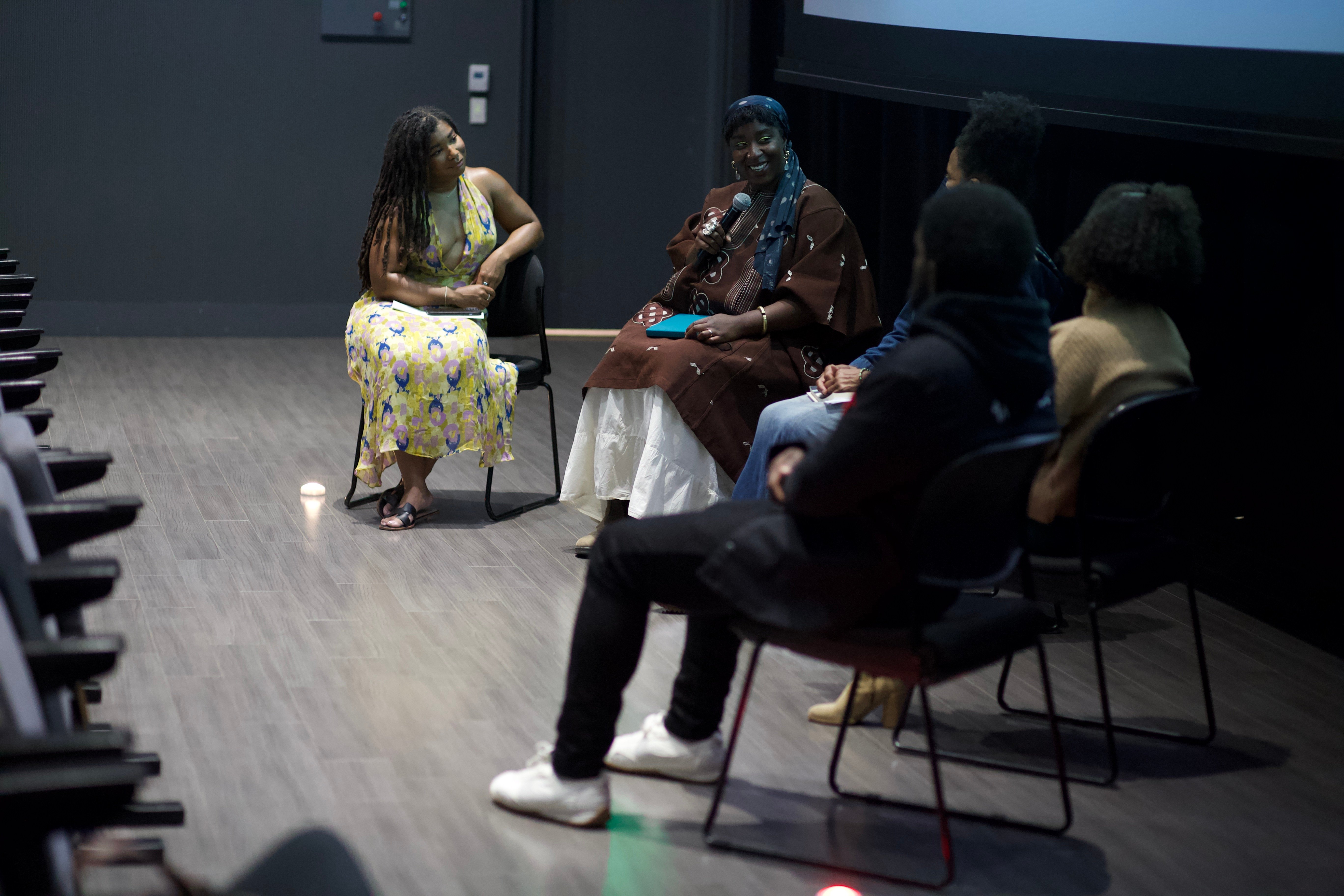
Oshman Hall filled with the sound of audience members rubbing their palms together on Friday, April 10, as amara tabor-smith — choreographer and artist-in-residence at Stanford — led a participatory movement opening exercise for “But Some of Us Are Brave,” Stanford’s inaugural Black Women’s Film Festival.
“It was just a really great grounding exercise for everyone in the room. I definitely felt that energy,” said Dineo Maine, a third year Ph.D. candidate in the art and art history.
The two-day festival included a panel on Black poetics, a conversation with filmmaker Cheryl Fabio M.A. ’76, a poetry reading by Denning Visiting Artist Hanif Abdurraqib and screenings of rarely-seen films including Maya Angelou’s “The Tapestry” (1976), “Circles” (1976) written by Alexis De Veaux, Pratibha Parma’s “A Place of Rage” (1991), Aarin Burch’s “Spin Cycle” (1991) and Fabio’s “Rainbow Black: Poet Sarah Webster Fabio” (1976).
Event organizer Kyéra Sterling, a Ph.D. candidate in art and art history and the Black Studies Collective co-director, used her opening remarks to read an excerpt written by Michelle Russell from, “All the Women are White, All the Blacks Are Men, But Some of Us Are Brave,” an anthology that inspired the name of the festival. Sterling specializes in film and media studies and wanted to organize an event honoring National Poetry Month, which takes place in April. However, in February Sterling attended a conference at Vassar College on women’s work of preserving independent film. That planted a seed in Sterling’s mind, which she tended into a full-fledged festival that centered on the works of Bay Area filmmakers and poets.
During the panel titled “Opening Riffs: Sounding Black Poetics,” Sterling and Bryn Evans, a third-year Ph.D. candidate in art and art history and Black Studies Collective co-director, invited artists Yétúndé Ọlágbajú, Abdurraqib and tabor-smith to discuss Black poetics, collaboration and the expansive nature of their artistic practices, which include poetry, choreography, sculpture and performance. Ọlágbajú explained their collaborative work is motivated by the desire to give Black women and femmes “a space to be enraged” — an offering that is often not afforded in the world in the face of constant injustice.
Responding to the invitation for panelists to share where poetics flowed through their bodies, tabor-smith said: “It is poetry to survive. The ways that [Black and Brown people] find breath and perseverance, joy, laughter — I feel that the poetry is in our motion.” When reflecting on the legacy of Black women’s intellectual production, Abdurraqib said: “One of the great fortunes of my life was and is to be a child of a mother who wrote.”
The first night concluded with screenings of “The Tapestry” and “Circles” — two teleplays from the Peabody Award-winning “Visions” series that invested in emerging artists. In a video introduction, De Veaux reminded the audience that Black people’s access to reading and writing were criminalized in the U.S., and Black women have been able to produce “remarkable cultural works” despite oppressive conditions.
Sterling faced several challenges during the curatorial process. “In order to get access to these films — to get institutions to give me time with them — I had to develop the apparatus [the festival] and sell it without having seen these works,” Sterling said.
Even Sterling herself was not able to view every film beforehand. Hayley O’Malley, a film historian and art history professor at Rice University, was instrumental in securing access to some titles. Yet she was confident in the program: “I think there’s a bit of trust that I have as a Black woman, that the creative work that we do is always going to be incredibly valuable.”
The program continued on Saturday, April 11 with a screening of “A Place of Rage,” a documentary featuring June Jordan, Angela Davis and Alice Walker discussing the intersection of civil rights struggles. In one scene, Jordan describes advocacy for Palestinian people and LGBT individuals as the moral litmus tests of the era.
The festival marked filmmaker Shucheng Yan’s first time attending a film event at Stanford. “‘A Place of Rage’ was made a while ago and a lot of things still struck a chord,” she said.
Palo Alto resident Andrea Davis came to the event with her mother. “I enjoyed seeing these powerful women,” Davis said. “It’s really interesting to see them talking about the strength of Black women … This is very motivating to me as well, to keep going no matter what.”
Sterling took special efforts to reach out to area stakeholders when planning the festival.
“Something that has been really inspiring with this iteration [of the festival] is the amount of community members that have shown up from across the Bay Area,” Evans said.
Describing the experience of watching “Spin Cycle,” filmmaker Imani Dennison M.F.A. ’27 said “It was such an incredible love letter to the past and such a poetic archive that I feel really thankful to have witnessed. It felt really nice to see another Black queer filmmaker document such an intimate part of their life.”
After a screening of “Rainbow Black: Poet Sarah Webster Fabio,” Fabio joined Sterling for a conversation about filming her mother for what culminated in her master’s thesis for her graduate work at Stanford. Although she faced financial constraints and logistical issues, Fabio took advantage of access to 16 millimeter cameras to become one of the first Black students at Stanford to make a thesis film. “When it comes to making a film, there’s another human being inside of me that shows up and gets it done. I think making this film helped develop that person in me,” said Fabio.
Despite the “incredible amount of elbow grease” it took to spearhead this event, Sterling said “The intimacies that emerged remain very profound. Ms. Fabio’s family surprised her [by coming to the event], and I went to undergrad with one of them. I think it’s a testament to the ways that we are really in lineage with one another,” she said.
Correction: This article has been updated to reflect that O’Malley is a professor of art history, not an art historian. The Daily regrets this error.