
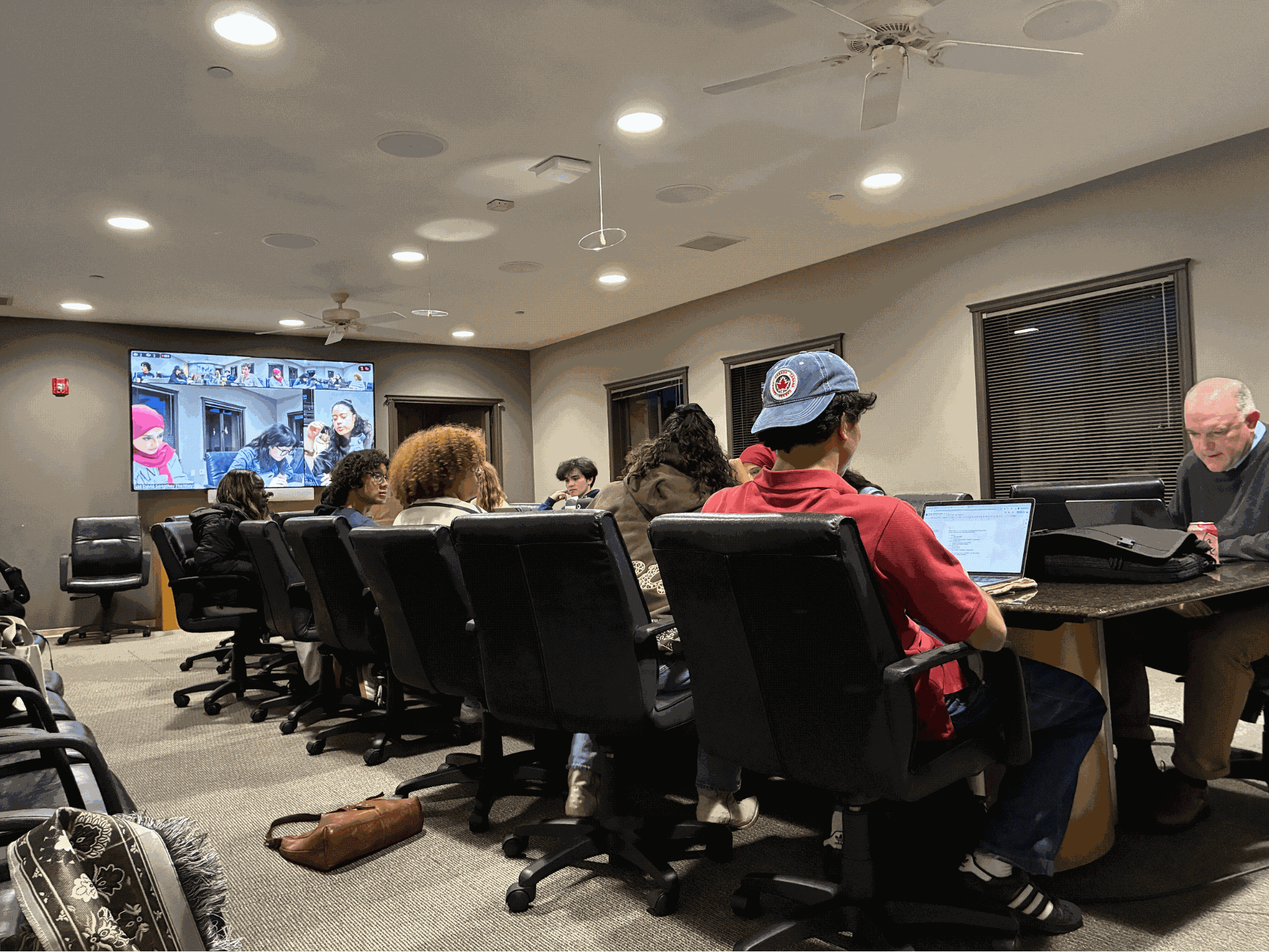
At its Wednesday meeting, the Undergraduate Senate (UGS) passed the Joint Bill on Proctoring Following the Conclusion of the AIWG Proctoring Pilot.
Under the Academic Integrity Working Group (AIWG) proctoring pilot, exam proctoring was only allowed in participating classes. The bill permits proctoring at any exam at Stanford, provides guidelines for proctoring and shifts oversight of the proctoring process to the Board on Conduct Affairs (BCA).
The UGS heard a presentation from the co-chairs of the Academic Integrity Working Group (AIWG), Xavier Arturo Millan ’26 and Jennifer Schwartz Poehlmann Ph.D. ’08, at its last meeting. During the presentation, they noted the benefits that both teachers and students have experienced from the addition of proctoring to exams, including improved exam experiences and ability to achieve learning goals.
The UGS also passed a resolution calling for improvements in on-campus gym hours and equipment. The bill asks the University to extend open hours in the evening on weekdays and add new machines to mitigate overcrowding. Co-Chair of Health and Safety Troy Harris ’27 stated that these requests were based on student feedback from the Health and Safety Committee’s survey on undergraduate health and wellness on campus.
Harris added that the Health and Safety Committee will be meeting with the executive director of Recreation and Wellness to discuss these proposed changes. “Most people indicated that extending times to midnight on weekdays would be the most beneficial, so that’s what we’re going to advocate for,” Harris said.
The UGS also passed the Joint Bill to Establish the ASSU Due Process Guard. This bill establishes an agency under the Associated Students of Stanford University (ASSU) to provide trained student advocates to people going through the Office of Community Standards (OCS) process. The proposed program will be funded similarly to other ASSU service agencies, like the ASSU Legal Counseling Office.
Xiaoyao Lu ’29 and Xinrui Li ’29 presented to the UGS about the University’s decision to make Beyond Sex Ed optional at future New Student Orientation (NSO) weeks. Beyond Sex Ed is a narrative-based sexual education program in which ten students share their lived experience. Li noted that Beyond Sex Ed is a unique and powerful program, providing students with an important educational experience, resources and a sense of community and openness around sex. She said this is especially important for incoming freshmen who are often far away from their support networks.
“[It]…creates human relationships directly within the community as we talk about sex and relationships, and that addresses the most difficult part of conversations with regards to sex and relationships; we don’t have support networks to talk about these things when we need it, because of how taboo it has been throughout our lives,” said Lu.
Li added that there aren’t plans for replacement modules for Beyond Sex Ed, besides the required Title XI and Title IX online modules assigned to student accounts prior to NSO.
Lu and Li said the decision was made without adequate student input, criticizing the “semi-secret” nature of the change.
“When it comes to the question about what resources students get to empower their decisions about their bodies and their safety, we think that should be a question for students to answer,” Lu said.
UGS members expressed their support for the program, and for drafting a measure that would allow students to express their thoughts on the continuation of Beyond Sex Ed as a required part of NSO. UGS Chair David Sengthay ’26 added that he is interested in drafting a resolution and working with the Faculty Senate to bring attention to this issue. “To me, this is an absolute tragedy for our campus to lose because it is…a very monumental point of our NSO to attend that program,” Sengthay said.