
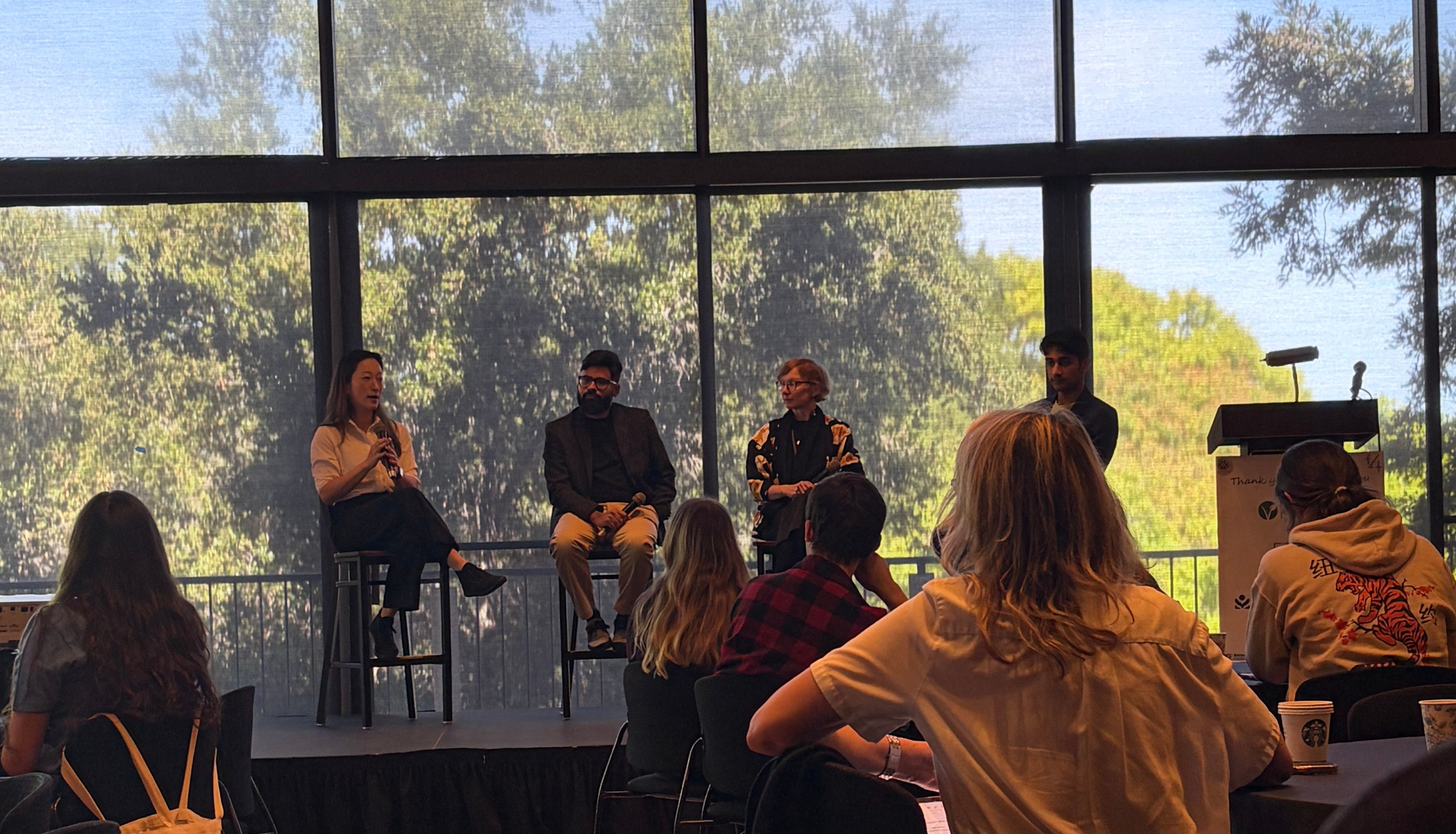
The third annual Food4Thought festival brought students and professionals to Tresidder Oak Lounge on Friday and Saturday to explore solutions to growing climate pressures that threaten the ways food is produced and consumed.
The event, which was previously held at Harvard University, brought together 275 participants from 136 cities and 14 countries to address the mounting pressure on food systems. Through events from campus dining advocacy to a resource and career fair, the conference aimed to invite collaboration across disciplines to find new, sustainable solutions to the problem.
For this year’s festival, co-directors Nancy Zhang ’28 and Sofia Vera Verduzco ’25 M.S. ’25 hoped to highlight developments in food systems on the West Coast, particularly their intersection with technology.
“There’s a lot going on here in terms of future food, [and] in terms of startups in connection to tech, and that’s something that we really wanted to highlight,” Zhang said.
The event’s program reflected that focus, with a panel on AI applications in food systems, where panelists ranging from bioengineering professors at Stanford to food tech company executives spoke on topics from food texturization to influencing consumer behavior.
“[AI] is definitely a lot bigger this year, and it’s something that’s not my personal background, but it’s really important to understand it,” said Trinity Olander, a student at Boston University and co-director of the 2025 Food4Thought festival who attended this year’s event as well.
Another discussion the event hosted was a “Rethinking Finance for Food Systems” panel, where experts examined what it took to build scalable and sustainable ventures in the space.
“It doesn’t just take one person,” said Heather Courtney, founding general partner at Alwyn Capital, during the finance panel on building a startup. “Be thinking about how what you can do plugs in with something that somebody else can do and build a company around that.”
While creating the event, the organizing team focused on interactive programming. Workshops and three case challenges — including finance, consulting and tech — encouraged participants to translate what they learned into real ideas.
“Most of the [events] are workshops where you get to meet other people. We have people coming over from all over the country, so that’s really exciting,” Verduzco said.
Some of the case challenges will continue into the summer, allowing teams to go beyond the scope of the festival prizes. Between the case challenges and a research competition, the festival’s prizes will total $5,000.
Organizing the festival took months of work, with a team of organizers backing Verduzco and Zhang as they planned dozens of events leading up to the weekend.
“There’s a lot of intricacies or details about conference planning that you don’t think of, until you’re actually facing a problem that you didn’t know existed,” Zhang said. The festival provided travel grants to over 50 students, posing a large logistical hurdle for organizers.
But for Zhang and Verduzco, organizing the festival was worth the effort — and participants shared the same perspective.
“It’s incredible to have so many passionate students coming from all different universities being here,” said Yaqi Grover MBA ’24 M.S. ’26, who also sat on the finance panel. “The young people here, I think a lot of them will be able to go on to have [a] very good, positive impact [on food systems].”
Olander also highlighted the “interdisciplinary lens to alternative proteins” that the festival took, with students attending from across majors. “It’s something that can be very siloed, and I think especially at this point we are [at] historically, it’s really important to bring people together.”
As a result of the conference, Verduzco hopes to “spark ideas for change” in its attendees.
“You can make change in many different ways. Even if you are working within consulting, you can make change within consulting, you can make change within the company you are working in,” said Verduzco. “The biggest thing that we can do personally… is just contribute.”