
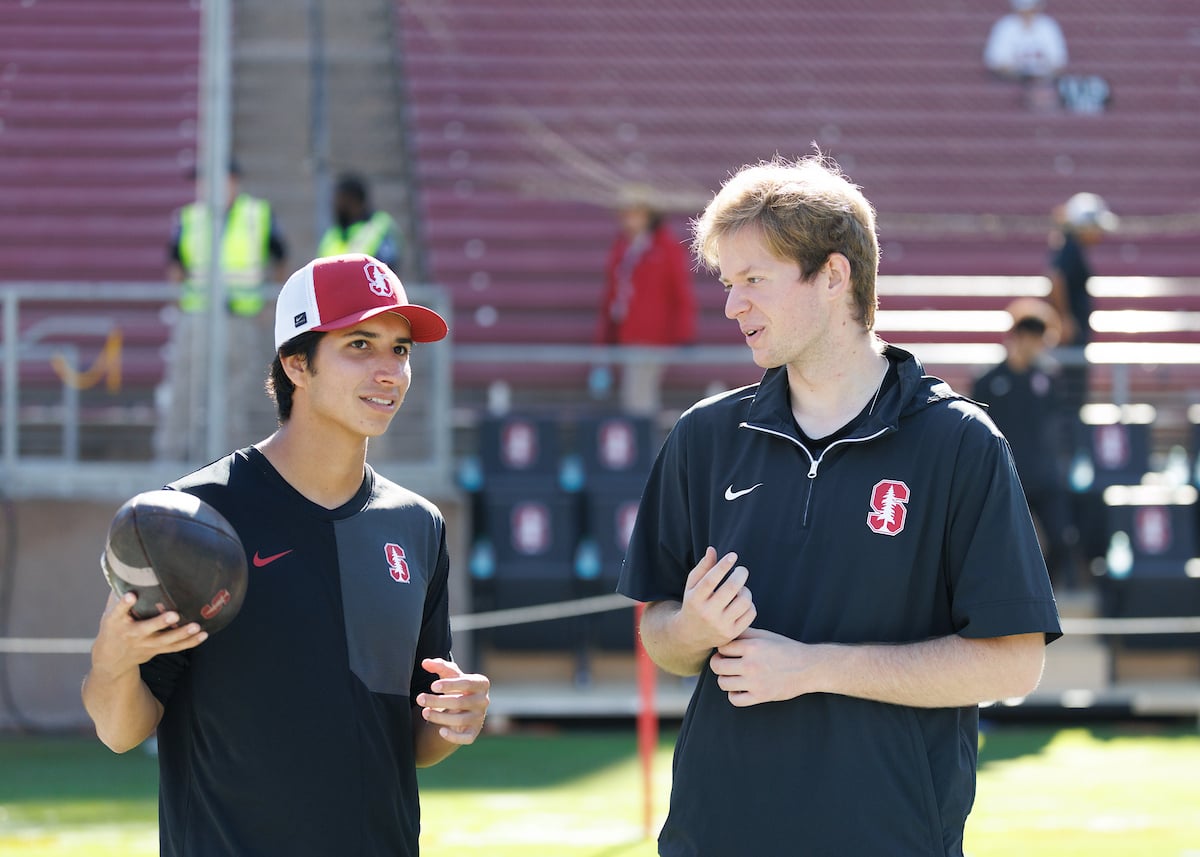
At 7 a.m., an hour before practice officially begins, Stanford’s team managers are already at work: dragging out equipment, organizing drills and mapping out a practice schedule. By the time players arrive, everything is in place.
What most fans never see is that behind every practice, every game and even every film replay review, there’s a group of students quietly making it all run. Stanford football, for example, has 11 student managers who help run the spring season.
“I’ll arrive at the facility around seven, and we’ll have a meeting in the equipment room where we’ll receive a schedule layout for what practice is going to look like,” said football student manager Ethan Rehnborg ‘29. “Everything’s timed down to the minute. And usually in this time, players will come into the equipment room and fist bump us, ask for some gloves or other equipment. So it’s a fun energy. It’s a light vibe.”
For many managers, the role offers a new way to engage with sports they have spent years playing.
“In high school, volleyball was a way for me to get into a good college,” said beach volleyball practice player Oliver Shiekh ‘29. “I realized that instead of playing volleyball in a superficial matter to get recruited or something, I could just play strictly for fun. It’s so much better.”
Men’s basketball manager Jameson Callaghan ’29 described a similar shift in perspective.
“I really have loved basketball for a long time, and even though I think playing it is super fun, I think being involved with a team in any way can be really great,” he said. “I coached a little bit last year for some youth teams, and so seeing it from different angles I think is super fun. And being a small part of the Stanford team is cool because it’s high-level basketball, and everyone really cares about it a lot.”
Beyond the logistics, the role also creates connections that can feel rare on a campus where athletics and student life can sometimes feel separate.
“On campus, the athletics teams feel kind of separate from everyone else,” Rehnborg said, “so just the ability to kind of break that divide and get to know them is pretty important.”
“Occasionally, I’ll get a meal with a player,” Callaghan said. “In the space between games or practices, when we’re in the locker room, everyone’s talking and asking how each other is. Everyone’s just super nice to each other.”
That closeness leaves an impression.
“I’ve never been on a team with more committed, nice, fun, just sweet, hard-working people ever, and I’ve been on sports teams my whole life,” said Shiekh about beach volleyball. “They’re ranked number one for a reason.”
While managers operate behind the scenes, their work is essential to keeping practices and games running smoothly, from setting up drills to assisting with film and in-game decisions.
Still, what keeps them coming back isn’t just the responsibility. It’s the energy.
“The 6 a.m. wake-up is rough,” Rehnborg said, “but the loud music, coaches fist-bumping you, Andrew Luck’s running out and giving you a high five. It really just energizes me for the rest of the day.”
That passion extends beyond the job itself.
“I’m forever grateful, and I’m gonna play the sport until I die. I hope that I can play when I’m 70, and I want to play with my kids,” Shiekh said.
The student manager position is truly a unique and rewarding experience for all students involved.
“The season was not super easy in terms of some tough losses, and obviously really wanting to make the tournament and being short of that,” Callaghan said, regarding the men’s basketball team, “but all in all, it was a really great experience, and I’m pretty glad that I signed up to be manager.”
And, of course, being a student manager comes with some really great perks.
“Last practice, I noticed that my face was getting burnt… I said to my boss, ‘Coach, I might need a hat,’” Rehnborg said. “Without hesitation, once we got into the equipment room, he opened up this hat cupboard, and there were 15 different kinds of hats, and he let me choose any ones I wanted. So I just feel like I’m being looked after. And I now have two new hats, which is cool.”
At the same time, managers gain a deeper appreciation for the athletes they work alongside.
“A really big part of [the players’] day is dedicated to the team and getting better… For them, it’s almost like a second job on top of all the school work and everything,” Callaghan said. “It’s not easy, but it’s made me really appreciate how hard people are working and just the way that they really love what they’re doing… I really admire that on the side of the players and the coaches.”
Even in a role that often goes unnoticed, that love — for the sport, the team and the experience — is what defines being a student manager.