
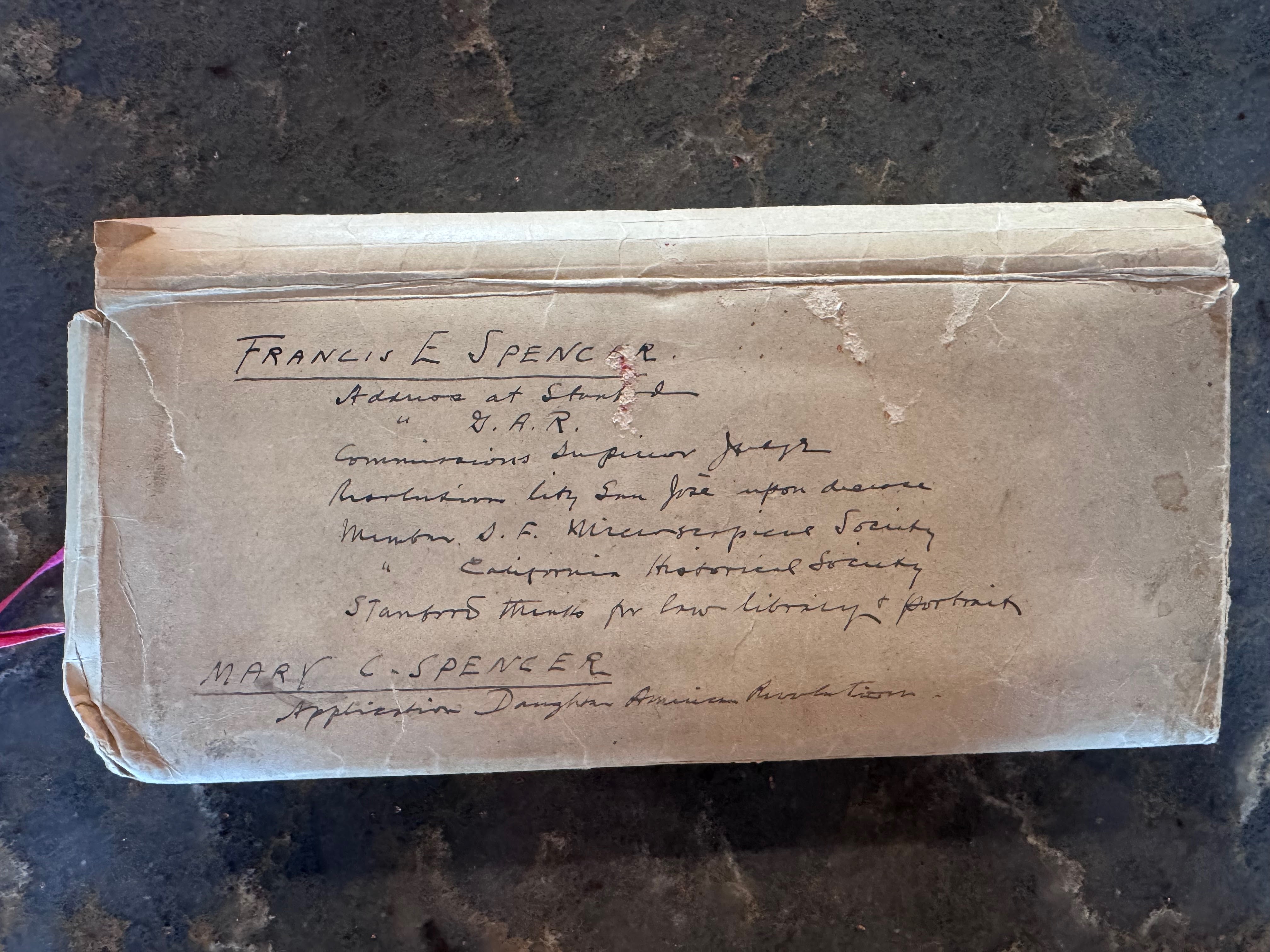
In late January, Catherine Devlin sat on the floor of her parents’ sunroom digging through green plastic bins of family documents and heirlooms. Afternoon light poured through three walls of rectangular windows and pooled around her on the red tiles. Devlin’s father sat to her left in a disgruntled armchair, the pair sorting through the medley of their inheritance.
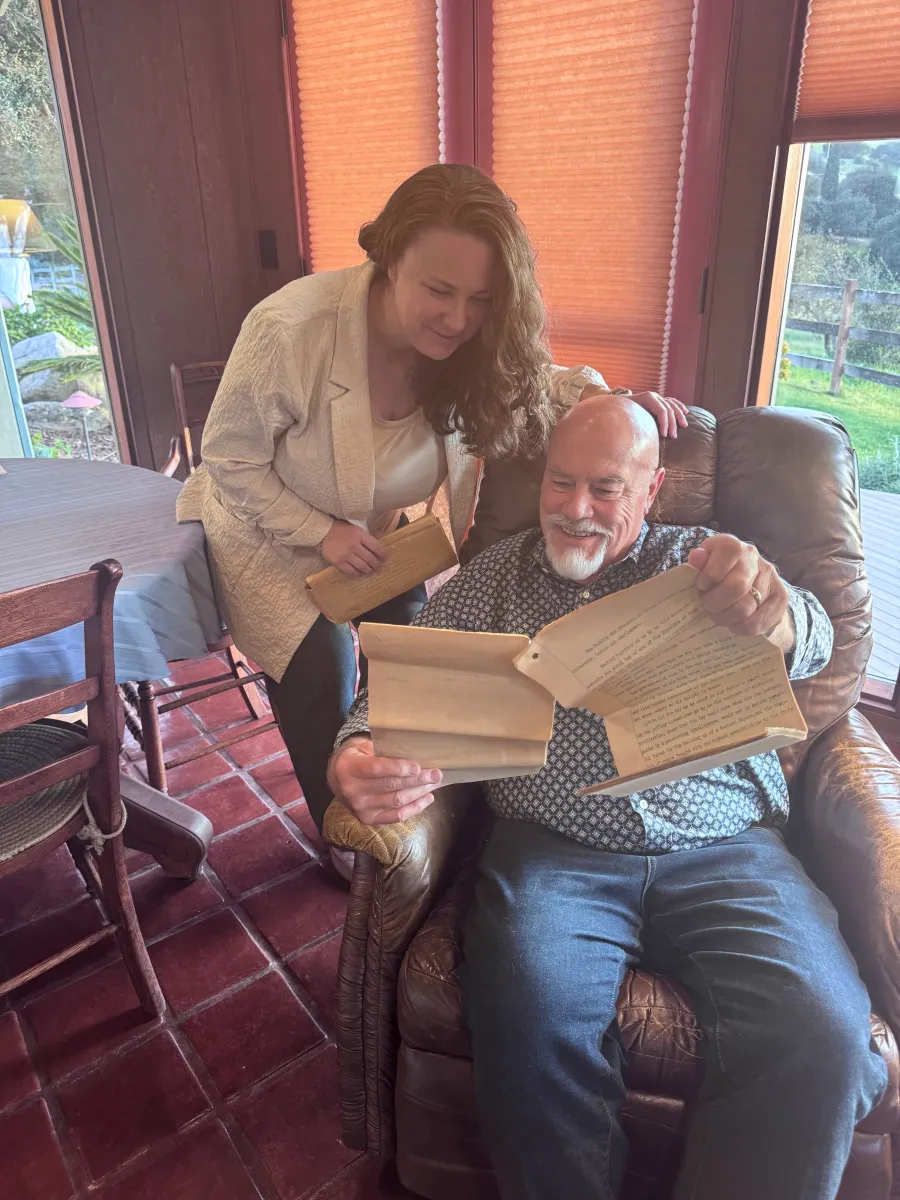
Reaching into one of the bins, Devlin pulled out a thick parchment envelope that had softened with age. The name of her great-great-grandfather, Francis E. Spencer, was written in capital letters across the top, while below, tightly scrawled handwriting listed the envelope’s contents. The first item read: “Address at Stanford.”
Intrigued, Devlin unsealed the envelope, pulling out an 18-page stack of text. A rusted rivet held the speech together. Flipping through, she found several pages fastened upside down. Occasional interlineations marked where Spencer inked in revisions to his rows of indigo type.
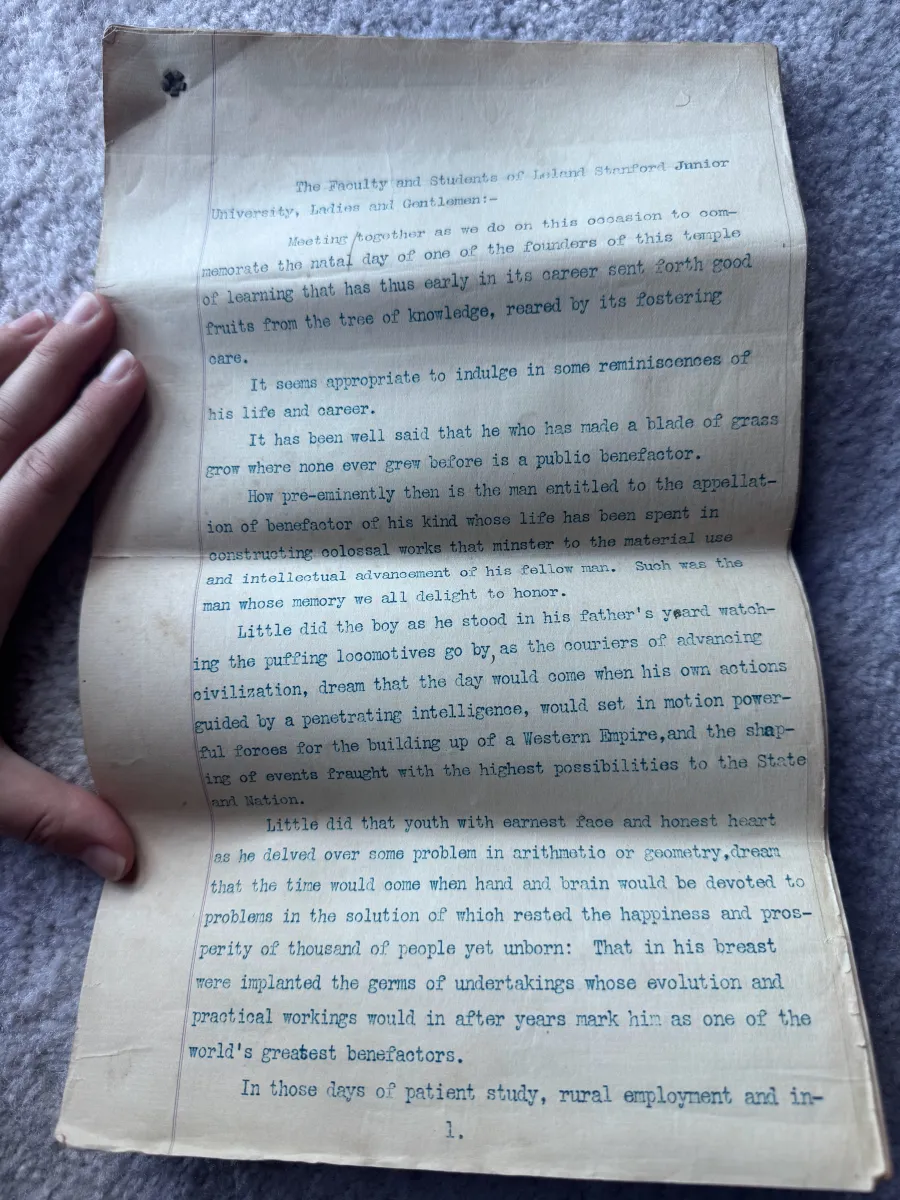
The speech began:
The Faculty and Students of Leland Stanford Junior University, Ladies and Gentlemen:
Meeting together as we do on this occasion to commemorate the natal day of one of the founders of this temple of learning that has thus early in its career sent forth good fruits from the tree of knowledge, reared by its fostering care.
It seems appropriate to indulge in some reminiscences of his life and career.
***
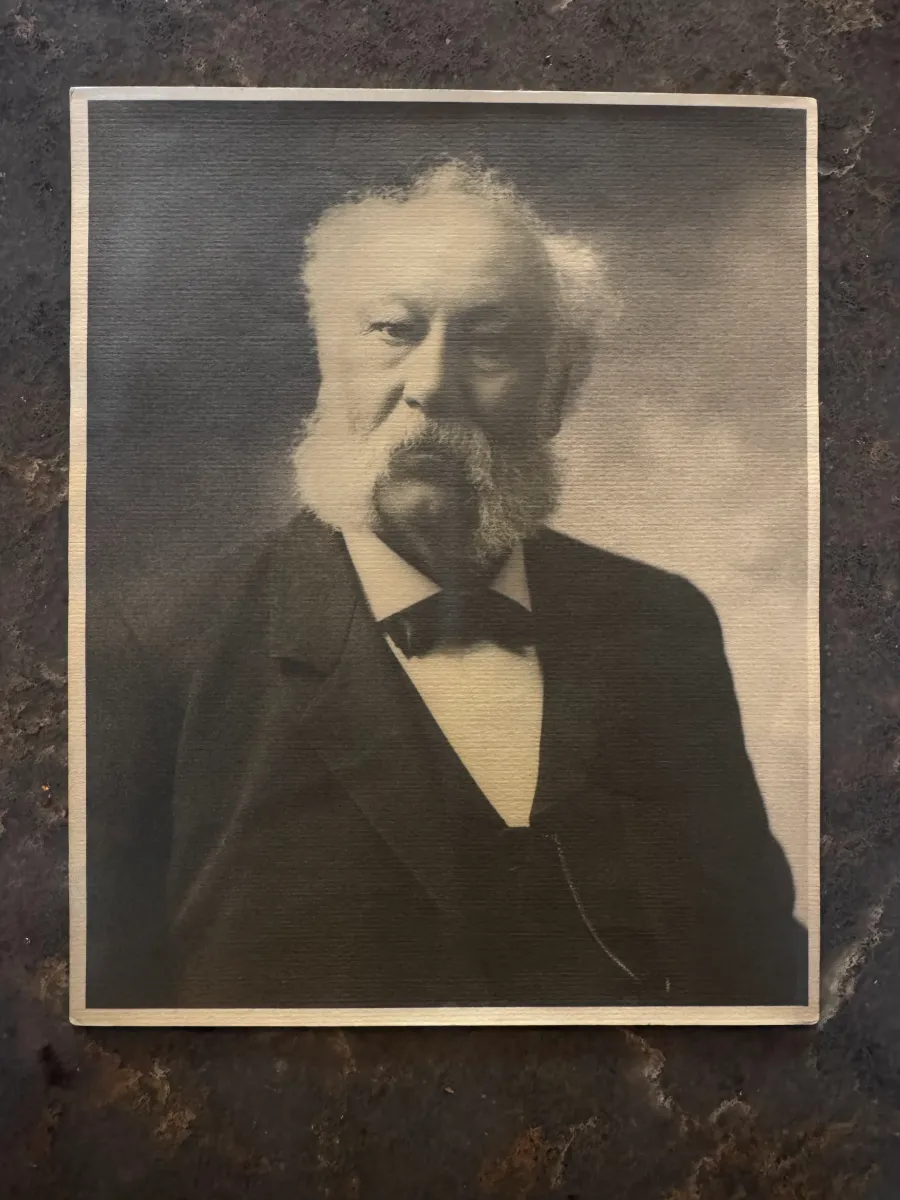
On March 9, 1898, Judge Francis E. Spencer, a member of Stanford University’s original 24-person Board of Trustees and close friend of the Stanford family, delivered a speech commemorating the life and legacy of the University’s founder, Leland Stanford. Stanford had passed away five years prior. The March 9 anniversary, proclaimed Founder’s Day, marked what would have been his 74th birthday.
As part of the day’s festivities, the Stanford community gathered in the local church to remember the deceased patriarch. Spencer’s speech was followed by a English Professor A.G. Newcomer’s reading of the “Memorial Ode”, along with other musical pieces.
Spencer, who passed away less than two months after his Founder’s Day speech, had also delivered the address at the University’s opening in 1891.
The 128-year-old eulogy is a reminder that the school’s founding family, frozen in time through sandstone and name, were also parents shaped by the throes of loss. Spencer bore their story five years after Leland’s passing, humanizing him and his wife for future generations.
Like Leland Stanford, Spencer moved to San Jose when he was 18 years old. In San Jose, he initially worked as a sheep raiser and farmer but soon turned to law and was admitted to practice by the California Supreme Court in 1858. He went on to serve a term as California state assemblyman for the 7th District and was later elected judge of the Superior Court of Santa Clara County.
Before Spencer’s speech arrived in the hands of his great-great-granddaughter, it spent decades filed away in a large bookshelf in his grandson’s home in Saratoga, California. Following the death of his grandson’s wife, the speech was transferred in one of the many green bins to his great-grandson’s barn in San Luis Obispo. It remained there for 27 years. Then, several months ago, his great-grandson, Clayton Hall, decided it was time to go through the family’s things with his children. “I’m getting old and it has more perspective for Cat and her brother,” said Hall. “If I can at least shed some light on some of the documentation.”
His daughter, Catherine Devlin, describes reading the speech as a “window into a family member” whom she knew very little about growing up. Both Devlin and her father were surprised to learn that Spencer was a close acquaintance of the Stanfords.
Spencer characterizes his speech as “reminiscent and biographical… dealing more with plain facts than indulging in empty laudations.” But it is also the account of a friend.
In his remarks, Spencer describes an early meeting with the Stanford family.
It was in the Winter of 1860 on the occasion of the meeting of the Presidential Electoral College to cast the vote of this State for Abrahm [sic] Lincoln, that I with a number of friends had the honor of breakfasting with Mr. and Mrs. Stanford at their lovely home.
He recounts how Leland’s wife, Jane, “entertained her guests with her experiences in crossing Nicaragua, and naively added that her husband had promised when she should next visit her Eastern home she should make the journey by rail.”
Famed for his railroad ventures, Leland Stanford would be elected president of the Central Pacific Railroad Company of California the next year. Eight years after that, in Promontory Summit, Utah, he would hammer in the last spike to connect the Central Pacific and Union Pacific railroads, fastening the nation’s first transcontinental railway. Spencer recalls the historic moment, proclaiming May 10, 1869 as the day “the grandest republic of the world wore for the first time a priceless girdle.”
Before pledging his ballot to Lincoln, Spencer had, “with many of the young men of those early days,” backed Stanford in his bid for California governor. “From that time to his death our intercourse was cordial, I might say intimate,” wrote Spencer.
In 1859, nine years after entering the Union, California had yet to elect a Republican governor. “Against his inclination and without much hope of being elected [Stanford] accepted the nomination of his party,” wrote Spencer. Although he lost this first contest, Stanford was back two years later, winning a decisive victory just in time for the launch of the Civil War.
In 1862, with only Oregon to the north, California was an amalgamation of Americans hailing from all 34 U.S. states and various foreign nations. This, wrote Spencer, made it “a hotbed of an element dangerous to the peace of State and Country,” with the state’s ultimate allegiance “for a time kept in painful suspense.”
Even before earning the title “War Governor” for his Union-bolstering policy, Stanford was an unyielding advocate for the Union’s preservation. In his remarks, Spencer quotes a passage from Stanford’s inaugural speech to highlight the freshman governor’s rectitude.
The Citizens of California are by birth the representatives of all parts of the Union, and are naturally imbued with more or less of local sympathies, let us be as tolerant and charitable of opinion as possible, but none should ever forget that California is one of the United States; that she is loyal to the Union; that her citizens have quite recently unmistakably declared their devotion to our national unity, their recognition of the supremecy [sic] of the national government and their determination to maintain both inviolate.
Stanford was the last California governor to serve a two-year term, with the length increased to four during his tenure. He left office with a legacy of wartime railroad investment (in which he had a financial stake), forest conservation, and cutting the state’s debt in half.
Following his single term, Stanford devoted his focus to the railroad business for two decades before returning to politics as a U.S. senator in 1885, a post he occupied until his death.
However, the moment that quaked Leland and Jane Stanford’s world came one year before his senatorial bid. On March 13, 1884, four days after his father’s birthday, 15-year-old Leland Stanford Jr. passed away from typhoid fever while traveling with his parents in Florence, Italy. Their son’s death altered the trajectory of their lives.
The parents with their hold thus loosened upon the material things of this life, resolved to do for the youths of the Country what they had hoped to do for their own and at the same time to perpetuate his name by erecting to his memory a monument not of marble to crumble away in the passing years, but by founding and endowing an educational institution bearing his name, that would afford to the youth of this Country, of both sexes, opportunities for acquiring a liberal and practical education, fitting them the better to battle with the stern realities of life.
The Stanfords’ mission to preserve their son’s legacy was granted form on the anniversary that Spencer’s speech commemorates. On March 9, 1885, California’s legislature passed the Endowment Act, sanctioning the establishment of private, tax-exempt educational institutions through a deed of trust. The family thus founded Leland Stanford Junior University, endowing their over 8,000-acre Palo Alto farm and roughly $20 million to a Board of Trustees, of whom Spencer was a member.
The University’s opening ceremony was held in 1891 on the Main Quadrangle, between the “sand stone jewels” of the newly built campus. Stanford, backed by a portrait of the University’s namesake, addressed a seated audience of over 500 enrolled students, saying of the occasion, “For Mrs. Stanford and myself this ceremony marks an epoch in our lives for we see in part the realization of the hopes and efforts of years.” Leland Stanford would pass away less than two years later, but as Spencer reflects just five years after the founder’s death, “he builded better than he knew.”
Following Leland Sr.’s death, Jane Stanford took the helm, ensuring the University’s continued success. Amid precarious financial circumstances triggered by a national depression and a federal suit filed in the wake of her husband’s outstanding railroad debts, the family’s assets were frozen. In response, Mrs. Stanford funneled the money from her husband’s will into the University to save it from bankruptcy.
“She has struggled against adverse conditions which would have overborne a woman of less heroic mold,” wrote Spencer. “But the victory is hers.”
Half a decade after Leland Stanford’s death, Spencer faced a congregation of students and faculty, as Leland had done that sunny day back in 1891. Bearing the legacy of his friend, he concluded his remarks with a request of his young audience:
Of the two founders and the twenty-four original trustees, twenty-six in all, ten have already paid nature’s debt. But a few years will elapse when all the other original actors in this founding will have done likewise, and none will remain to personally remind the Alumni and students of this University, May I ask that in the coming years you and those who come after you, will keep green in your memories this anniversary day and all that its observance signifies?
The scanned speech can be found here.