
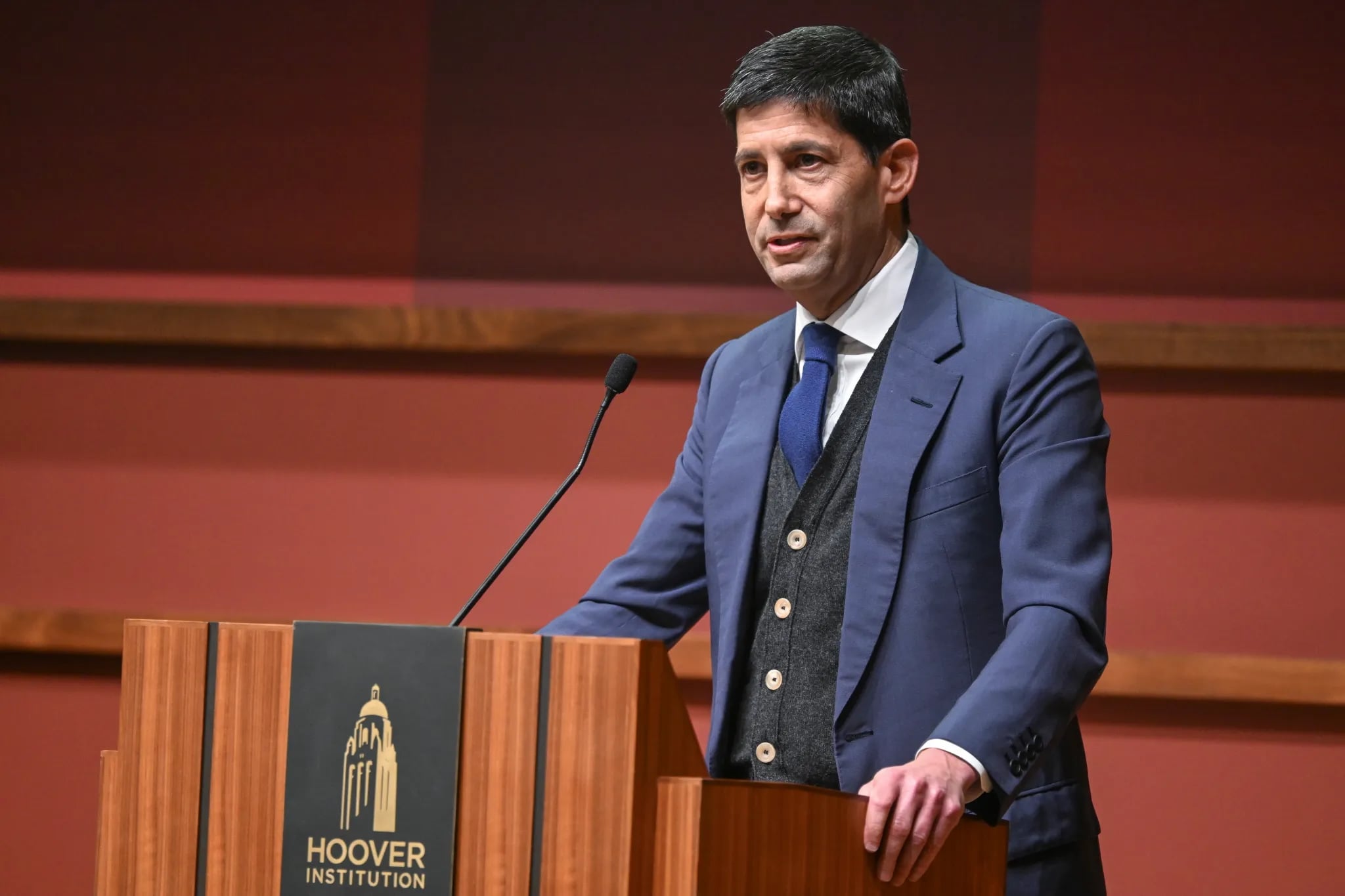
Kevin Warsh ’92 believes high inflation and rising costs of living can be traced back to one central source: the entity that he’s been tapped to lead.
In a Federal Reserve Chair confirmation hearing on Tuesday, Warsh repeatedly condemned the Fed’s policies for driving up inflation, and criticized the central bank for “letting inflation take hold of the economy in 2021 and 2022.” During the hearing, Warsh spoke repeatedly of “reforming” the Fed. “Independence is earned,” he said. “And as the Fed hasn’t delivered on [its] promises, we shouldn’t be surprised that we hear politics are entering the room.”
Warsh vowed to make “big changes” to the Fed’s Forward Guidance, which projects the probable course of upcoming monetary policy “As [the Fed] wanders into areas upon which it has neither authority or public expertise, it loses its focus,” he said.
Warsh, a Stanford graduate, served as the youngest-ever member of the Federal Reserve from 2006 to 2011. Afterwards, he joined the Hoover Institute in 2011 as a Shepard Family Distinguished Visiting Fellow in Economics.
In February, Trump tapped Warsh to serve as the next chair of the Fed. Trump has attacked current Fed Chair Jerome Powell, whose term as chair ends in May, for refusing to lower interest rates. Powell has accused the Department of Justice, which launched a controversial criminal investigation into Powell and the Fed’s construction spending, of pressuring the Fed with federal prosecutors. Warsh has previously criticized the practice of keeping interest rates low, but has recently shifted his stance towards favoring such policies.
Warsh made several references to Stanford in his confirmation hearing. In his opening remarks, Warsh described his time at the Hoover Institute as formative to his understanding of economic governance. “Maybe the most important [thing I learned] was to be around people completely devoted to the ideas and ideals of our country,” said Warsh, referencing his tutelage under the late Secretary of State and Hoover Fellow George Shultz. He also praised Hoover Institute Director Condoleezza Rice.
Warsh joked about grade inflation at Stanford, where he taught until 2020, alongside other “elite” American universities. “Well, if I gave a student anything other than an A, the Dean would summon me to his office, because I would have hurt his self-image,” he said.
Lawmakers pressed Warsh about his personal finances, as well as his relationships to China, Trump and convicted sex offender Jeffrey Epstein. Warsh did not clarify his ties to Epstein, providing no direct response when Massachusetts Sen. Elizabeth Warren (D-Mass.) asked a direct question about his financial involvement with the former financier. Instead, he pledged to sell his hundreds of millions in assets if confirmed. Outside of the hearing, Walsh has also drawn scrutiny for his personal connections; his father-in-law, the billionaire Ronald Lauder, holds business interests in Greenland and has been credited with inspiring Trump to invade the nation.
The committee also grilled Warsh about his shifting perspective and connections to Trump. When Warren, the ranking member of the committee, asked Warsh if Trump had lost the 2020 election, Warsh said the Senate had certified the election. “I’m suggesting to you [that] in 2020 the Fed made a huge inflation problem,” he said in response to Warren’s question.
Warren described Warsh as a “sock puppet” for the president. She further accused Warsh of “[dismissing] increasing urgent concerns from housing advocates across the country regarding subprime mortgages” and “[arranging] multi-billion dollar bailouts” for Wall Street.
“The Senate should not be aiding and abetting Donald Trump’s illegal takeover of the Fed by installing his chosen sock puppet as chair,” said Warren, describing a potential Warsh confirmation as “an invitational for corruption and for economic catastrophe.”
Like Warren, Arizona Sen. Ruben Gallego questioned Warsh’s relationship with Trump. Gallego referenced a Wall Street Journal report from last December, in which Trump claimed that Warsh had already agreed to low interest rates. Warsh pushed back on this claim, repeatedly questioning the integrity of the publication.
“The president never generally or specifically suggested I should commit to any interest rate path whatsoever,” he said.
Republican committee members praised Warsh for his financial experience and commitment to public service.
“Kevin Warsh is battle-tested and brings the necessary experience from his time as Federal Reserve governor during the Great Recession,” said Committee Chair and South Carolina Sen. Tim Scott during the hearing. “Confirming Kevin Warsh will make sure that affordability is at the center of our economic agenda.”
Ohio Sen. Bernie Moreno expressed a similar sentiment. “You’re going to be confirmed. You’re going to be the Federal Reserve Chairman, and most importantly, you’re going to do an incredible job,” he said. “I’m honored to have been part of that process, and will vote for you resoundingly.”
North Carolina Sen. Thom Tillis, however, broke with party ranks. Echoing his previous sentiment, Tillis vowed to block Warsh’s nomination until the investigation into Powell is dropped.
“I can’t go forward until this bogus investigation is gone,” said Tillis. “Let’s get rid of this investigation so I can support your confirmation.”
On his part, Warsh also emphasized the AI boom’s potential for rate cuts, stressed the importance of renovating the Fed’s payment systems and cautioned against economic “group-think.” Ultimately, Warsh’s focus remained on inflation. When asked about the topic, Warsh said “price stability should be a change in prices such that no one’s talking about it.” He also vowed to wean the Fed off using balance sheets, and instead suggested that the central bank should focus on interest rates as its primary economic policy tool.
“You would need to have Ph.D. from an elite institution,” he said, “to believe that inflation doesn’t have something to do with money.”