
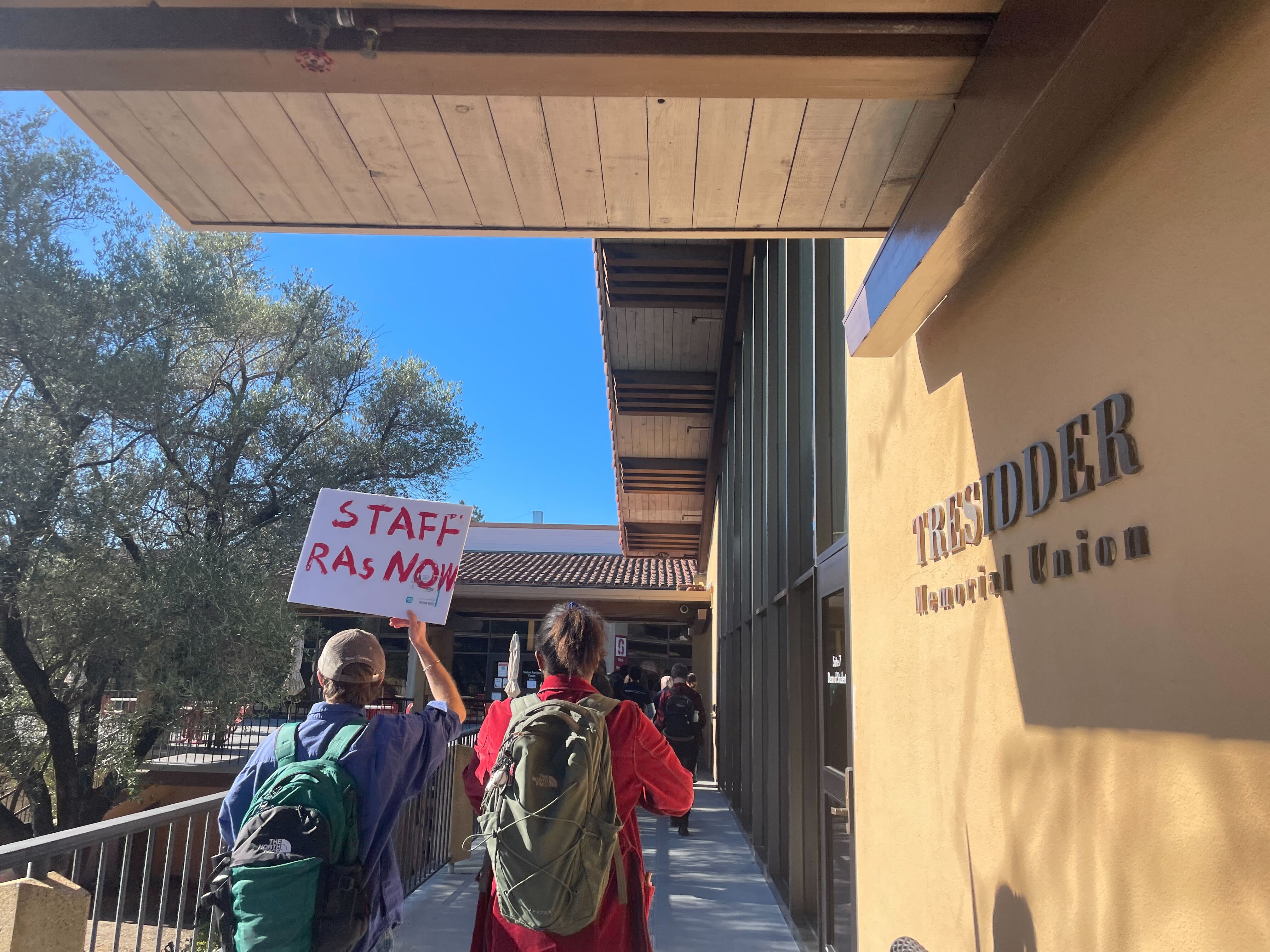
Resident Assistants (RAs) are unionizing in response to complaints of understaffed dorms, underpayment and poor communication from University administration.
Roughly 40% of Stanford RAs have signed union authorization cards, according to several organizers, surpassing the required 30% threshold to file for a union election with the National Labor Relations Board (NLRB).
“Why now? [RAs] want it as soon as possible. Organizing a union campaign takes a long time,” said Dawn Royster ’26, an RA at Branner Hall and contributor at The Daily. “It takes a lot of thoughtful conversation of explaining to people and RAs all over campus why they should care, why this matters and why being a part of a union would benefit them.”
The proposed union has been a year in the making, though RAs noted conversations around unionization have circulated for much longer. Moves to unionize come after RAs hosted a March on the Boss rally in January to present their grievances over underpayment, vacancies and a lack of transparency to the administration. After the event, some vacancies were filled while others remained open. Resident Assistants United Rising (RAUR), the proposed union, would represent undergraduate RAs in negotiations with the University over wages, staffing and workplace protections.
The Daily has reached out to the University for comment.
“There is strength [in] numbers,” said Marissa Meng ’26, an Okada RA who has been involved in the efforts to unionize.
If a majority of voting RAs approve the measure, the union would be formally recognized and enter collective bargaining negotiations with the University.
“All of these struggles could sometimes feel very cyclical, because every year it’s the same issue, every year there’s no substantial improvement,” said Shuci Zhang ’27, an organizer for the effort and RA at Terra House. “RAs need a union because it’ll provide us a consistent structure to bargain with the University as equals.”
RAUR will host a union card signing event this Friday. Zhang mentioned the choice to host the event on International Workers’ Day is intentional, to draw attention to how they feel the work of the RAs has been minimized.
“Unionization is just a result of years and years of Stanford treating RAs as disposable,” Farah Tantawy ’26 said, an RA at Robert Moore North (The Well House).
After the May Day event, RAUR plans to file a formal petition with the NLRB to begin an election. While they have already reached the legal minimum to file, organizers said they are holding the rally to mark the move towards establishing the union.
“I would say we still are looking for a more transparent hiring and firing process from Residential Education (ResEd), which is still something we have not gotten from them,” said Royster.
RAs complained of unjust wages as compared to peer institutions. At Stanford, RAs are paid a yearly stipend of $12,400. The yearly cost of room and board at Stanford starts at $21,035. In the process of unionizing at Stanford, RAs spoke with members of other RA unions across the country.
“This year especially [the union] has felt very crucial and I feel like we’ve been hit really hard with the budget cuts and the understaffing,” said Meng. “It has just been so immense. And I think so many RAs across the whole university are really feeling this burden of having to keep residents alive, and really not feeling any support from the University.”
The Daily has reached out to Residential Education (ResEd) for comment.
RAs see the union as a way to establish easier communication channels for their demands with the school — something they have struggled with in the past. A union would provide a legally binding contract to clarify the “conditions of employment and your labor,” according to Royster.
If the election is successful, RAUR will join student-worker unionization at peer institutions like the University of Pennsylvania, Columbia University, Dartmouth College and the University of California, Berkeley.