
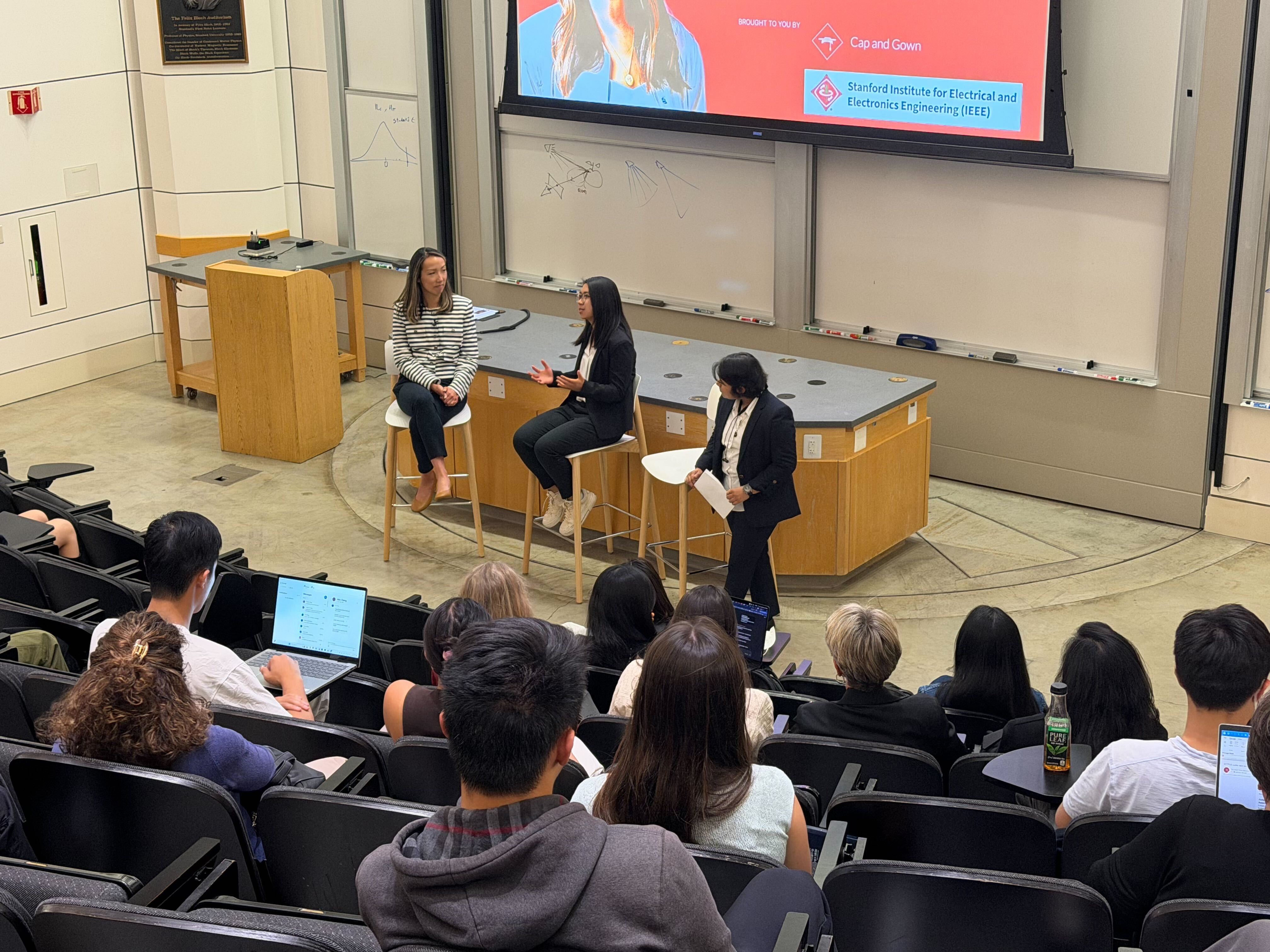
Clara Shih ’04 M.S. ’05, former Salesforce AI CEO and former head of Meta’s Business AI group, detailed her career in tech and the challenges Gen Z job seekers face in today’s AI-driven economy at a fireside chat co-hosted by Stanford Institute for Electrical and Electronics Engineering (IEEE) and Cap and Gown on Wednesday.
During the talk, Shih, who is currently senior advisor of Meta’s Business AI Group and founder and executive director of the New Work Foundation, traced a largely unplanned career path. From Google to co-founding Hearsay Systems — a social customer relationship management (CRM) startup that grew to $70 million in revenue — she later became the CEO of Salesforce AI and later head of Meta’s Business AI group. Shih shared some of the lessons she learned throughout her career.
Shih recounted applying to investment banking and consulting jobs out of Stanford and being rejected from all of them. “I was ambitious,” she said. “But I didn’t make the cut.”
She ended up at Google instead, before it was considered prestigious, and credited that rejection as one of the luckiest breaks of her career. When Salesforce rejected her pitch for a social CRM product built on Facebook’s application programming interface (API), she left and started Hearsay Systems herself.
Her advice to students was direct. When careers don’t go as planned, “that’s sometimes life’s way of saying you’ve got to focus on something else, and then you’re going to come back.”
“Clara was really honest about how failure is important,” said Milly Wong ’27, who moderated the event. “People at Stanford focus too much on success, but failure can be a cornerstone of what you’ll be doing in the future.”
Shih pushed back on the idea that hard work alone is enough, particularly at a school like Stanford. “Every time Meta Business AI posted a job, 10,000 people applied,” she said. “If you don’t bring something really strategic and special, you’re probably not going to get it.”
With that, Shih emphasized the importance of authenticity. Reflecting on her time as a student, she said she had spent much of it chasing goals that weren’t really her own. “I had inherited goals from other people, from society, from my parents,” she said. Once she let go of that, she found both her career and her relationships improved. “I was able to improve my probability of getting the things that I want, and also improve my authentic relationships.”
“[Shih] was basically just doing things she thought were interesting, but pursued them so fully that they ended up being useful for her career,” said Kawish Billore ’26, who moderated the event alongside Wong.
Shih also noted a shift in hiring practices she’s witnessed directly: entry-level recruiting has moved away from targeting only elite schools like Stanford, MIT and CMU, toward a much simpler standard — what have you actually built?
One of her strongest life lessons was about the value of opting out. “It’s almost more important and potentially harder to figure out what not to do than to figure out what to do,” she said. Shih pointed to her own decision to step back from Hearsay during COVID-19 as an example — noting how it was an agonizing choice at the time, widely misunderstood by those around her, but ultimately the right one.
“Know which things are important, and show yourself some grace so that you can focus on the things that you really want to be strategic about,” Shih said.
Shih closed with a picture of the landscape facing new graduates. According to her, nearly half of recent graduates are working jobs that don’t require their degree.
She attributed part of the problem to a widening gap between those using AI agents and those who aren’t. “For those who are using AI agents, companies will fight to hire you,” she said. “For those who aren’t, you may be left behind.”
“If you’re a student, you have to take it on yourself [to adapt to AI],” Shih said to The Daily, noting how universities often take longer to adapt than the pace of change that is currently being seen with AI.
However, Shih also cautioned against over-reliance on AI.“ There are situations where we delegate our thinking to AI — that’s not good,” Shih told The Daily. “There are other situations where we remain in the driver’s seat and we’re using AI as a thought partner, and that can be really powerful.”
To address what she sees as a growing information gap between Silicon Valley and everywhere else, Shih launched the New Work Foundation, along with its content platform Dear CC, aimed at helping Gen Z job seekers navigate the AI economy.
When asked what the single most important thing a Stanford student could do before graduating, Shih was direct. “Use Claude Code to deploy agents in their personal life,” she said.
“This talk was different from previous IEEE events,” Wong told the Daily. “It was more about her personal story. There was a lot of value in just learning how to be a Stanford student and not be so scared.”