
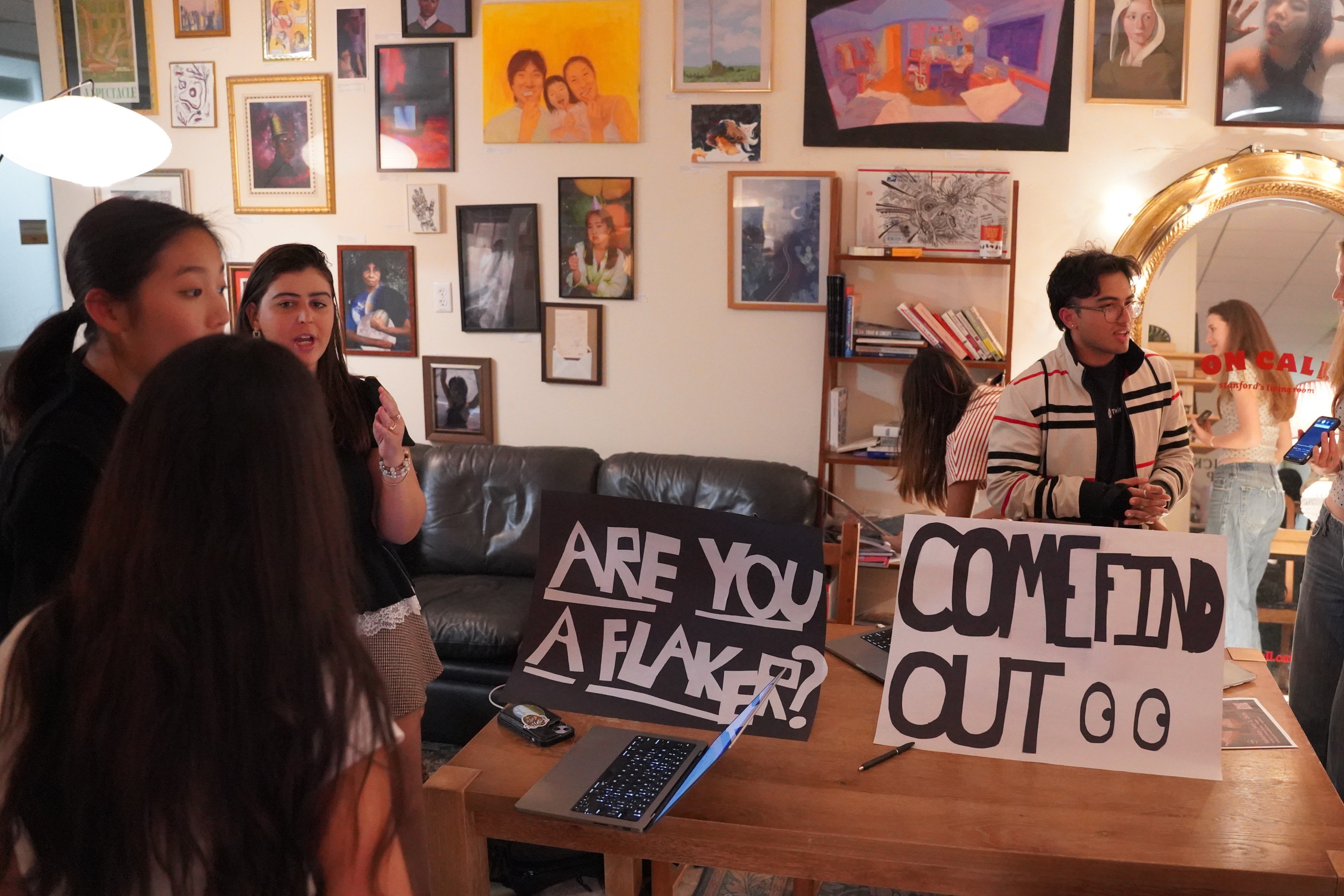
“Are you a flaker? Come find out” read a handmade sign propped up at On Call Cafe Thursday evening. Behind the sign stood Divyesh Khatri ’26, Emilio Farrell ’26, Kassius Thomas ’26 and Julia Segal ’26, the team behind “Flaudit” — an online tool that reads through users’ text messages and determines their level of flakiness.
At the launch, the team prompted passersby to download the program. After Flaudit analyzes a user’s messages, it generates a “wrapped”-style overview including the amount of times the user flaked on their friends, the number of times the user’s friends flaked on them and a “flake score” showing the percent of plans the user made, among other statistics about the user’s habits.
“I thought that they did a really good job of pointing out a lot of different data analytics,” said Rhea Jain ’27 after downloading and testing Flaudit.
Jain said that the program’s use of specific data — the days of the week in which people flake the most, for example — showed the Flaudit team’s attention to detail. “I could tell that they really thought it through,” she said.
The team members created Flaudit for their design capstone project, and have been working on the product since winter quarter. Segal said the idea came from a desire to address a “flake culture” common among Stanford’s student body.
“It’s difficult for people to be present in the moment, and people are always thinking about the next thing and the next thing and the next thing,” Segal said. “They’re not necessarily appreciating the thing that’s right in front of them.”
She said that because she has organized campus events, flake culture is something she “feels very acutely.” According to Segal, experiencing last-minute flaking on group outings she’s organized sparked her interest in learning more about the phenomenon.
“Everyone I talked to, the moment I mentioned flake culture, had very, very visceral reactions,” Segal said. “Everyone seemed to feel one way or another about it.”
The team researched flake culture on campus by interviewing over 50 students, according to Segal. While they were researching, the team noticed that many interviewees exhibited “cognitive dissonance” — identifying flake culture as a problem at Stanford but claiming that they themselves would never flake.
Khatri said that for the team, the key to addressing the issue lay in breaking a “flake loop of doom” where flakers continued to skip plans with their friends without being held accountable.
“In order to break the feedback loop of flaking, people need to see that they actually did flake, or that they will face some sort of consequences,” he said.
After conducting interviews, the team engaged in an “iterative process” involving several rounds of user research and prototype testing. Segal said that the team spoke to Dennis Boyle M.S. ’79, a consulting assistant professor in Stanford’s Hasso Plattner Institute of Design (d.school), for advice on the project. Boyle, who specializes in design for human behavior change, told the group that accountability is most important to changing users’ behaviors.
“What we found was that people were really most interested in an introspective experience, to be able to become more aware of their own habits without being publicly displayed,” Segal said.
According to Segal, the team has identified a three-criteria framework to measure the severity of a flake: time until the event, amount of time the event had been planned beforehand and the impact of flaking on another person’s plans. The framework developed naturally, as the users the team interviewed consistently and independently identified the criteria.
Members of the team served as the first guinea pigs for Flaudit, and continually ran the program on their computers to demonstrate it to patrons at On Call. The group said that creating and using the program has made them less likely to flake on plans — and they hope those effects spread to other Flaudit users.
“We just really focused on putting a group together that could build something impactful,” Khatri said.