
Whether America’s lead in AI — building the most capable models, attracting the best talent and shaping the global rules — endures will ultimately be decided by whether the public consents to the transition. America’s AI policy is not yet built for that test. Consent, here, means something concrete: workers have input before deployment decisions are made, credible pathways exist to adapt (retraining tied to labor demand, portable benefits and protections for workers whose roles get reshaped) and clear standards govern high-stakes uses.
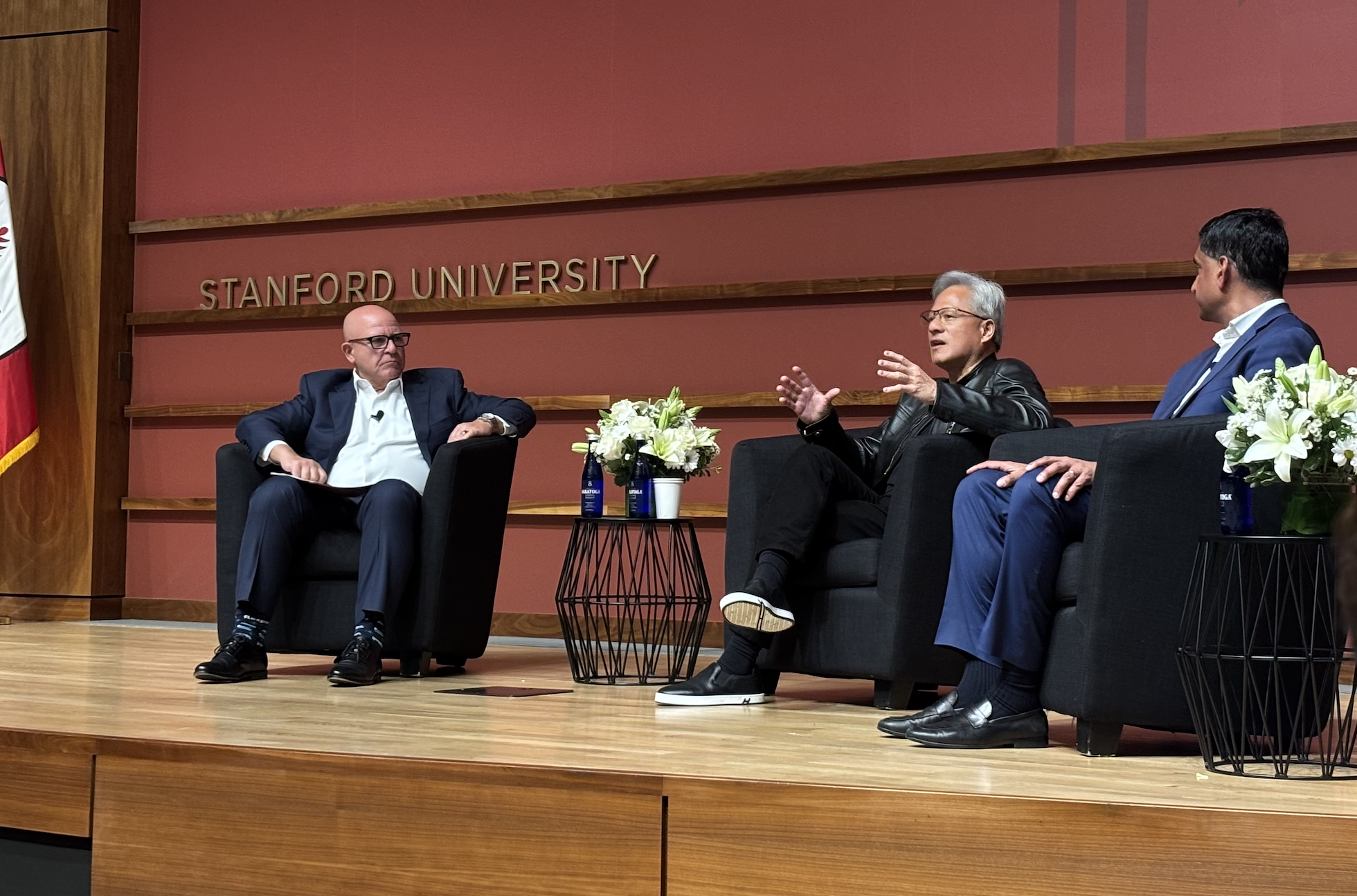
That question sat at the center of a discussion covered by The Daily at Stanford on April 9, when Jensen Huang M.S. ‘92 and Representative Ro Khanna agreed that the U.S. should lead the rest of the world in AI development and then disagreed about what kind of leadership could last.
Huang stressed diffusion. He described the AI stack — the various infrastructure that facilitates its use — as a hierarchy: energy, chips, models and applications. He argued that the application layer matters most because it is where technical capability turns into national advantage. A lead in models or chips means less if the technology never takes root in hospitals, classrooms, labs, factories and small businesses. He is right. He is also right that the regulatory question is often posed too crudely. Serious regulation targets specific high-stakes applications, not adoption as a category.
But diffusion can spread without strengthening institutions, and development speed can accelerate without users’ consent. Stanford’s AI index shows that the U.S. still leads in private AI investment and top models, even as both American and Chinese systems have traded the performance lead multiple times since early 2025. Pew finds that half of American adults feel more concerned than excited about AI in daily life.
That skepticism reflects a country that has already lived through one era of dazzling innovation with very uneven rewards. The Internet generated enormous aggregate gains, accounting for a substantial share of GDP growth in developed economies, but the digital economy also polarized opportunity: high-digital workers captured higher wages and more resilience, while low-digital workers faced weaker wage growth and greater automation exposure; whereas China absorbed globalization through export-led industrialization. AI lands in America carrying that context. The question now is whether Americans believe the transition is being built with them or done to them.
Khanna named the problem more directly. “This idea that we could just be a financial nation, an innovation nation without maintaining an industrial base was a mistake for our national security and for social cohesion,” he said. Americans do not just need more access to AI. They need some reason to believe that the gains will be broad and the labor market shock survivable — and that the people selling the technology are not simply asking everyone else to absorb the disruption. He emphasized that the American Dream still depends on openness: attracting global talent and funding research universities where academic freedom produces breakthroughs.
That American openness is indeed foundational to the country’s growth. Georgetown’s Center for Security and Emerging Technology (CSET) finds that immigrant founders were behind most of America’s most promising AI startups as of 2019. UC Berkeley Professor AnnaLee Saxenian showed long ago that Silicon Valley grew through brain circulation, not national closure. Today, restrictive immigration policies threaten the very pipeline that built America’s AI sector. A politics that praises American AI leadership while treating foreign talent as suspect is self-sabotage dressed up as industrial policy.
Stanford’s own research complicates both sides. A Stanford Institute for Human-Centered Artificial Intelligence (HAI) study found that workers mainly want AI to take over repetitive tasks while preserving human oversight and agency. It also found that 41% of mapped tasks landed in zones where workers did not want automation, whether or not it was technically feasible. That should puncture the assumption that faster deployment is always better deployment, a conclusion Huang’s framing invites, even if he did not state it outright. What matters is whether firms are automating the right things; that question is part of what determines whether the public consents at all.
How AI reshapes work depends less on the technology than on the rules surrounding it. HAI Professor Erik Brynjolfsson and his co-authors found that generative AI raised productivity by 14% on average in a study of customer-support workers, with especially large gains for novice and lower-skilled workers. But Daron Acemoglu, David Autor and Simon Johnson warn that current incentives still push firms toward automation instead of worker-complementary tools. The difference between those futures will be decided by tax policy, procurement, training systems and whether workers have any voice in deployment.
That is also where Khanna’s own side needs sharpening. “Jobs programs” and community college partnerships are not enough if they arrive as reassurance after deployment decisions have already been made elsewhere. If public consent is the scarce resource, then worker voice and training pipelines have to be built into adoption from the start, alongside clear standards for high-stakes uses. Otherwise, labor policy becomes a consolation prize for a transition designed without human labor in mind. The EU’s AI Act, for all its imperfections, at least attempted this by tying regulation to risk levels and requiring transparency before deployment. The U.S. has no comparable framework.
Stanford sits at the center of AI leadership: talent pipelines, research that sets the terms of debate and norms that govern how technology is built. If consent is the precondition for sustainable AI adoption, then the institutions training the next generation of builders carry a specific obligation: to accelerate the technology, yes, and also to make the case, in public, for why we should trust it.
Huang is right that fear can become a self-inflicted wound. Khanna is right that a technology this powerful will not remain politically sustainable if workers see only disruption while investors see only upside. The harder truth is that consent precedes any diffusion or redistribution that lasts. America will not “win” AI merely by building the best AI systems the fastest. It will win, if it does, by making adoption feel less like exposure and more like shared power: broadly beneficial, democratically legitimate and trusted by the workers and communities asked to live with it.