
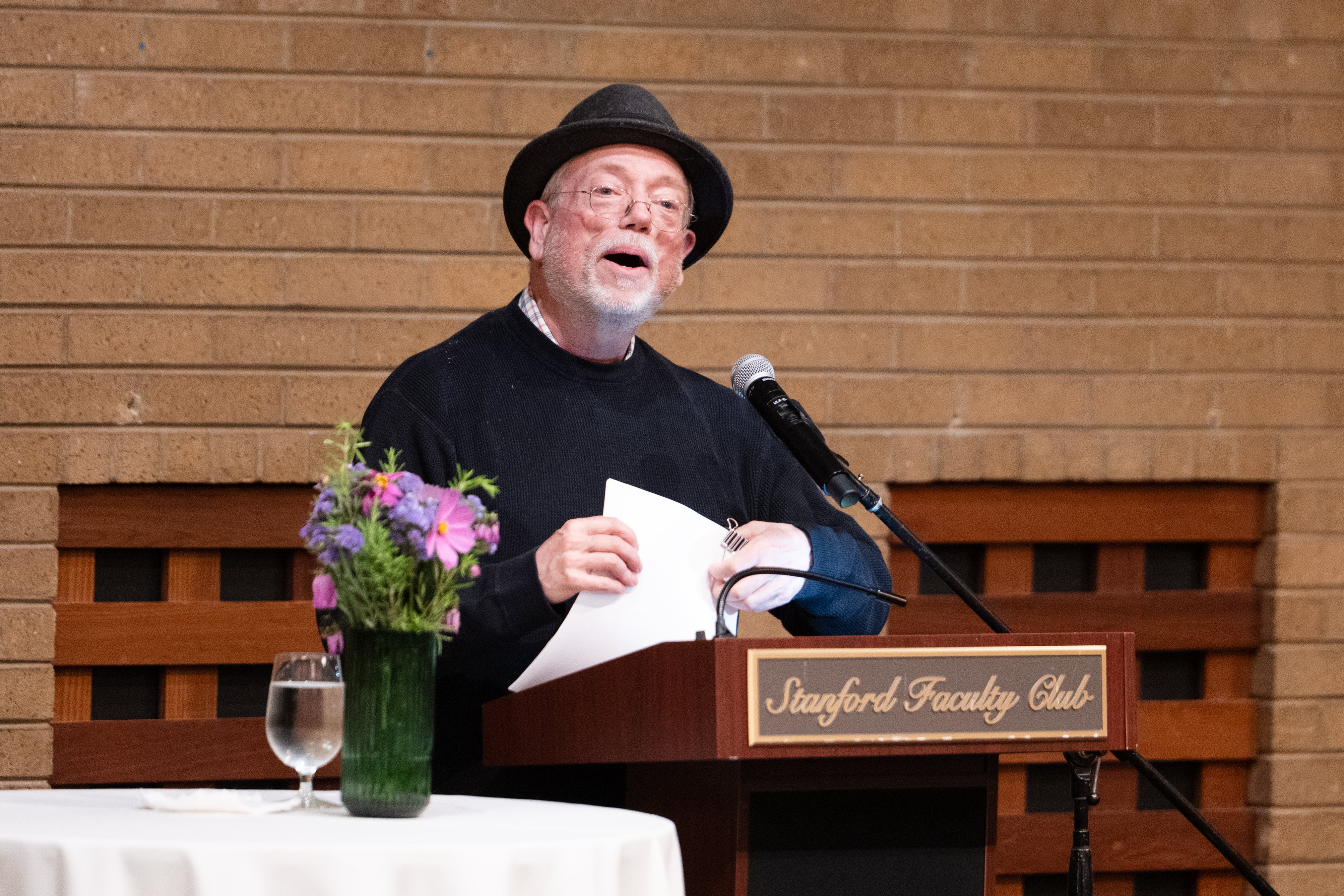
On April 29, the 2025-2026 Mohr Visiting Poet, D.A. Powell, presented his poetry to an audience of students, faculty and community members at the Stanford Faculty Club.
A professor in the English department at the University of San Francisco, Powell has published several poetry collections, including “Tea” (1998), “Lunch”(2000) and “Cocktails” (2004), which explore the intersections of nature, desire and community. As the Mohr Visiting Poet, he occupies a position reserved for distinguished poets to teach poetry seminars of their choice to 15 undergraduate students.
This year, Powell taught ENGLISH 192V: “Writing Poetry in the Age of the Moving Picture,” examining the changing conceptions and possibilities of the poetic image, in relation to the development of film.
The event was organized by the creative writing department. Knight Family Professor of Creative Writing Aracelis Girmay opened the event and introduced Powell to the audience.
After reading Powell’s poem “Senescence,” Girmay described his composition as “working in the frictions of sensibilities, language, traversed by life, body, imagination, passed through both losing and opening into the breach.” The element of a “rough edge, improvisatory condition… is part of his particular brilliance,” she said.
Powell began the evening with poems from his fourth book, “Chronic,” where every poem’s title either begins or ends with a letter C. The first poem of the evening was “he’s a maniac, maniac,” an ekphrastic. From the beginning line (“That in the Stanley Kubrick movie of your life”) to the ending line (“The villain returns. You are the villain. Any second. Last thoughts”), this poem establishes the inextricability of lived experience from forms, tropes and artistic renditions.
The next poem, “Corydon & Alexis,” takes its name from the lovers in Virgil’s “Eclogue II,” an early example of homoeroticism in pastoral poetry. The final line, “I put them on paper, too, so fragile, for nothing is ever going to last,” is a double entendre: the speaker places the “olallieberries, new-mown grass, the tender fruits of the coastal fig” gathered for his lover on paper, just as the poet puts the tender, precarious subject into print.
The fourth, the titular poem “Chronic,” fuses Powell’s reflections with a catalogue of the Central Valley’s flora, fauna and other natural phenomena. The “trudge on and if the war does not shake us from our quietude, nothing will” resounds like a clarion call toward resilience and joy, despite a litany of past and potential catastrophe.
The evening’s next few selections came from the collection “Useless Landscape, Or A Guide for Boys,” which fuses Powell’s eye for ekphrasis with an intimate look at the Central Valley, where Powell grew up.
The Central Valley “is that place that you drive through on your way to some other place,” Powell said. “But you move away from someplace, and you’re getting perspective… You remember all the life that was there and is in transition.”
One poem from the collection, “Landscape with Sections of Aqueduct,” rendered the region in minuscule detail with lines like “One guy peeled labels off beer bottles here.” Another poem, “Bojangles,” zeroes in on a bar in Sacramento, a place where “Nobody holds a gun to your head. Nobody beats you with the length of a hose.” Powell further highlighted the regional language and location with “Boonies,” the rural area that he defines as “where we could be boys together, a region of want.”
The evening took a humorous turn as Powell read from “Tricks,” which took first place in the chapbook contest by the Literary Journal of the University of Montana. In “Trigger Warning,” Powell demonstrated his deftness with clever punchlines, like “I dated an X-ray tech, but he never saw me. Dated a magic act, but he never saw out of me.”
Powell then offered a full reading of “Senescence”, a call-back to Girmay’s introduction. He ended the night with “The Miracle of Giving,” a poem he had written as a gift for a friend. The line “When I hungered the word fed me” reflected the presence of connection, faith, desire and community in much of Powell’s work.
Afterward, Powell responded to questions from the audience.
Milian Chen ’28 asked about Powell’s incorporation of scientific terminology into the poems. Powell’s response encouraged integrating different voices in one’s writing.
“Sometimes we tend to limit ourselves to what we think is appropriate or accessible or conveying an idea,” Powell said. “We can break out of those homes, those things that try to contain us and try to hold us in place.”
For Chen, a student involved with sustainability on the Stanford campus, Powell’s incorporated elements “about climate change, about changes in his own life and things unexpected, about love, about things not being permanent, resonated with me,” she said. “I really enjoyed them and the way he shared it with a bunch of humor in between.”
Another audience member asked Powell about how to approach writing about fear and writing when afraid.
“Life is over before you know it,” Powell said. “If you’re waiting to be not afraid to write, it’s going to pass you by.”
Correction: This article has been updated to reflect that Chen’s pronouns are she/her. The Daily regrets this error.