
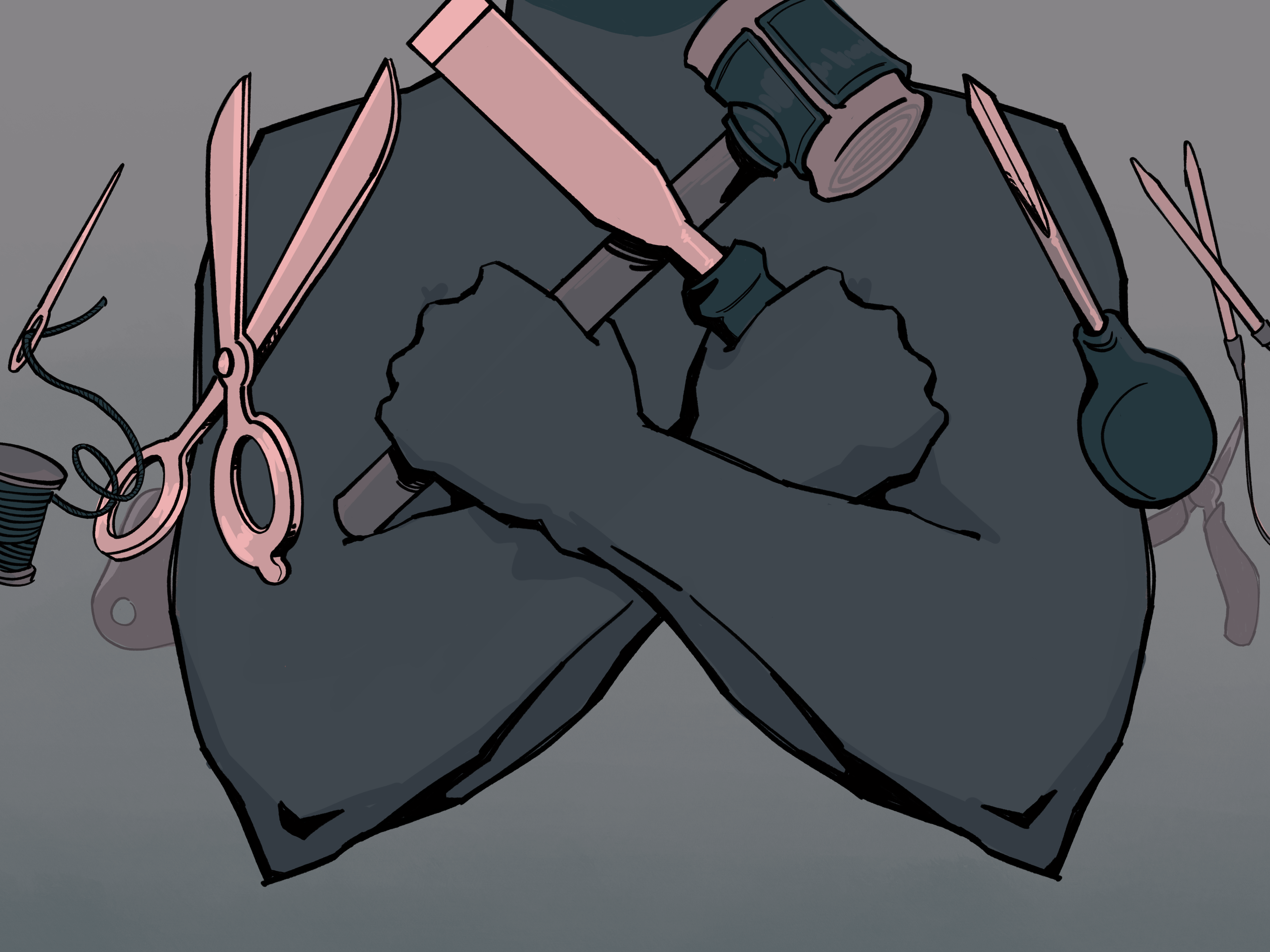
In “Culture of Craft,” Quinn Cook ’29 documents the culture of craft, those who practice it and what we might learn from them.
For all my bloviation about the procedure and technique of crafting, it must be recognized that the culmination of the creation process is a product. An object. A thing. The act of working does not magically persist after the work itself has ceased; the result is first and foremost an article to use.
At this level of understanding, craft risks losing its seemingly special tinge and becoming just another variant of a commodity. It enters what Marx called the “fantastic form” of commodity fetishism, where the hand of the maker recedes from view, and the object we encounter appears to stand alone, unmoored from its origins.
Craft, however, has a defiance to this reduction unlike any other. Most commodities manufactured nowadays require an external infusion of narratability — the goal of marketing campaigns, of the calculated distressing of products, of the skeuomorphism of digital designs, is to imbue fundamentally inhuman things with personal meaning. Craft objects, on the other hand, invite stories not as external additions, but as something latent within themselves.
Hand-thrown bowls, for example, reflect slight asymmetries, the rhythm of the wheel or the pressure of its maker’s hands at the lip. A carved chair holds decisions about grain, tension and design. They compress the story of their creation, constraints and improvisations into their form in a way that cannot be replicated through the superficial packaging of ad campaigns. Narratability emerges not from what is said about the item, but from what is inscribed within it.
This stubborn, embodied memory of crafted items comes to resemble what anthropologist Marcel Mauss argued about gifts: that objects can carry the presence, even the obligation, of a person. Gifts, in particular, bind giver and receiver in a web of reciprocity, because something of the giver remains attached to the thing given.
Likewise, to hold or to own a handcrafted object is, potentially, to enter into a relation with its maker. They are not an abstract category or concept of labor, but a situated and skilled individual, and their creation is less a detached commodity and than it is a point of contact with them. In this sense, the crafted object is not just narratable; it is relational.
To recognize this objectified intersubjectivity is to shift the item’s status. The fetish character weakens, because the object begins to disclose, rather than conceal, the labor — the person — behind it. Craft thus exhibits the same essence that architectural historian William Lethaby ascribed to art: It shows that “it was made by a human being for a human being.”
Craftsmen, of course, do not sit apart from standard economic markets — even artisans sell, brand and scale — but, within this setting, the crafted object can still carry a different kind of presence. What matters is not simply that it is “handmade,” but that it remains legible as the result of skill and intent, bearing the imprint of its underlying human nature.
So, though craft does not exit the fetishized commodity system, it creates moral friction with the idea that objects are totally socially dead. Craftsmanship mediates a connection between maker and user that is neither purely economic nor fully personal, but carries aspects of both, problematizing the fungibility and disposability of commodities without necessitating the duty of a Maussian gift.
Its obligation, then, doesn’t demand reciprocity, but recognition. Though one should not feel as though they “owe” something in return to the craftsman, they may feel compelled to regard their purchase differently: that it is not disposable, contains labor and is, in many ways, meaningfully bound to its maker.
Unlike a gift, there is no closure to this cycle. The obligation that comes with receiving a gift may be resolved by returning a gift in kind, but the obligation of purchasing a crafted item — though it has been nominally filled by the fact that it was bought and sold for a fair price in the marketplace — cannot be discharged so easily.
With time we may lose our attunement to this through habitual inattention, but the nagging feeling persists. The recognition of craft, narrow as it may be, resists the comfortable habit that renders commodities mute.
Eventually, we may find that this restless energy begins to spread, that our need to recognize labor does not (and should not) stop at the handmade or personally known. Extended far enough outwards, this awareness that objects are never merely given, but actively made, forms the basis of all ethical consumption: not simply buying differently, but seeing differently.
The geographical origins of a purchase is easy enough to find on its tag. The challenge for us is to ask and think about in earnest — what human hand made it. What were they paid? How were they treated? Who are they? On this final question, we cannot fail to remind ourselves, no matter how divorced production and consumption become, that they, too, are a person.