
Antonio De Jesús López is San Mateo County’s 2025–2027 Poet Laureate and a former Mayor and Councilmember of the City of East Palo Alto (2020–2024). He is a Ph.D. candidate in modern thought and literature at Stanford University. His second book of poetry, “The Right to Remain Violets,” is forthcoming from the University of Arizona Press.
It took courage to cast that vote.
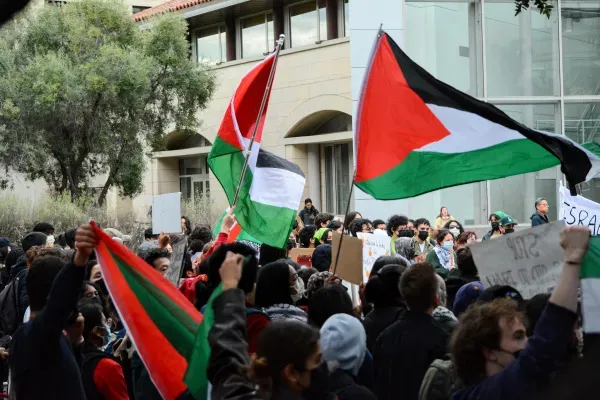
I still remember how quiet the chambers got just before we did the vote in March 2024. The dais of the East Palo Alto City Council. My year as Mayor. Four of us in the room — Councilmember Abrica was absent — raising our hands together to call for a ceasefire in Gaza. Our small city of 30,000, mostly Black, Brown, immigrant and working-class, became the first in San Mateo County to make that call.
We did not pass it because it was easy. We passed it because we had already watched, in the months leading up, the national discourse insist that to call for a ceasefire was antisemitic, that to name what was happening to Palestinian civilians was an attack on Jewish people. We refused that conflation. We refused it because moral clarity — the capacity to name violence against innocent civilians as wrong, regardless of which actor, state or otherwise, is perpetuating it — is not the same as moral selectivity.
Less than two years later, the same collapse is back at our doorstep. Only this time, the East Palo Alto Council is being asked to ratify it.
This week, the Council is being asked to adopt a proclamation against antisemitism that incorporates the International Holocaust Remembrance Alliance’s “working definition of antisemitism.” Let me be clear: fighting antisemitism is necessary and urgent. Jewish students, families and institutions deserve our unequivocal protection—in East Palo Alto and everywhere else.
But the IHRA definition is, in fact, the codification of the very collapse our ceasefire vote refused. It has been criticized—including, importantly, by many Jewish scholars, civil rights organizations and legal experts—for conflating criticism of the State of Israel with hatred of the Jewish people. To embed that conflation in our municipal policy is to tell our Palestinian, Arab, Muslim and allied neighbors that questioning a foreign government’s conduct is now functionally equivalent to bigotry. That is not a defense of Jewish life.
“Antonio,” some will say, “what’s the harm? It’s a non-binding definition.” But a “non-binding” framework, once adopted, becomes the language of training, of HR complaints, of grant compliance, of which voices get heard at public comment and which get gaveled out of order.
“Antonio,” others will say, “isn’t this just symbolic?” The ceasefire resolution put our community on the record at a moment when other cities were silent. It was also the proudest vote I cast as Mayor.
The timing makes this harder. Our city did not formally recognize Arab American Heritage Month, even as the San Mateo County Board of Supervisors did, along with dozens of cities in both San Mateo and Santa Clara County. And the current East Palo Alto Mayor brought this proclamation forward within days of attending an all-expenses-paid Combat Antisemitism Movement gathering in Savannah, Georgia. I am not making accusations. I am asking that we be honest about what a sponsored trip from a national political organization looks like to the people who actually live here. Sequencing matters. Sponsorship matters.
This is not abstract. East Palo Alto is the Black families who built it before there was an EPA to build. The Tongan and Samoan churches. The Mexican abuelas walking pan dulce home from Mi Pueblo. The Yemeni shopkeeper on University Avenue. The Palestinian family whose nightly news is also their family WhatsApp group. The Jewish neighbor who chose this city, in part, because it knows how to hold difference. A proclamation that elevates one community’s pain by chilling another community’s speech does not represent any of them. And contrary to what its proponents claim, it does not make Jewish residents safer. Hate that goes unnamed in one direction does not stay contained. It metastasizes.
The Council must remove the IHRA Working Definition from the proclamation. We are fully capable of condemning antisemitic hate plainly and forcefully, in language that does not double as a speech code. We must stay true to the identity and values of our community.
We must also eliminate our public alignment with the Combat Antisemitism Movement (CAM) gathering. Supporting Jewish safety is one thing. Lending our City’s name to a particular political organization is another, and it should not happen in the slipstream of a sponsored trip. CAM does not disclose its funding. Its board and senior staff include former Israeli government ministers, former Israeli Defense Forces spokespeople and a former chief censor of the Israeli military. In 2023, two of the most mainstream Jewish organizations in America—the Jewish Council for Public Affairs and the Jewish Federations of North America—withdrew from CAM’s coalition.
In the same proclamation, the Council must also reaffirm our commitment against Islamophobia, anti-Arab and anti-Palestinian discrimination and the targeting of any community in our midst. If we are speaking against one form of hate, we must speak against all of them.
This was never only about Palestine. The memory of the Holocaust should teach us, of all things, never to deprive a people of water, education and a homeland. To weaponize that memory in service of the opposite is not a defense of Jewish life—it is a betrayal of what that memory demands of us. The Council can condemn antisemitism without conditioning Jewish safety on Palestinian silence, without silencing the voices of those protesting apartheid, without forfeiting our right to critique a foreign government. That is what courage looks like in 2026.