
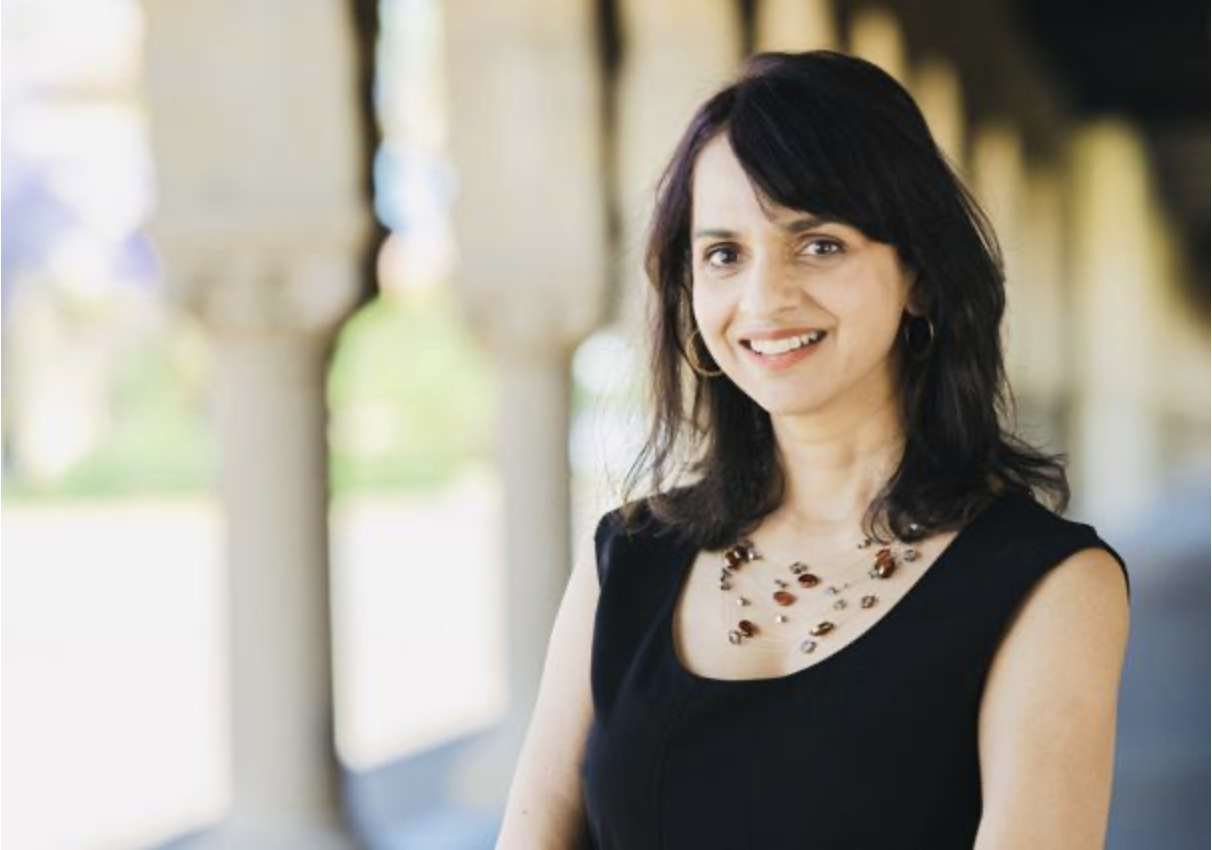
Jisha Menon, the Robert G. Freeman Professor of International Studies at Stanford, will end her term as faculty director of the Stanford Global Studies (SGS) division at the end of the academic year. She has held the role since 2021 and will chair the department of Theater and Performance Studies (TAPS), beginning in the upcoming academic year. She is a professor of TAPS and, by courtesy, of Comparative Literature.
Menon’s scholarship has been central to shaping interdisciplinary conversations on postcolonial theory and performance studies. Her first monograph, “The Performance of Nationalism,” is a foundational account of the theatrical dimensions of national identity as examined through the partition of the Indian subcontinent. Her second book, “Brutal Beauty,” traces the postcolonial city of Bangalore in the wake of economic liberalization, demonstrating how aesthetics can scaffold the undemocratic effects of neoliberal reform. She has also co-edited the books “Violence Performed” and “Performing the Secular.”
Menon wrote to The Daily reflecting on her transition between roles.
The Stanford Daily (TSD): As Faculty Director of Stanford Global Studies since 2021, what have been the most generative or unexpected directions the center has taken, and how have they reshaped your understanding of “the global” as an intellectual and institutional project?
Jisha Menon (JM): Over the past four years, my main goal as Faculty Director was to transform Stanford Global Studies from primarily an administrative umbrella into a more visible intellectual hub for global inquiry on campus. When I began the role, SGS already supported extraordinary work across fourteen regional and transnational centers and a network of more than 300 affiliated faculty. What it didn’t have was a strong institutional identity as an intellectual entity in its own right. Rather than simply coordinating existing centers, we worked to position SGS as a site of encounter, a place where scholars grounded in particular regions or disciplines could engage shared global questions together.
Through cross-regional initiatives such as Oceanic Imaginaries and collaborative programming, faculty and students increasingly began to think across traditional boundaries while maintaining the depth of area expertise that makes global inquiry meaningful. What was most rewarding was seeing how quickly faculty and students embraced this shift. SGS increasingly became an intellectual partner to its centers, not simply a support structure. In the process, “the global” came to be seen less as a geographic scale than as an institutional and intellectual practice: creating conditions that enable translation across difference, sustained collaboration and forms of inquiry responsive to an interconnected yet uneven world.
The challenges our students face exceed disciplinary and national boundaries, and leadership today requires building institutions capable of collaboration at that scale. My hope is that SGS continues to operate as a catalyst, preparing students not only to understand global complexity but to engage it responsibly.
TSD: Looking back, how have you navigated the tension between interdisciplinarity as an ideal and the practical constraints of institutional structures, funding and pedagogy?
JM: Interdisciplinarity works best when it is treated not as a slogan but as an institutional practice. Disciplines remain essential because they provide rigor, methodological training and intellectual depth. The challenge for universities is to create structures that allow scholars to move across those foundations without losing them. Both in my own research and in administrative work, I have learned that successful interdisciplinary collaboration depends on trust, sustained relationships and thoughtful institutional design: shared programs, stable funding and pedagogical spaces where different forms of expertise can genuinely meet and potentially transform one another.
As Faculty Director, I focused on building those conditions. Rather than invoking interdisciplinarity as an abstract ideal, we worked to create concrete opportunities for collaboration — including faculty global research workshops that brought scholars from different disciplines together with students in active research settings. By supporting these workshops and making them publicly accessible online, we expanded both participation and global reach, allowing interdisciplinary inquiry to extend beyond the campus itself. New research ideas often emerge at points of encounter, but they flourish only when institutions support intellectual risk-taking and curiosity. Our work in this context is less about directing collaboration than about designing environments in which collaboration becomes possible and sustainable.
TSD: As you step away from this role, what do you hope will endure from your term — and what remains unfinished, perhaps productively so?
JM: I hope what endures is the shift toward collaboration as an institutional habit. During my tenure, I worked deliberately to encourage centers to engage one another and to partner more broadly across campus. Universities tend to reward work within established units, but many of the most exciting intellectual developments occur when those boundaries become permeable. If SGS continues to function as a catalyst — bringing people together who might not otherwise have worked collaboratively — then I would consider that the most meaningful legacy of my time as director. What remains unfinished is also what makes academic institutions dynamic: the work of intellectual community-building is ongoing. The most productive institutional work is often creating frameworks flexible enough to support futures we cannot fully anticipate.
TSD: How do you envision the future of Stanford Global Studies in a moment where the very terms of “globality” are being contested, fractured or reimagined?
JM: In times of geopolitical uncertainty, global studies is more essential than ever. Even as political discourse becomes more polarized and more fragmented, the challenges confronting societies remain deeply interconnected. The future of global studies lies in cultivating what might be called “global thinking” — approaches grounded in specific histories and local knowledge while remaining capable of dialogue across borders and differences. This requires intellectual humility, sustained listening and an awareness of unequal power structures shaping global exchange. SGS helps model that form of engagement, preparing students to navigate complexity responsibly and to participate thoughtfully in an interdependent world.
TSD: In transitioning to your role as Chair of TAPS, how do you see your administrative and intellectual commitments evolving, particularly at the intersection of performance, politics and transnational inquiry?
JM: My work at SGS reinforced for me that intellectual leadership is fundamentally about creating conditions in which others can do their best work. I bring that same commitment to TAPS. I look forward to supporting research and artistic excellence, fostering collaborative intellectual cultures and encouraging scholars and artists to engage questions that extend beyond disciplinary boundaries. The arts have a distinctive capacity to engage polarized political realities because the arts cultivate empathy, listening and imaginative role-playing. Theatre, literature and the arts allow us to approach difficult questions through artistic and literary mediation, allowing difficult conversations to unfold productively. As chair, my goal is to strengthen TAPS as a space where creative practice and critical inquiry inform one another, and where performance serves as both artistic expression and a mode of global and civic understanding.
TSD: Across your work — as a scholar of performance and as an institutional leader — how do you think about the relationship between theory and praxis, especially within the university as a site of both critique and constraint?
JM: Theory and practice are most productive when understood as mutually constitutive rather than oppositional. One of the university’s distinctive contributions is its capacity to sustain reflection alongside experimentation. Within TAPS, we encourage scholars and artists to move between critical and creative registers — bringing analytical rigor to artistic practice while allowing creative work to expand scholarly imagination. The broader responsibility of the university is to cultivate habits of inquiry: careful argumentation, ethical reflection and the capacity to rethink established assumptions. In that sense, theory and praxis together sustain the university as a space not only of critique, but of possibility.