
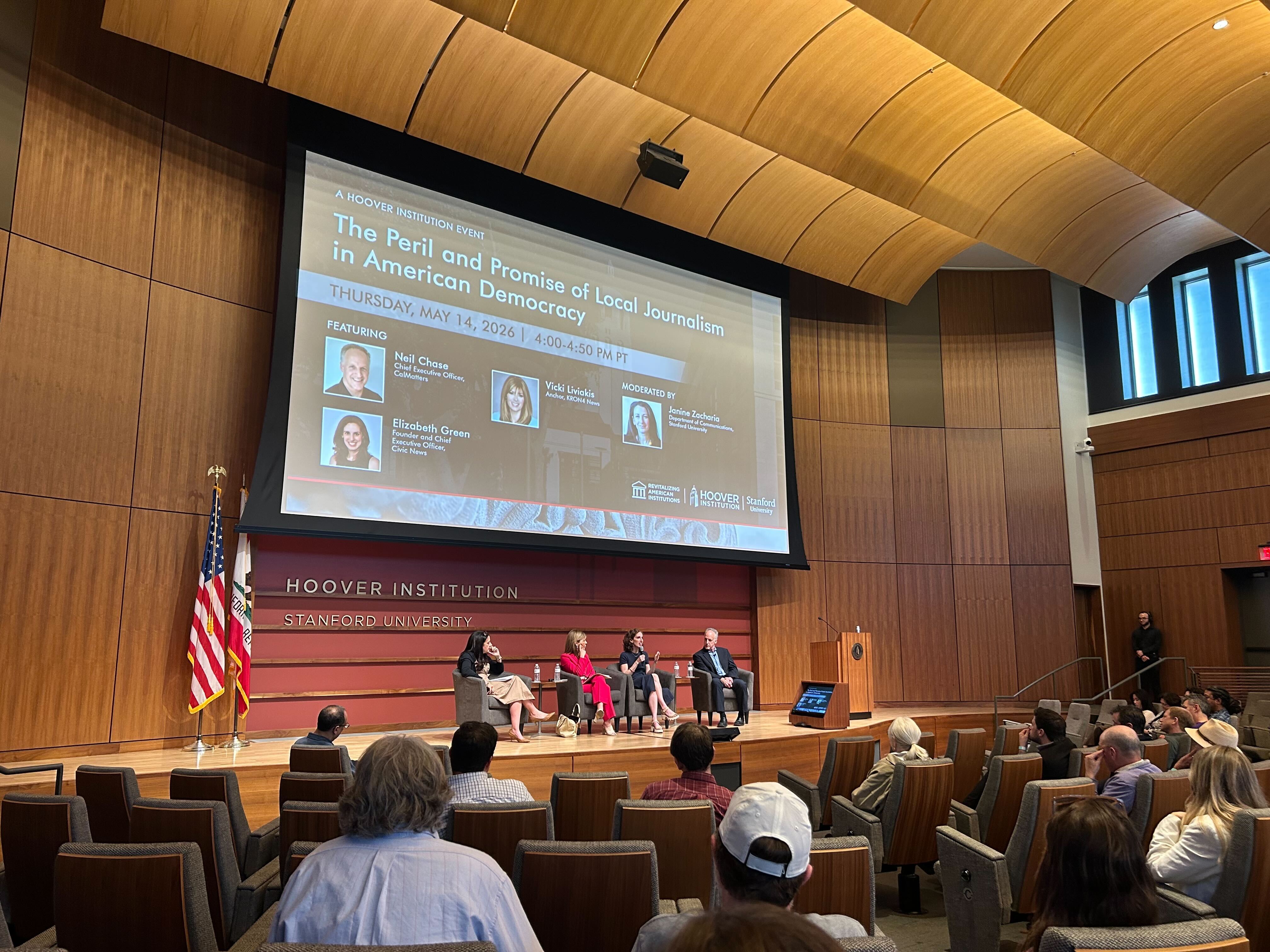
The changing media landscape brings new challenges and opportunities, said news executives and journalists in a panel hosted by the Hoover Institution Center for Revitalizing American Institutions on Thursday.
The event, titled “The Peril and Promise of Local Journalism in American Democracy,” brought CalMatters CEO Neil Chase, Founder and CEO of Civic News Company Elizabeth Green, and KRON4 news anchor Vicki Liviakis together for a discussion in Hauck Auditorium. It was moderated by communication professor Janine Zacharia, a former journalist for The Washington Post, Bloomberg, Reuters and other news outlets.
Speakers emphasized the need for news organizations to evolve alongside changing times by targeting a specific audience, adapting to new technologies and collaborating with one another.
“A lot of American institutions are being forced to change, and then they need to rebuild trust as they change,” Green said. “News is just one of those [institutions].”
Zacharia cited metrics from the Local News Initiative’s “The State of Local News” 2025 report: nearly 40% of all local U.S. newspapers have vanished in the last two decades and approximately 50 million Americans live in news deserts, where they have limited or no access to reliable news. She suggested these shifts carry major implications for the role of journalists in U.S. democracy.
Chase argued it may be harder to rebuild trust in the media at the national level, where individuals are divided between “red and blue,” but easier to do so at the local level, where there is a “more subtle differentiation” between their ideological positions.
“How do we solve the national problem? I’m not sure,” he said. “How do we solve the problem in the state and local things that we do? I think we’re in a better position to do that, by establishing trust with the journalism organizations and being physically present.”
Green highlighted the power of local journalism to reduce political polarization, noting that in communities with a local newspaper, there is less voting along party lines, down-ballot voting, and divisive dialogue.
The speakers encouraged journalists to carefully define and understand their audiences.
Green said Civic News has found that about 15% of Americans are civically active, and that members of this group have a higher demand for news than the average person. On this basis, she argued it is important to target the 15% because they act as “trusted messengers” who disseminate information to the rest of their communities.
“If you target everybody, you will reach nobody,” she said.
Chase added that it is no longer enough to simply put news “out there.” “You have to be equally conscious about who you’re trying to get it to, who would benefit from it, and what is the effect of people in your community getting it or not getting it,” he said.
Building on Chase’s point, Liviakis emphasized the need to “adapt to where the people are.” She said at KRON4, she and her colleagues are adjusting to new mediums, including streaming, podcasting and vertical video.
California Lieutenant Governor Eleni Kounalakis, who attended the event, said her biggest takeaway was that there is still enormous demand for accurate information, and that there are still a lot of smart, capable people who are drawn to journalism.
“There’s demand for high quality information. There are people who are out there delivering it,” Kounalakis said. “It’s really a question of, how do those voices compete with so much other noise in this attention economy?”
Another major theme of the discussion was collaboration between news organizations — a promising new avenue for the future of journalism.
“We all now understand a) we’re too small to do [journalism] on our own and b) there are brilliant people doing things,” Chase said.
He pointed to a partnership between CalMatters and other media organizations during the Los Angeles fires. Green similarly highlighted Civic News’ work with Chicago-based outlets during the city’s school board elections — work that produced an “astronomically high” voter turnout.
Attendee Hannah Bensen M.A. ’25, an alumna of the journalism master’s program, said she was especially interested in collaboration between news organizations as a potential way to bolster journalism. “I liked the framing that there are things to be excited about in journalism right now,” she said. “There’s a lot of negativity about the direction the industry is trending in, but I always want to hear about the solutions.”
At the same time, the speakers expressed concern about growing threats to reporters.
Chase said CalMatters receives threats to sue for every story they publish. He also voiced worry that the Department of the Treasury might decide news outlets no longer qualify as educational organizations under nonprofit tax code.
Liviakis noted that reporters not only face legal threats and harassment, but also physical violence. She recounted a time a KRON4 News security guard was killed, traumatizing a colleague of hers at the scene.
The speakers also called attention to President Donald Trump’s aggressive rhetoric toward journalists — in particular, when he said he wouldn’t mind if someone had to shoot through the press to get to him at a rally.
“It gives permission, right?” Chase said. “Someone thinks ‘If the president can do it, I can do it.’”
Despite these challenges, Zacharia maintained that journalism is “the best job on the planet.” “That’s why I’ve been here for 15 years teaching the next generation of journalists to go do accountability reporting, because I think our democracy needs it,” she said.
Liviakis echoed this sentiment. “We do this because we love it,” she said, “because we hope that we are able… to engage people and to have democracy live to fight another day.”