
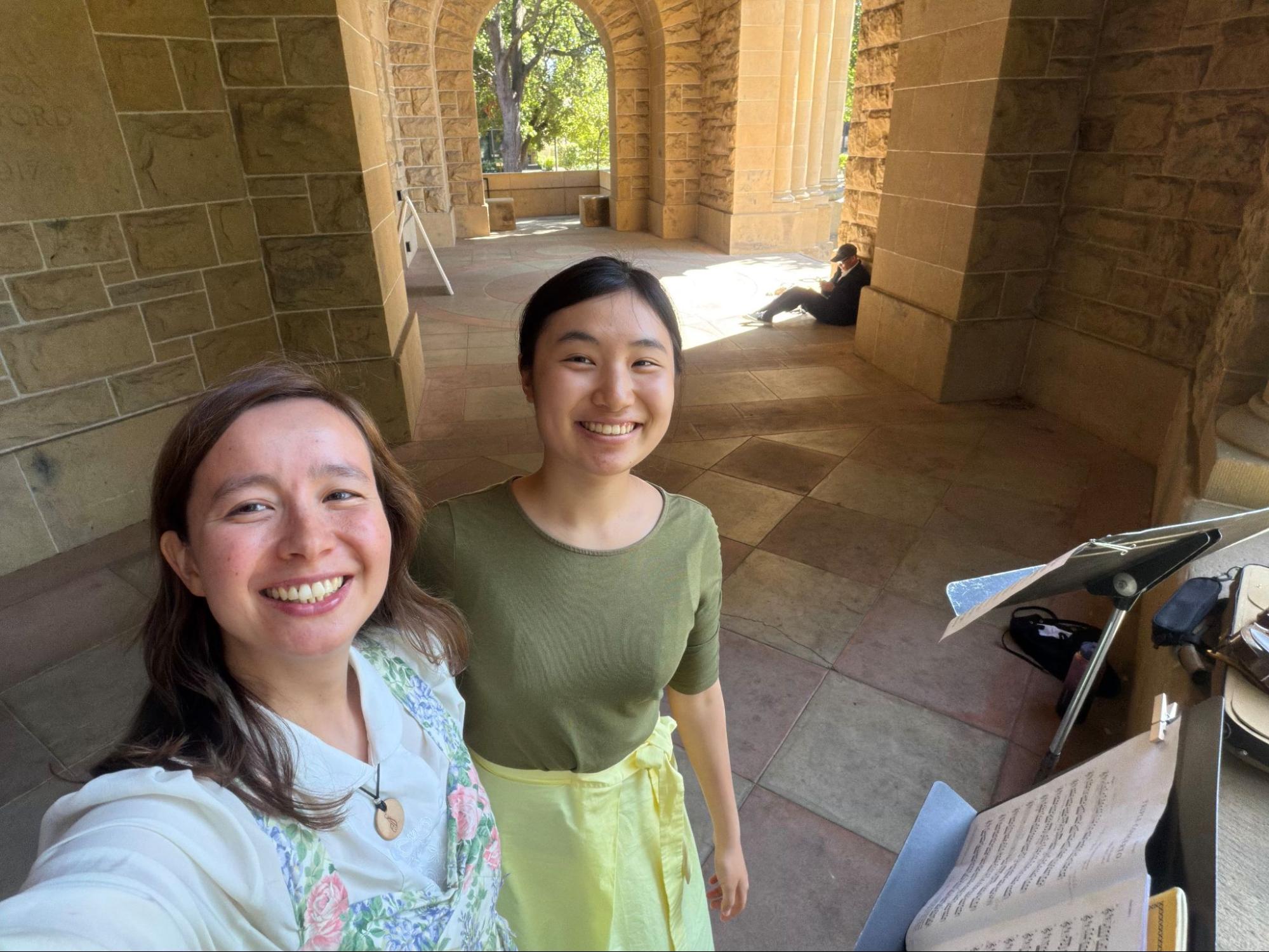
Last Sunday afternoon, I biked over to the Stanford arches, violin on my back. My friend was waiting for me, armed with two music stands, sheet music and fistfuls of binder clips. A couple of days ago, she had asked me if I wanted to sight-read duets in public. I had never thought of anything so fun before.
“Which one do you want to do first?” she asked brightly.
“Let’s start with the Mozart,” I said.
At first, I was acutely embarrassed by my sight-reading, wincing every time I hit a wrong note. But soon I shook myself out of it. Just enjoy the music, I told myself. After all, that is the only reason why we were doing this: for the fun of it.
As I relaxed into the flow of the music, my tone rang clearer and notes came easier. We were playing under the sandstone arches of the art gallery pavilion next to Main Quad. The acoustics resembled that of a church hall — resonant and clear. The voices of our violins blended together sweetly; the instantly-recognizable strains of “Eine Kleine Nachtmusik” floated in the air.
After every piece, we broke into huge grins and high-fived each other. “That was so fun!”
Passersby paused before the arches to listen to our music, their faces lit up in delight. A man who had been sitting nearby became our most supportive audience member, warmly applauding every piece.
***
In many ways, this moment encapsulated how my relationship to music had changed since I came to Stanford.
Music used to be my most important work. In high school, I practiced hours a day; I went to competitions, honor orchestras and summer festivals, and in my final year, auditioned for conservatory programs.
Then, it was over. Violin had “served its purpose.” If I so wished, I could never touch my violin again.
I was a bit dazed. I kept practicing, partially from momentum, and partially because I did not want to lose the skill I had honed with so much sweat and tears. One day in late senior year of high school, I remember walking into my lesson nervous that I had not made enough progress. After I played through the piece, my teacher looked at me for a moment. “Why do you still want to play? What do you want to do with the violin now?”
Suddenly, I found myself fighting back tears. It was a good question: I was not going to conservatory, nor was I majoring in music. “I… want to play in the orchestra at Stanford,” I managed to say. But really I meant, I want to keep on playing. It made me incredibly sad to contemplate the end of my time with the violin.
Of course, my time with the violin never ended. I joined the Stanford Philharmonia and continued taking private lessons. But the end of high school marked the end of my violin career. Never again would it be my main focus.
During much of freshman year, I was saddened by the little time I had to practice, frustrated by my lack of progress and in continual fear of technical decline. My violin professor made me realize that I was approaching music in fundamentally the same way I had before: by grinding one piece for an audition. But I could no longer spend hours practicing. And that approach did not make sense now, because I had no auditions; I was not practicing for anything. The only reason I was doing this was because I wanted to.
That realization was liberating. Instead of thinking I must practice an hour a day, I began to think, the Beethoven concerto is so beautiful; I want to play it well. I began to practice, not simply for fear of losing my skill, but for the love of the music. In short, I learned how to play the violin as a hobby.
Quite strangely, the moment I made this shift fully — the moment I let go of all sense of obligation and playing became something purely for enjoyment — I became a better musician, in every way, than I was before.
My journey with the violin is not unique. A rather strange and beautiful result of who Stanford chooses is that you will find musicians in the most unlikely places, many of whom pursued music at a high level before coming here. We all must choose what music means to us now. A few pursue it professionally, but most do not. We major in things like Computer Science (CS), or are pre-med, and struggle to find time with our instruments in the midst of all our responsibilities. But the fact that we do — that we play in orchestra or wind symphony, do chamber music, take lessons — means that our love of music has endured. Often, as in my case, it has grown.
I remember once complaining to my mom about why I spent so much effort on music in high school when I never intended to make a career of it. “It’s like you’re planting a tree, caring for it with all your heart for four years, and then leaving it to wither,” I said.
No, my mom replied. You are planting a tree that will stay with you for the rest of your life.
I realize now that she is right.
***
My friend and I finished our last duet. The man who had been listening to us the whole time comes forward with a song request. Laughingly, stumbling along, we gave it our best.
He applauded at the end. “Thank you, that was beautiful.”
As we left, he gave us each a bottle of water. It was a sweet token of appreciation. I was touched by how much he evidently enjoyed our music.
“Are you here regularly?” he asked.
My friend looked at me. “Every other week,” she said. “Sunday afternoons.”