
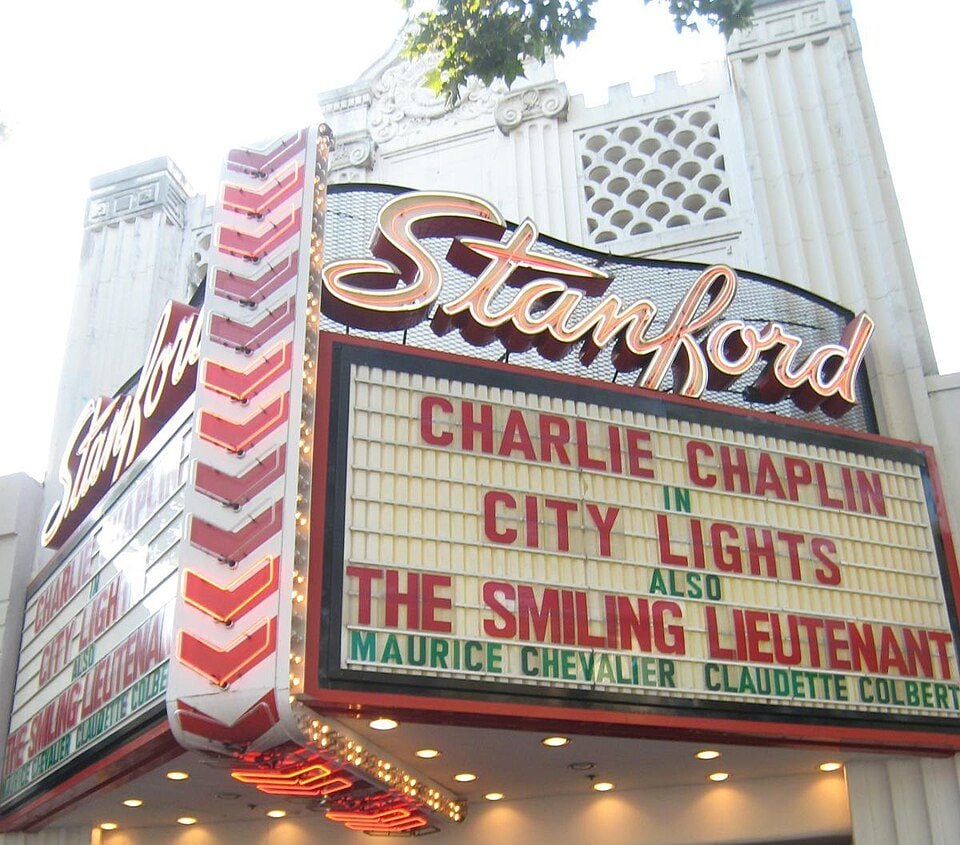
Walking down the crowded sidewalks of University Avenue, I can’t help but soak in the enchanting neon glow of The Stanford Theatre’s marquee, an artistic oasis in what sometimes feels like the cultural desert that is Silicon Valley. The theater and its iconic signage — the inspiration for the graphic of my own film column, “What I’ve Scene Lately” — cut through the Peninsula’s thick technomodernism like a refreshing beacon of historical memory.
Inching towards the gold-trimmed ticket booth for the first time earlier this quarter, I felt like an excited little kid. From ornate Persian and Moorish architectural details to dramatic crystal chandeliers, the lobby is like an art deco time capsule. Venturing into the theater, I was met by a sea of Cardinal-red velvet — luxurious seats, curtains and intricate drapery framing the screen — and the old-timey sound of a Mighty Wurlitzer organ. Soon, the carnival-like tune faded, the instrument descended from center stage into a cavern below, and the lights dimmed: showtime. Staring up at the 35mm projection of Hitchcock’s “Rebecca,” my mind wandered: is this what it would have felt like to be a Stanford student in 1940, before doomscrolling replaced movie-theater magic as the leading form of entertainment?
When I returned to my dorm that night, I took a deep dive into the Stanford Theatre. Sure, you could call me a “Civic, Liberal, and Global Education (COLLEGE)-reading procrastinator,” but I prefer “cultural historian” or perhaps even “investigative journalist.” My digging revealed a storied past. Built in 1925, the theater was the talk of the Bay, with local papers praising it as “the pride of the Peninsula.” Designed by San Francisco architecture firm Weeks and Day, the building reflected the extravagant tastes of the era and seated nearly 1500, making it one of the area’s largest venues. The movie-going palace saw a packed house on opening night, premiering the silent comedy “I’ll Show You the Town” (1925). The theater embodied American cinema’s Golden Era, a time when Hollywood studio giants reigned as kings of culture.
Over the decades, the theater’s role in the Palo Alto community evolved just as America’s relationship with film did. Opening during the transition from silent films to “talkies”, the Stanford Theatre — equipped with a lavish orchestra pit for accompanying silent films — had to embrace the advent of synchronized sound and pivot from its original design to keep up with the times. Throughout the 1930s and 40s, the establishment was the heartbeat of downtown nightlife. Attending was a social ritual: families wore their finest for evening screenings and college sweethearts frequented the premier date spot.
Like many single-screen theaters, The Stanford began to see its decline after World War II. By the 1950s, television brought entertainment into people’s living rooms and the spectacle of the movie theater faded. Across America, historic theaters were demolished and converted into office buildings, retail store fronts and parking lots. Facing waning attendance, the Stanford Theatre fell into ruin. Come the 1980s, the organ had been dismantled and sold for parts and the once-grand interior had fallen into despair. It seemed inevitable that the community’s former downtown darling would meet the same fate as its contemporaries.
However, The Stanford Theatre’s plot took a turn for the better when, in 1987, David Woodley Packard — classic film enthusiast and son of Hewlett-Packard cofounder David Packard — organized a Fred Astaire film festival. An enthusiastic turnout inspired the Packard family to preserve this gem of Palo Alto history. Upon purchasing the theater, The David and Lucile Packard Foundation restored it to its former glory. The Stanford reopened in 1989 with a screening of “The Wizard of Oz” (1939).
Following its revival, the theater became a highly successful nonprofit operation. Emphasizing historical authenticity (35mm projection, live organ performances, vintage intermissions, double features, etc.), the theater gained national fame among film lovers, accounting for roughly a quarter of all classic film attendance in the United States. In 1992, on the 50th anniversary of “Casablanca” (1942), more people saw the Humphrey Bogart classic at the Stanford Theatre than anywhere else in the country.
So why has this blast from the past become a national cultural sensation, despite being surrounded by venture capital, tech startups and streamers?
Some might draw parallels to the Renaissance’s patronage system and banking-backed artistic rebirth. I see it as an analog sanctuary, a rebel with a cause, “The Last Picture Show.” In a time starved of togetherness and grounded reality, the last thing people want is the alienating experience of watching an endless stream of media alone on their phones. We want connection. We want to collectively feel emotions as part of an audience. In an AI-obsessed world of convenience and formulaic regurgitation, we want 90 minutes spent embracing the beauty of craft and human storytelling.
The next time I feel the movie itch, I’ll trade the Netflix “tudum” for the Mighty Wurlitzer. I’m willing to pay seven dollars — that’s right, the price of your Voyager order — to experience traditional moviegoing. Even if you can’t find time to enjoy one of the Master of Suspense’s masterpieces during this month’s Hitchcock series, visiting The Stanford Theatre is a must. Maybe give up the midday Coupa fix for a day and taste a slice of Palo Alto’s cultural history.