
Editor’s Note: This article is a review and includes subjective thoughts, opinions and critiques.
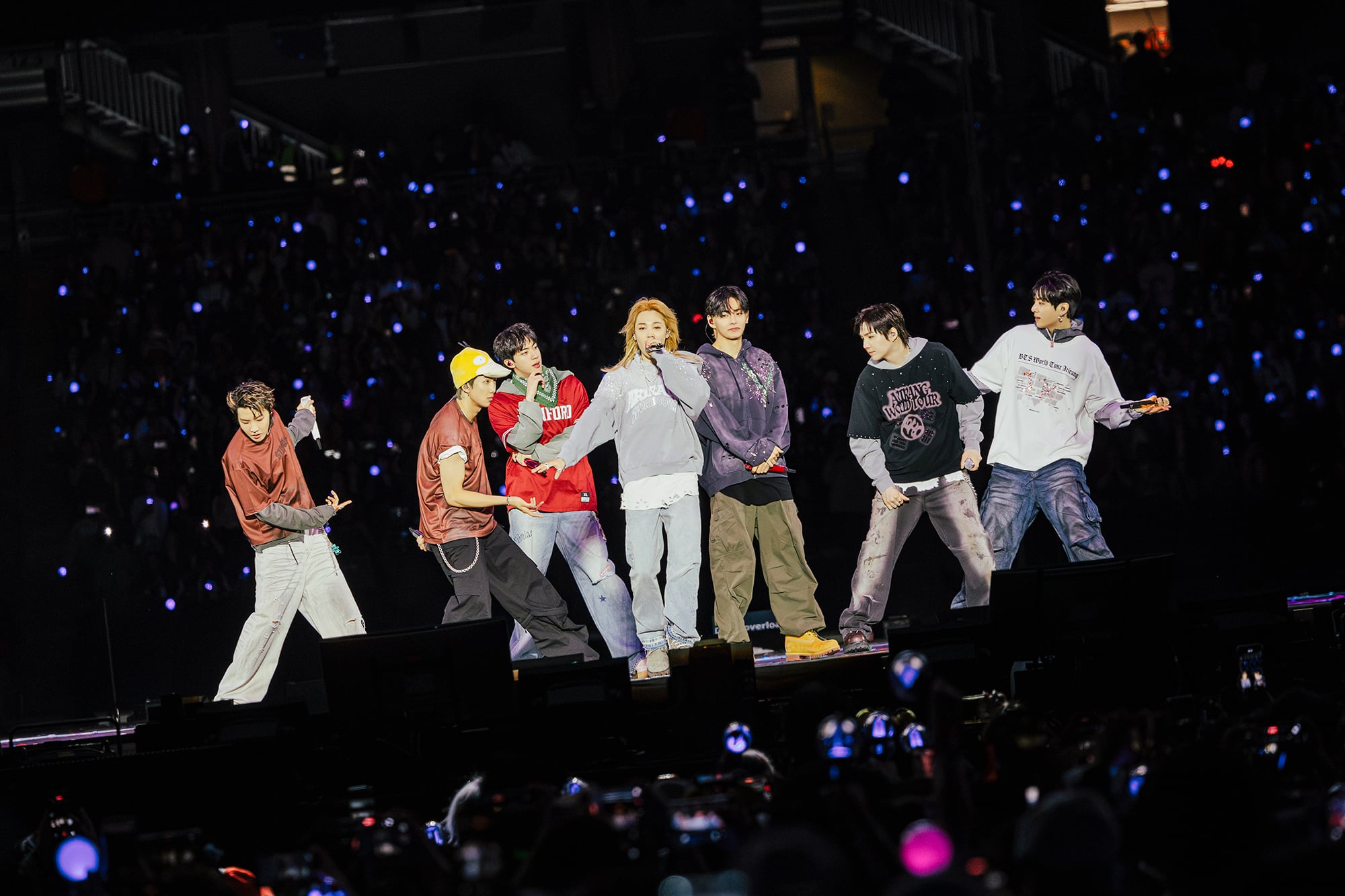
BTS launched the first of three sold-out ARIRANG World Tour performances at Stanford Stadium on Saturday, marking the group’s long-awaited return to large-scale touring after nearly four years away. Originally, BTS was only slated to perform Saturday and Sunday — a Tuesday show was added following staggering demand. Between South Korea’s mandatory military service and the cancellation of the “Map of the Soul” world tour, BTS fans (also known as ARMY) have been waiting far longer than expected to see the seven-member K-Pop group perform together again.
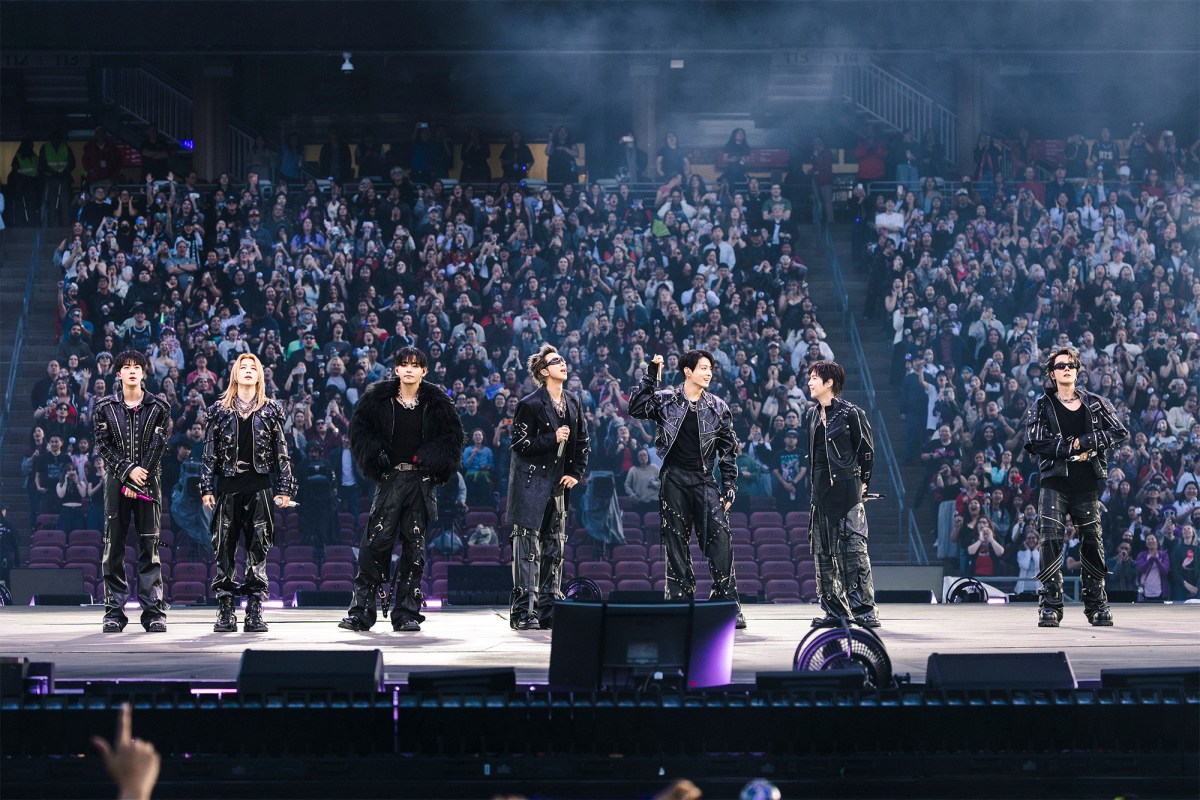
Minutes before the show’s scheduled start, Stanford’s stadium already felt electric. Tens of thousands of fans — many of them Stanford students, many from out of town — stood screaming toward an empty platform, reacting to visuals of traditional Korean motifs on the giant screens as though the concert had already begun. Light sticks waved. Phones remained fixed toward the stage in anticipation. When red smoke finally drifted onto the stage ahead of the opening song, “Hooligan,” the reaction felt immediate and deafening.
The screaming rarely stopped from there. Every member’s entrance prompted new cheers. Vocal highlights drew shrieks loud enough to rival the music itself; even smaller moments sparked excitement. A smile, quick interaction or close-up on the screens often triggered another round of cheers from the crowd. As someone who entered the show knowing remarkably little about BTS, the emotional investment from fans felt impossible to ignore.
To be precise, my BTS knowledge extended to exactly two songs: “Dynamite” and “My Universe,” with the latter being the group’s collaboration with Coldplay. I also embarrassingly thought “Butter” was called “Sugar.” Still, curiosity led me to attend the first night of BTS’ Stanford run, only the second major concert residency at Stanford Stadium following Coldplay last spring.
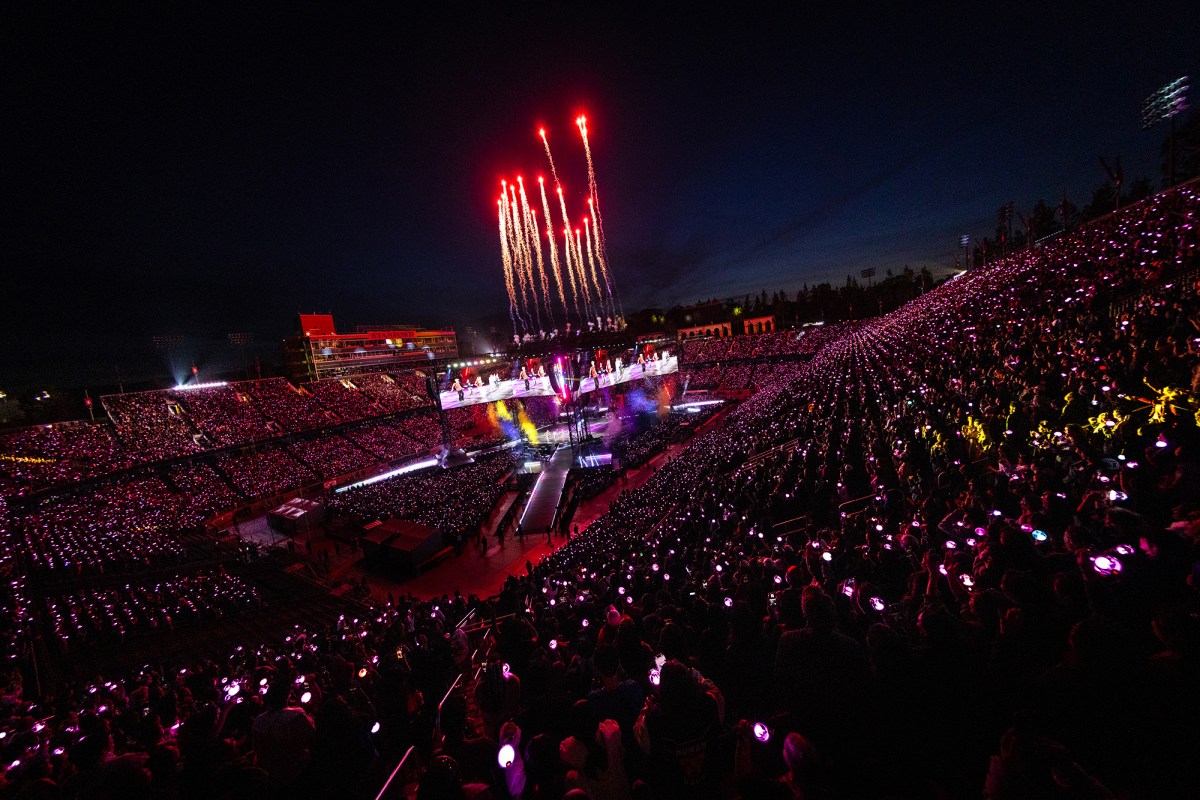
Pyrotechnics and fireworks punctuated major moments throughout the evening while an elevated circular stage rotated through the stadium. By the time BTS reached a remixed version of “Run BTS,” the third song of the night and unexpectedly one of my personal favorites, the electric energy inside Stanford Stadium had fully settled into place.
Even without recognizing much of the setlist, the performance itself proved surprisingly easy to enjoy. Daniel Xu ’29, a news desk editor for The Daily, initially attended Saturday’s performance as a casual observer. “The concert made me a fan,” Xu said, praising BTS’ “timing, intentionality and ability to tap into the mood of the audience.” For Xu, the performance became “a reminder that sometimes, artists can bring people together as much as a nation state.”
Stanford Stadium’s 10 p.m. curfew created one of the evening’s more unusual dynamics. Since the show began shortly after 7 p.m., much of the first half unfolded in broad daylight. The sunlight gave the concert an unexpectedly casual atmosphere, but also muted parts of BTS’ visual spectacle. Thousands of light sticks glowed throughout the crowd despite a staggering $69 price tag before batteries, but their effect initially struggled to fully register against the bright California sky. Fireworks and stage lighting similarly lost some impact.
BTS themselves seemed fully aware of it. Early in the evening, band leader RM joked that performing while the sun was still out felt “a little embarrassing,” laughing with the crowd before saying the night would still be unforgettable. The group also openly acknowledged the language barrier early on, promising to make the evening memorable regardless.
The concert unfolded in distinct acts. Black outfits eventually gave way to brighter streetwear as the set moved toward hip-hop influences, including “2.0,” a Mike WiLL Made-IT-produced track. “Merry-Go-Round” closed the first act, accompanied by visuals that transformed Stanford Stadium’s video boards into something resembling the song’s title.
Remixed versions of “Fake Love” and “Not Today” brought renewed energy to the second half of the performance, while “Body to Body” introduced digital flags onto the stage in one of the evening’s more visually striking moments. Towards the end of the second act, stadium screens briefly shifted toward fans themselves for the first time, capturing emotional reactions throughout the crowd and turning the audience into part of the show.
Saturday’s audience also received two surprise songs (“N.O” and “Anpanman”), a rotating tradition unique to each show and one that longtime fans around me greeted with immediate excitement.
Dayanara Yepez Ramirez ’28, a columnist for The Daily who attended Sunday night’s performance after following the band for nearly a decade, described finally seeing the group live as “absolutely surreal.”
It made them “think back to when I had a whole Instagram fanpage for [BTS],” Yepez Ramirez said. As a self-described “Yoongi bias,” they especially cherished seeing SUGA smile throughout the show and later changed their Instagram profile picture to a photo of him wearing a Stanford cap on stage.
That wasn’t the only nod to the Farm: At one point, band member V jokingly asked whether anyone in the crowd actually attended Stanford before adding, “Can I join Stanford?”, prompting cheers from the audience.
Though minor imperfections occasionally surfaced, including broken pixels on one of the screens and members’ visible reliance on teleprompters during speaking moments, those details rarely distracted from the evening.
BTS closed Saturday’s performance with “Into the Sun” as confetti drifted across the stadium and fans lingered in the moment. For a show that had heavily relied on fireworks and pyro throughout, the absence of one final burst of spectacle felt somewhat surprising. Still, the quieter ending shifted focus toward the members’ final moments with the crowd.
For some students, the weekend carried meaning beyond the performance itself.
“As a senior it felt like a truly full circle moment for me to listen to the songs I once did 10 years ago with the friends I made in just the last few years,” Ninjin Bayarjargal ’26 said. “I was emotional about the growth of both myself and those around me and BTS’ growth and return to the stage.”
“We are all on our little journeys and I’m grateful to everyone at Stanford who made this possible,” Bayarjargal said.
As the night sky finally emerged above a sea of light sticks and fans screaming toward a stage they had waited years to see occupied again, the appeal became easier to understand.
With one Stanford Stadium performance still remaining Tuesday night, the opportunity feels like far more than another concert stop. For longtime ARMY, it is an eagerly-anticipated return. For newcomers like me, curiosity alone may be enough reason to understand the magnetism that has kept fans waiting for a moment like this.