
Nick Miller ’29 is a Political Science student at Stanford. He approaches contested campus topics through data and primary sources.
When the Muslim Student Union (MSU)’s $175,000 ASSU funding request appeared on the spring ballot, it sparked public outrage. Posts flooded Fizz, including, as the Daily reported, posts with Islamophobic tropes. The MSU and its allies used that ugliness to frame all criticism as bigotry, a label that proved effective at shutting down conversation without addressing the underlying question: does the MSU actually need $175,000 of mandatory student fees to operate?
According to the data, they do not.
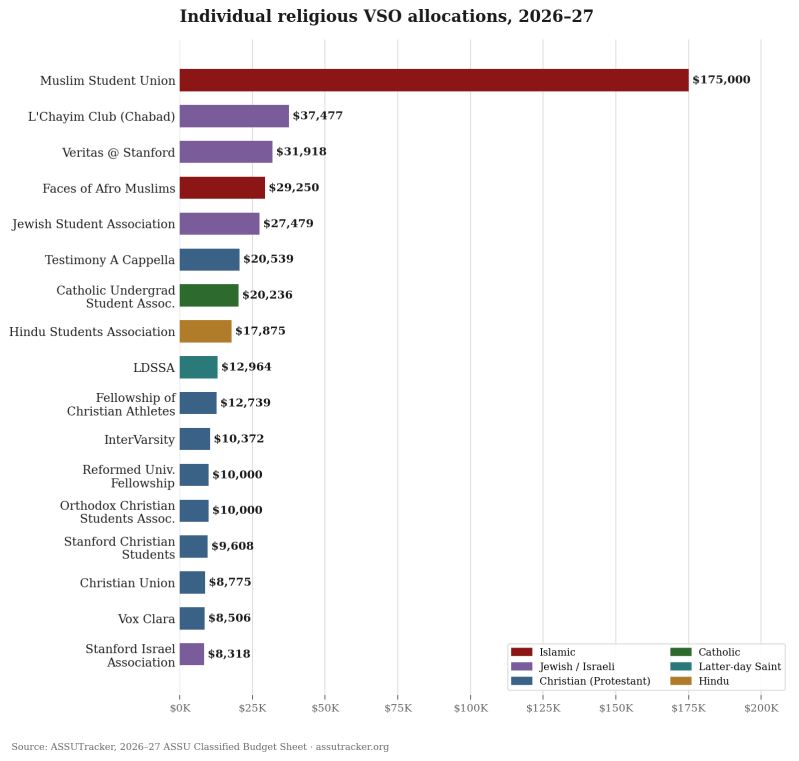
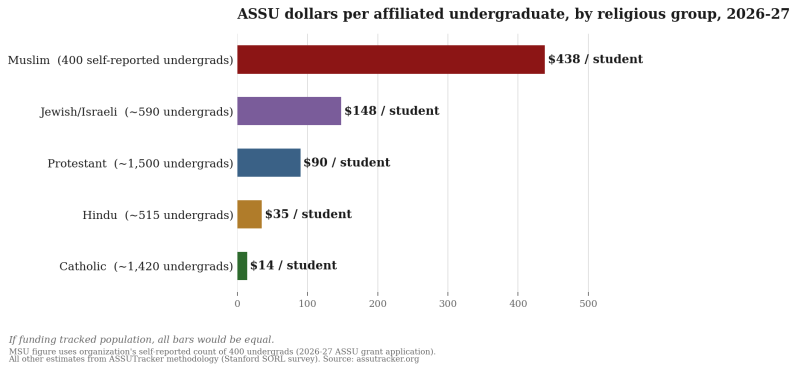
The funding request was approved, making MSU the fourth-most-funded group among 253 clubs, placing it ahead of Alternative Spring Break, The Stanford Daily and The Stanford Robotics Club. When combined with Faces of Afro Muslims, the total funding allocation to Islamic groups rises to $204,250. At the individual level, the ASSU directs roughly $438 per student toward Islamic-category programming, whereas Catholic students receive $14.
The application is public record. Of the $175,000 approved, roughly $138,500 (79%) is food. Ramadan programming alone accounts for $80,000, with $69,000 of that going toward nightly iftars. At the Stanford Political Union’s “Stanford and Religion” event, students pointed out that many dining halls close at 8, preventing Muslim students from eating dinner during Ramadan. However, Vish Karthikeyan ‘27, a Stanford Dining employee, disputed that directly via email: “Stanford offers Suhoor and Iftar meals in Wilbur and Lakeside from sunset to 8:30 p.m. As an employee of Stanford Dining, I know this to be true. I am not sure why the MSU feels the need to spend thousands of ASSU dollars instead of making use of this service, which they claim to be non-existent.” The MSU’s application makes no mention of Stanford Dining’s existing Ramadan provisions.
Also, MSU’s original request was not $175,000. Rather, it was $196,654, $57,541 over the 4% annual increase cap. The application was returned for revision before being resubmitted and approved. Stanford Law professor Michael McConnell, who argued Rosenberger v. University of Virginia before the Supreme Court, called funding disparities like these “a red flag” in an email. “Religion is regarded as a viewpoint,” he wrote, “and the government must be viewpoint-neutral when a program is a ‘public forum.'” More pointedly, he noted that recent Free Exercise decisions hold that the government cannot deny funds to an eligible activity solely because it is religious, meaning the real question is whether other religious groups have sought comparable funding for meals and meetings and have been turned down. The issue is not whether religious groups receive funding. They do. The issue is proportion.
The application reveals more. The ASSU asks two direct questions:
Does the organization have savings or funding from non-ASSU sources? No.
Has the organization sought funding from non-ASSU sources? No.
No justification is offered for either answer. The ASSU’s own policies state that ASSU funding should be a last resort. According to their own application, they did not seek support from alumni, outside organizations or benefactors.
Cru, which has a chapter at Stanford, operates at over 1,500 US campuses on a national staff-support model. The Catholic community draws on Archdiocesan funding, and the contrast becomes clearest at the margins: the Latter-day Saint Student Association (LDSSA) operates on $12,964 in ASSU funding, less than the MSU’s $15,000 post-Jummah pizza line item. When asked whether the Stanford Institute of Religion’s nearby building reduces their costs, LDSSA leadership was direct: “The Stanford LDSSA does not control the space, its scheduling, or its use.” Without ASSU funding, they wrote, “we would be unable to fund any of our programming.” They run a full calendar of student programming for what the MSU spends on pizza.
The MSU need not even become a 501(c)(3) to receive outside donations; no legal structure is required. Ari Kelman, a professor of forms and practices of religious knowledge transmission, put it plainly: “There are, to my knowledge, no legal obstacles to establishing campus-adjacent programs for either religious or cultural or national or ethnic groups. Why haven’t Muslim communities organized to support and run them? I don’t know. It is a very good question.”
The MSU has the capacity to find outside donors. The Pillars Fund, a Muslim-American grantmaking foundation backed by the Ford Foundation, the Kellogg Foundation and MacKenzie Scott, has distributed over $15 million to Muslim organizations since 2010. Notably, its founder was inspired by a workshop at the Stanford University Center for Philanthropy and Civil Society. Closer still, the American Muslim Community Foundation, the country’s first grassroots Islamic community foundation, operates grant programs specifically for Muslim organizations in the Bay Area. MSA National, the national umbrella organization of which the MSU is an affiliate, itself raises funds from individual donors and grant-making foundations. The infrastructure exists. The MSU answers, via omission, whether any of this available funding was pursued.
The MSU brought this scrutiny on itself, not by existing, not by serving its community, but by submitting a nearly $200,000 request, getting sent back for exceeding the cap, not pursuing a single alternative dollar and then calling anyone who asked a question a bigot. The question was never whether MSU belongs on campus. It was whether $175,000 in mandatory student fees was the right mechanism to sustain it, and whether anyone thought to ask if there was another way.