
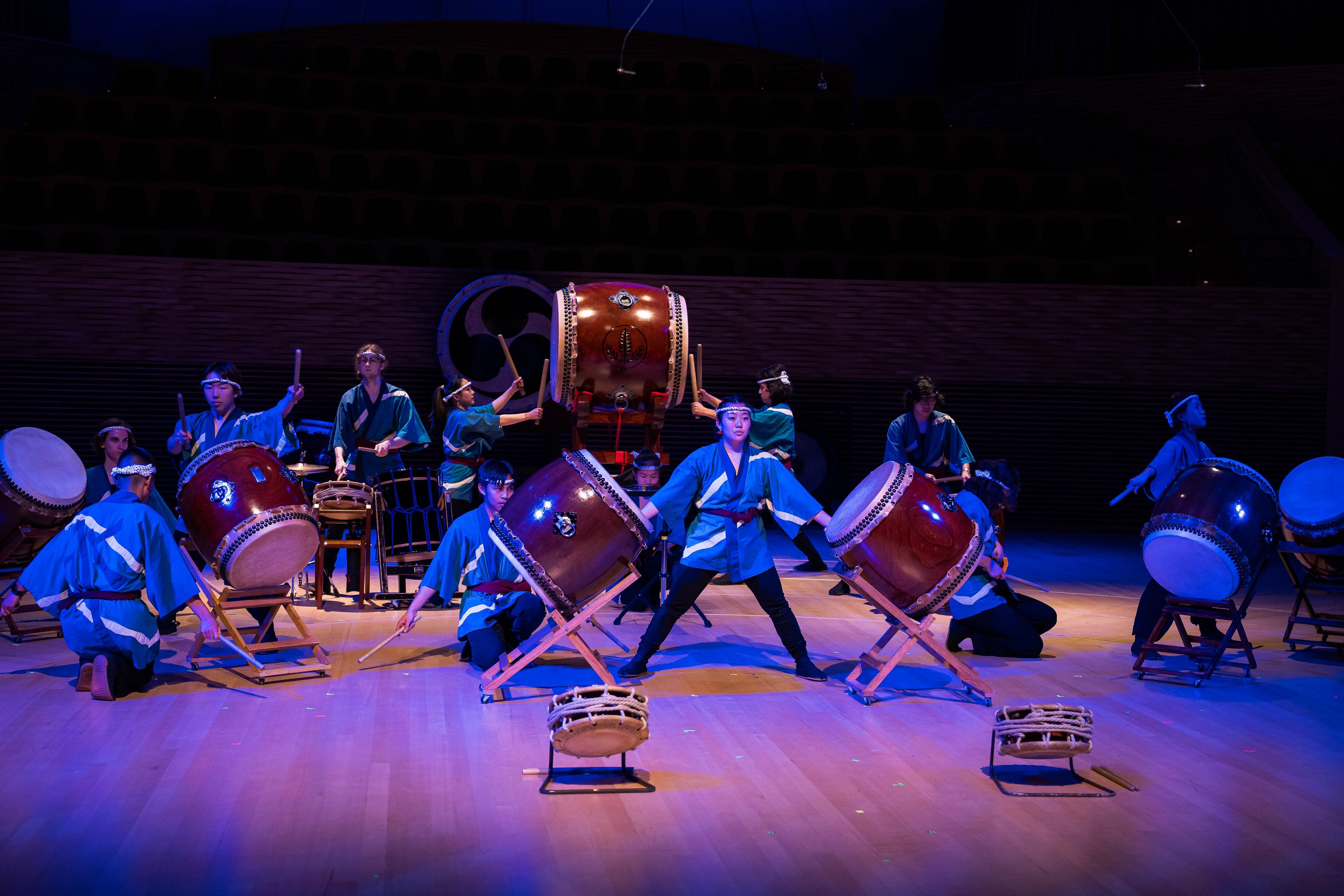
Second year Ph.D. student Yuka Tatsumi, co-president, co-logistics coordinator and webmaster for Stanford Taiko (ST), still remembers her first time watching a taiko performance in middle school. The music was “not just sound, not just [a] visual performance — it was a whole-body sensory experience.”
For the uninitiated, taiko refers to a centuries-old traditional style of Japanese drumming. Dan Kubota ’27, ST’s co-president and co-logistics coordinator and a writer for The Daily, described taiko’s unique position within Japanese culture as going beyond an art form.
“It lies [at] the intersection of art and athleticism. It reminds me a lot of dance — it’s very physically intensive but at the same time it falls into performing arts in terms of music,” Kubota said. “The art form definitely wouldn’t be what it is without the culture that it came from.”
Teisha Rei Nishimitsu ’26, co-performance director and co-tour coordinator, provided a more ambiguous outlook.
“Personally, I don’t know if it is possible to define what ‘taiko’ is, as it is ever-changing like every art form and tradition,” Nishimitsu wrote to The Daily. “However, I think the impact of taiko lies in its history and its community. It is incredibly important that no matter how taiko persists in the coming years, we remember its roots in Japan, America and Japanese Americans.”
Auditions for ST occur in multiple rounds during fall quarter, after which members obtain a unit of course credit when beginning in the winter. Unlike most taiko groups, Tatsumi said, ST’s 22 members “all train on every instrument [owned by ST]. In other words, they are expected to be able to play any part of any song.” That said, each member often becomes known for preferring a particular instrument or style.
Though such a practice might seem daunting to new members, Tatsumi explained more practically what this looks like for members with no experience with taiko.
“Students without a taiko background can definitely pick it up — in ST, the older members spend a lot of time teaching first-years in the fall, and all first-years debut at our annual first performance in mid-January,” Tatsumi wrote.
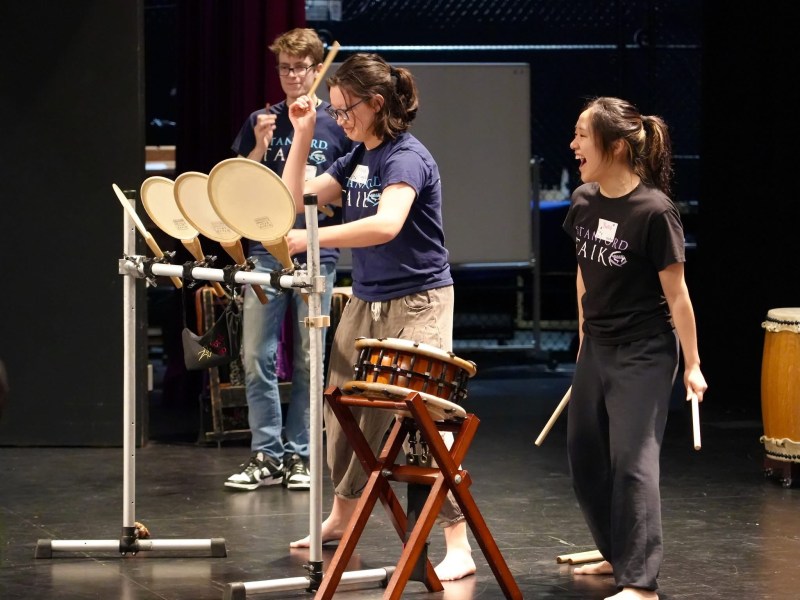
ST often accompanies students throughout their undergraduate journey, greeting them with a performance at Admit Weekend and at the end of their journey during Baccalaureate.
Nishimitsu added that some members’ lack of experience can be inspiring due to their “tenacity and dedication.”
“The majority of our group has no prior experience, and yet everyone is so motivated and passionate about learning how to play taiko,” Nishimitsu said. “Their energy reminds me of the joy that taiko can bring out in others and how vibrant and supportive the greater taiko community is.”
Nishimitsu, Kubota and Tatsumi all agree that the deep cultural foundation of the art has helped them further their connection with their heritage.
Nishimitsu, who is gosei (fifth-generation Japanese American), said she “grew up feeling connected to [her] Japanese heritage, as a lot of the culture was inherently a part of local Hawaii practices,” where her family arrived from Japan in the late 1800s. She is particularly interested in taiko’s role in expressing the struggles Japanese Americans faced during World War II, as it “became a striking voice [for] a community seen as soft-spoken.”
Tatsumi, who was born in Nara, Japan and was raised in Kyoto, said she has struggled with not feeling “Japanese enough” after studying for nine years in America.
For her, taiko “has become one way for [her] to stay connected to her culture … while also learning more about Japanese American culture and history.”
Tatsumi is especially proud that “taiko in North America also has a history of being connected to women’s empowerment, breaking the expectation that women should stay quiet or small.” Beyond the genuine joy of making art, taiko is a way for Tatsumi to remind herself that it is “okay to be loud, strong, and heard, especially as someone who identifies as female and Japanese.”
Though these members of taiko all come from a Japanese background, the community is open to everyone on campus, including those who do not identify as Japanese or Japanese American, Kubota and Tatsumi said.
“Stanford Taiko welcomes students from absolutely any background,” Tatsumi wrote. “Some members have a personal or cultural connection to Japan, while others … are drawn to the musicality, the performing arts aspect, the physicality or the community.”
Kubota, who is Japanese American, highlighted her ancestors’ sacrifices, her family’s help and how it inspires her to use taiko as a storytelling art.
“I think at Stanford we almost have a responsibility to tell stories and to be joyful, loud and take up space,” Kubota said. “Especially since this is an institution that didn’t necessarily want us here, given Stanford’s dark past with eugenicists among other things.”