
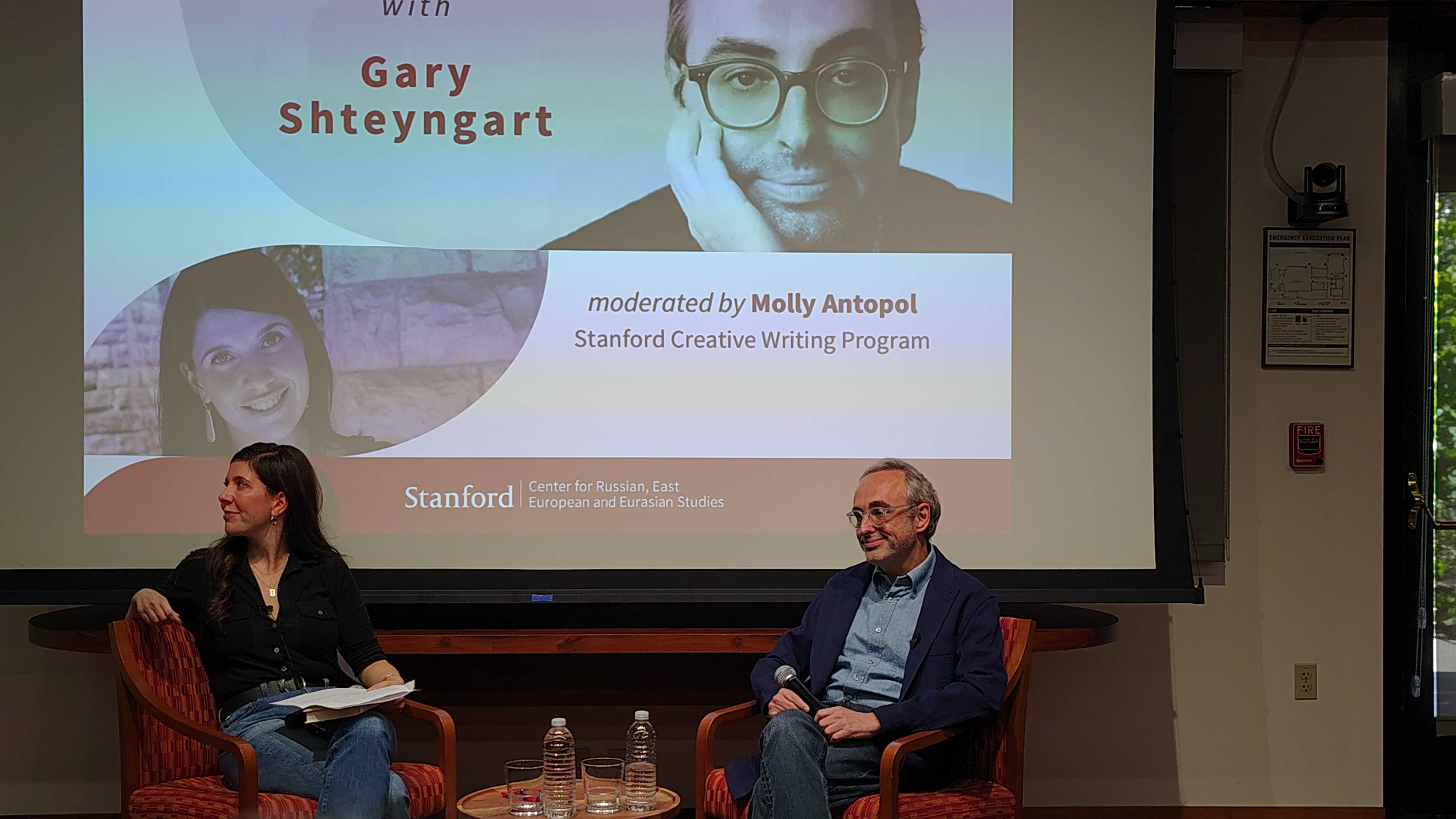
Bestselling satirist Gary Shteyngart drew a packed audience to Levinthal Hall on May 13 for a conversation about his latest novel, “Vera, or Faith,” in the context of American identity, Russian literary influences and what he described as the country’s “very weird and sort of dark moment.”
A Soviet-born American writer, Shteyngart is known for his satirical works on the Russian immigrant experience in America. For this event — hosted by the Stanford Humanities Center as part of the Helena Brandt Visiting Scholar Program and co-sponsored by the Center for Russian, East European and Eurasian Studies, the Stanford Creative Writing Program and the Taube Center for Jewish Studies — Shtyengart discussed Soviet and post-Soviet life with moderator and assistant English professor Molly Antopol. The event included a signing of Shteyngart’s recent books, including: “Super Sad True Love Story,” “Lake Success” and “Vera, or Faith.”
Antopol opened the event by recalling reading Shteyngart’s debut, “The Russian Debutante’s Handbook,” praising his “enormous heart for every single person on the page” and his ability to make readers laugh and weep “in a single paragraph.”
Shteyngart then read an excerpt from “Vera, or Faith,” a novel told through the eyes of a half-Korean, half-Jewish 10-year-old who keeps a diary of words whose meaning she doesn’t yet know.
The shift to writing from a child’s perspective was a first for Shteyngart.
“I never thought I’d have a kid,” Shteyngart said. “Then I had a kid, and I thought, you know, ‘I need a little return on investment.'”
Vera’s anxious cataloguing of unfamiliar words mirrored his own immigrant childhood, he told the audience, when his parents, like other Soviet émigrés trying to learn English, wrote vocabulary on IBM punch cards: English on one side, Russian on the other.
He also recounted writing his first book at age five, “Lenin and His Magical Goose,” commissioned by his grandmother, an editor at a Soviet newspaper, who paid him in pieces of cheese.
Throughout the evening, Shteyngart described himself as a “SAP,” short for Soviet Ashkenazi Pessimist, which is a worldview he traced to a childhood spent absorbing whispered jokes at the kitchen table about Brezhnev and the Olympics.
Several of his novels, including “Super Sad True Love Story,” published in 2010, discuss what he perceives as American technological and political decline.
“For me, it’s not even that the glass is half empty — it’s like there’s no glass. It’s just a table,” Shteyngart said.
His reflections on contemporary crises also included COVID-19, which inspired his 2021 novel “Our Country Friends,” where he described the pandemic as oddly generative. Similarly, asthma gave him a different relationship to the disease and to mortality more broadly.
Shteyngart said that fiction does not necessarily have an obligation to engage with current politics, but that “If you look at the world around us right now, the responsibility of art is to document what is happening to the human soul under these insane pressures.”
Pressed on book bans and recent corporate pressure on late-night satirists, he didn’t soften his assessment: “It’s very Putinesque, if you will, very Orbanesque. Going after comics — especially not funny ones like Kimmel — is very depressing.”
He continued: “When a country decides to change its modality, its way of thinking and its relationship to democracy, it all falls apart.”
At the discussion portion’s conclusion, Ayaan Dhruv, a 10th-grade student at the Nueva School in San Mateo, opened the audience Q&A by asking Shteyngart, “Can you describe a little bit about your writing process?”
Shteyngart advised that aspiring writers limit themselves to two or three hours of work daily.
“It doesn’t get better after that — it gets worse, in fact,” he said. “I write like Proust. I write in bed. I never leave bed.” Shteyngart described a routine of morning writing, long afternoon walks, a session with his therapist and what he called “the crying hour” at a bar with fellow writers in Manhattan.
Shteyngart shared that he also takes an immersive approach to his craft: For his book “Lake Success,” he rode a Greyhound across the country, like the book’s protagonist, and spent four years embedded with hedge fund managers. “Their wives would often reach out to me,” he said. “They’d be like, ‘You want to talk to my husband? He is crazy.'”
When asked by Dhruv about the influence of Soviet dissident writers on his own work, Shteyngart highlighted Solzhenitsyn’s early work — “‘Ivan Denisovich’ and ‘Cancer Ward,’ all those novels were incredible” — and Nabokov, whose “Pnin” he called his favorite novel of all time and a staple of the humor seminar he teaches at Columbia. He recommended Sergei Dovlatov’s “The Compromise” as his favorite Soviet-era novel, named Ivan Turgenev’s “Fathers and Sons” as his favorite work of 19th-century Russian literature and acknowledged Nikolai Gogol’s “Dead Souls” as a massive influence.
He framed the trajectory of American literature as one of necessary widening and diversification. “As America changes, so does its literature,” he said, citing his mentor, English professor Chang-rae Lee, alongside Pulitzer Prize-winning authors Junot Díaz and Jhumpa Lahiri.
“[It was] fantastic to see the Stanford community engaged with this wonderful author, to hear their questions and the witty answers from the author,” economics professor Andrzej Skrzypacz said. “A highlight for me was the author reading an excerpt from his newest book.”
Despite the night’s dark political subtext, Shteyngart closed on a note of self-deprecating Americana, describing his recent purchase of a Toyota Highlander and a family-sized package of toilet paper as the true milestone of his Americanization.
“That’s like a naturalization certificate,” he said. “When you stuff that shit in there, it’s just incredible — you feel USA.”
Correction: This article was updated to reflect that Dhruv is a 10th-grader, not an 11th-grader. The Daily regrets this error.
Update: This article was updated to indicate that Dhruv asked Shteyngart about the influence of dissident Soviet writers, and to clarify Dhruv attends the Nueva School.