
I.
I learned their names — two years too late.
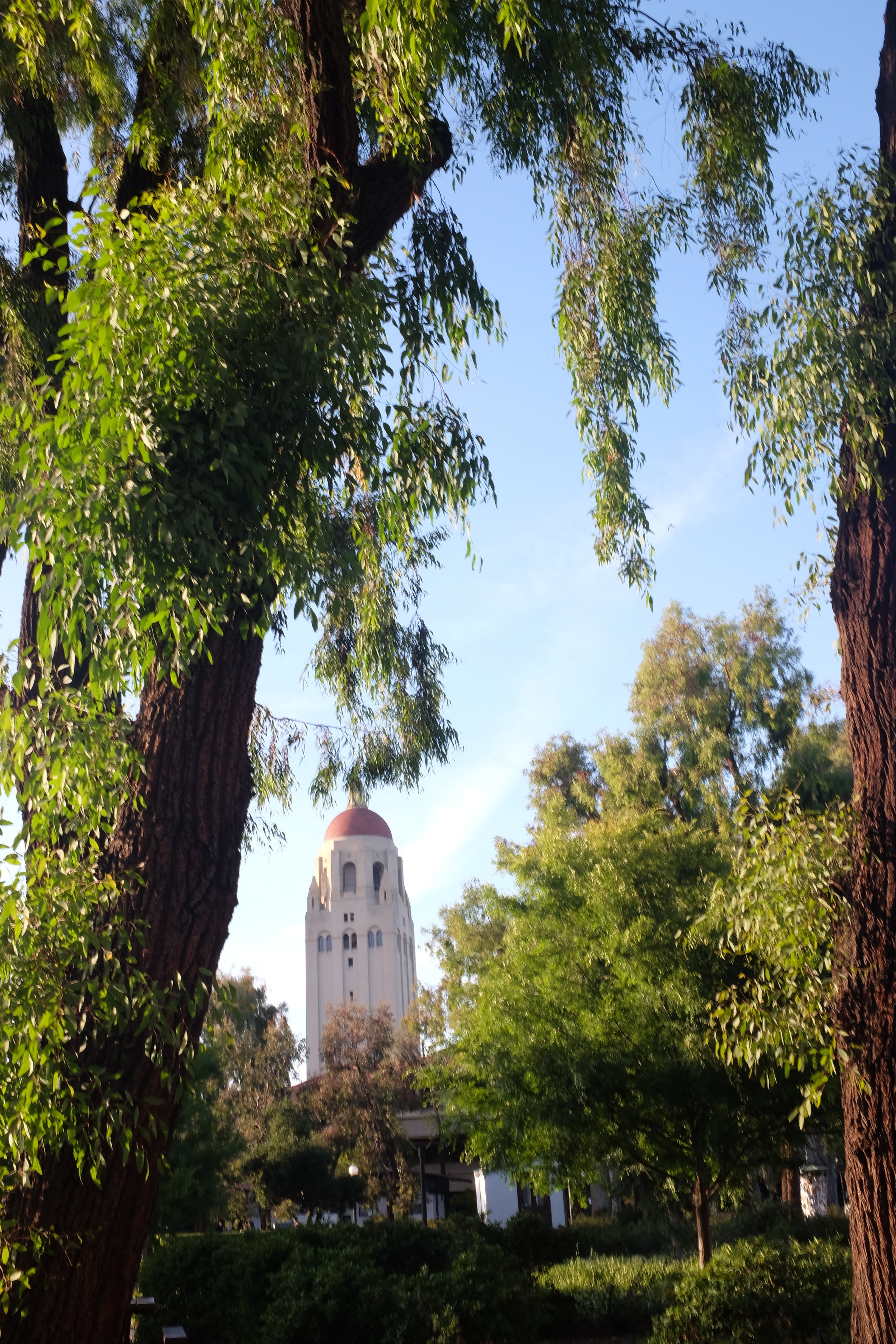
Coast live oaks have shaded the path of my ceaseless spinning. I’ve circled the crest where they’ve sensibly, sagely, rooted themselves in one spot on my favorite place on earth: Lake Lagunita. I’ve written about my (now retired) cyclical commitment to running its edges over and over and over again during my freshman year; the cadence of comfort brought more light to my life than I could describe here. These trees canopy over the roughly 0.9 mile loop (imperfectly whole) around Lake Lagunita. And I only recently learned their names.
II.
I’ve always been a lover of trees. The day before I received my acceptance letter from Stanford, my sister and I meandered around the local Home Depot parking lot to pick out a dark green, miniature pine tree for Christmas. To this day, I attribute my good fortune to hugging its dark green, remarkably bristled and benevolent branches. As my arms wrapped around its prickly circumference, I found solace in the peace of loving, despite.
And yet, up until a few weeks ago, I had only known a few names of its extended kin: Eucalyptus, Ginkgo, Palm, Redwood, and a few more. But what about the others? They’re all around us, and we hardly care to know their names. I don’t mean to anthropomorphize trees. It would be a disservice to the souls that I believe exist within them as true, earthly things: the kind which respects nature’s equilibrium we humans have feverishly exploited. We have lost the right to even consider trees as a contrast class, yet they are nonetheless an analogous organism on this spinning, spectacularly misunderstood sphere we call earth.
Something came to mind, though, as I walked past my favorite tree: the swamp mahogany. You have seen this tree before. It brings shade to the teeming crowds who wait on sweltering spring days as coffee brews at Coupa Green. As I stood, entranced by the dappled line shining through its translucent, gold-rimmed leaves, I was suddenly sunken by a slow, creeping reckoning with the question, “Who else have I forgotten to see?”
III.
Linnea. That’s her name. I only recently learned this, even though I have admittedly walked past her several times before. Linnea is a librarian who often reads at the entrance of Lane Library, always with a smile on her face and something kind to say. As she checked my bag on the way out one day, I remember stopping in my tracks when she said, “It’s good to see you, I haven’t seen you recently!” It was then that I realized how foolish I’d been. I had been so ignorant to believe she couldn’t have possibly remembered me. I think of the many times before where I’ve acted as a stranger to someone who hardly was one. Linnea and I now catch up every time I walk out of Lane Library. We’ve traded stories about allergies and books and the sorts. And each time, I find reason to smile.
Still yet, the question gripped me, “who else do I forget to see?” Even in the heart of Silicon Valley, the downtown Palo Alto that is brimming with college students is frequented equally by the same houseless individuals. Our ‘escape’ from the ‘bubble’ of Palm Tree Paradise is their home. And yet we walk past the most vulnerable members of our community as if we cannot see them. But we know their faces.
Peter Singer remarked in a canonical piece, “Famine, Affluence, and Mortality,” that our apathy is linked to a question about distality— how far we are from the problem. Why is it that we would, without hesitation, jump into the river to save a drowning child? Yet, when given the opportunity to, we do not donate a few dollars to a child who is presently starving across the globe? Singer suggests we often only care about what is close to us — intimate, pressing, prudent. It seems to me that this theory doesn’t withstand the test of time: we have proven him wrong, and beyond a reasonable doubt.
IV.
It may seem casual, inert even, to divert your gaze from the eyes of another; but it is sometimes — arguably often — crippling to the soul of another. When we walk past a former loved one, a former friend, a former acquaintance, a person whom we only met once, or someone we imagined sharing a last name with, we participate in a crude form of malice. We are blind to the tarnishing of our souls in this practice of not seeing. And at what cost?
Milan Kundera writes in one of my favorite novels, “The Unbearable Lightness of Being,” “our lives are made up of many others.” Kundera is right: we are the composite structure, the mosaic, of every stranger and lover we have exchanged words with, parted ways with, practiced cowardice and consciousness with. To pretend not to see — withholding recognition out of casual cruelty or inarticulable apathy — is then a sensational act of violence to not only the other, but the self. Our personhood is cosmically constructed: every sentence slung at us in a heated exchange, every rock and cradle of a caregiver or lover, every snide remark from a passerby, every verbal and nonverbal memory is elemental to how we (dis)engage with the world around us.
I’ll concede this much: it is painful to recognize. This is palpable in the way we walk with our eyes glued to our pixelated screens, headphones in, hardly where our feet are. It is painful to recognize a person, who carries what you wish to forget, to not see. I’ve been there. But it is equally, if not incorrigibly more, painful to acquiesce to the estrangement which has become common practice. This is the kind of distancing which has fractured the very communities which bridge us into what we know as human(kind). When did we forget what it is to be kind? I’m beginning to realize that recognition is nested within the heart of it.
V.
Back to the trees. John Durham Peters, professor of communications at Yale, delivered a sermon-like remark a few weeks ago wherein he casually mentioned kin preference: trees, shortly before death, shoot out their nutrients to their kin. In a final act of benevolence — the kind that bears no instrumental value — the tree falls.
I thought about this in the context of the Berkeleian, colloquially contested philosophical question: If a tree falls in a forest and no one hears a sound, did it really fall? Through the logic of kin preference, the tree falls and we’ve failed to ask the right question. It doesn’t matter if there is a witness to its falling. Its nutrients have been dispersed in a final, courageous act of love. That much is guaranteed. That much is enough to evidence a life lived.
The seeds of this realization were sowed on a backpacking trip, prior to stepping foot onto Palm Drive. It was there, in the thick of the Plumas National Forest, where I met the Aspen Tree. It was there, in the omniscient everpresent which only mother nature can nurture, where I learned about interconnectedness and its progeny: recognition. Aspen trees, I learned, are fundamentally connected through the roots twisting below the soiled terrain.
“It’s all just one tree,” I remember a friend saying as he pointed at the grove of Aspens: white speckled marvels, swaying in the wind.
VI.
Trees have taught me that we each deserve to be seen; trees continue to teach me that recognition is a practice in acknowledging the soul of another. And may we learn to see one another in this tethered, together way.