
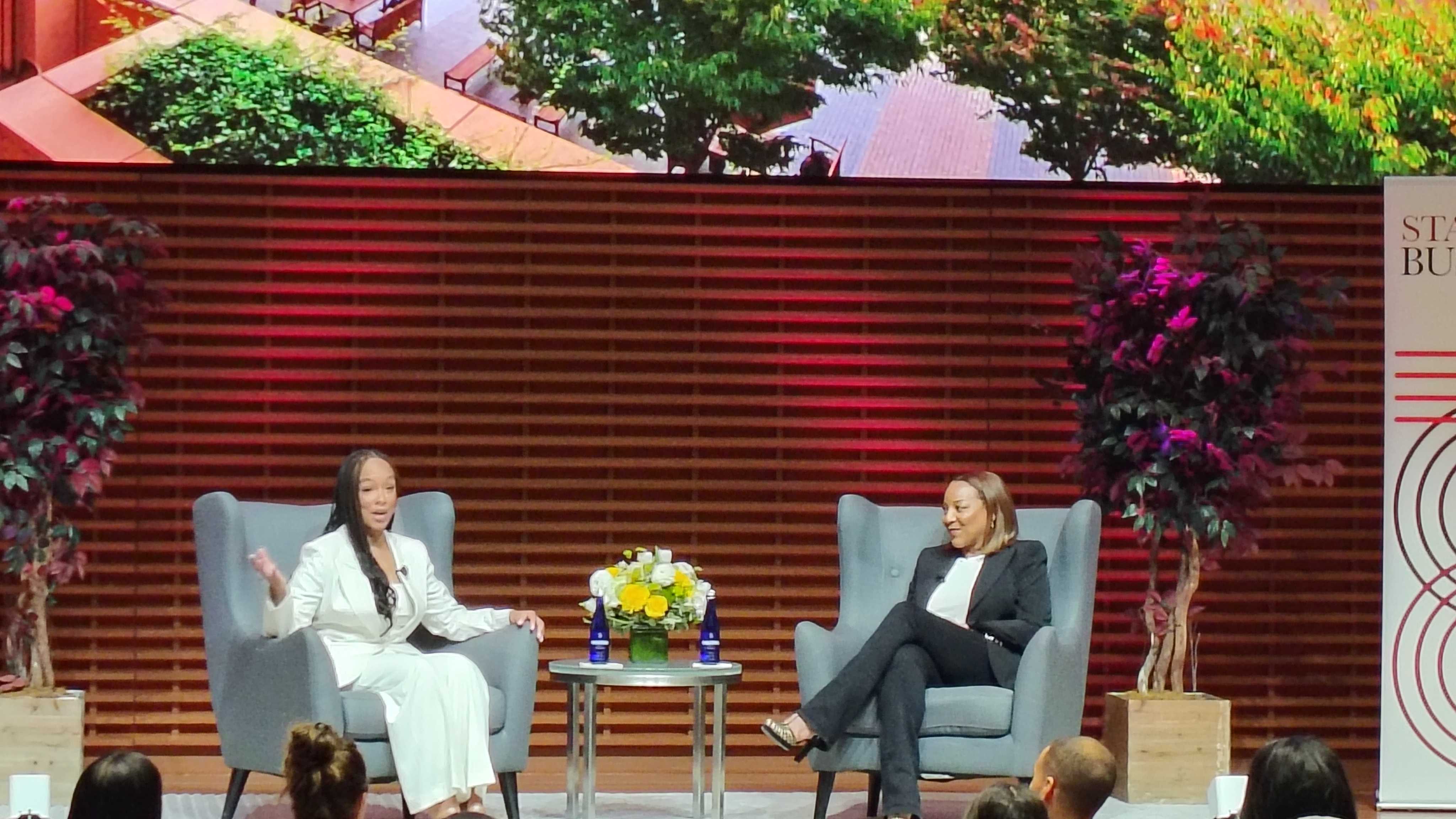
Tekedra Mawakana, co-CEO of Waymo, told a crowd at Stanford Graduate School of Business (GSB) that building a reliable driverless vehicle requires discipline, humility and a willingness to be terrified by one’s own ambition.
Amira Weeks MBA ’26 moderated the talk last Thursday, an installment of the “View From The Top” speaker series.
Mawakana, who joined Waymo in 2017 as vice president of public policy and government affairs after legal and public policy roles at AOL, Yahoo and eBay, was named co-CEO in 2021 alongside Dmitri Dolgov. She is one of the few Black female chief executives leading a major American technology company.
In her view, commitment is the reason for Waymo’s leadership in the autonomous vehicle race. “It takes a tremendous amount of discipline” to resist pressure to scale quickly, she said, adding that the company welcomes competition because “we have to teach everyone everything.”
When asked how Waymo could earn trust from communities skeptical of tech, Mawakana said the only durable answer was “an overwhelming amount of evidence to the contrary” sustained over time. “It won’t be a specific marketing campaign … You have to actually be good.”
Graduating during the early-internet era gave Mawakana a “front seat” to a new technology and the regulatory questions it raised, she said, comparing that moment to students graduating into the AI era today. Today’s graduates, she said, are getting a similar first-hand experience of a technological revolution.
Mawakana initially turned down working at Waymo. What changed her mind was the realization that she had “optimized for certainty” throughout her career — including by working at predictable companies and opting for known compensation — and had never given herself permission to work in what she called “an environment of abundance.”
“If it doesn’t terrify you, it’s probably not worth it,” she said, quoting a saying she keeps on a personal Tumblr blog. Joining Waymo meant leaving a team spanning five continents to lead a team of one. “It was really, ‘Do I have the confidence in my abilities as a builder to go all the way back to the beginning and build something that’s never been built?’”
She advised students contemplating their own leaps to trust the “small voice” saying they were prepared. “You have to have self-belief, that voice is your experience speaking to you,” Mawakana added.
Addressing safety considerations, she said her company has built safety into its software-release framework, reporting channels and willingness to pause when concerns arise.
“‘Safe enough’ isn’t good enough,” she said, citing the 1.2 million people killed globally on roadways each year. According to her, Waymo is currently showing a 13-times reduction in serious injury-causing crashes compared to human drivers.
When it came to competing models, including Tesla’s camera-only approach, Mawakana drew a sharp distinction. “We are building the driver. We are not building vehicles,” she said, describing plans for ride-hailing taxis, local delivery, long-haul trucking and personal cars.
“The topic of cost parity is really interesting,” said Manmeet Bhabra MBA ’27, citing Waymo’s fleet-ownership model versus competitors’ ride-share approach. “At what point can you actually achieve economic viability? [It was] really interesting to get her thoughts on that.”
Looking ahead by 10 to 20 years, Mawakana said she hopes the technology helps cities reclaim space currently devoted to parked cars. “My hope is that we’ll see cities with more green spaces, more convening spots,” she said, with transportation budgets redeployed into other services.
She predicted that for many, driving will become “a joyride” done for pleasure rather than necessity.
For many attendees, the conversation underscored both the promise and the open questions surrounding the autonomous vehicle industry.
Arjun Mehrotra MBA ’27, who has previously worked in robotics, said Mawakana’s emphasis on safety stood out. “Waymo is one of those companies that I think is truly going to transform the world,” he said. “They’re at the forefront, so it’s just fascinating to hear [Mawakana’s] perspective.”