
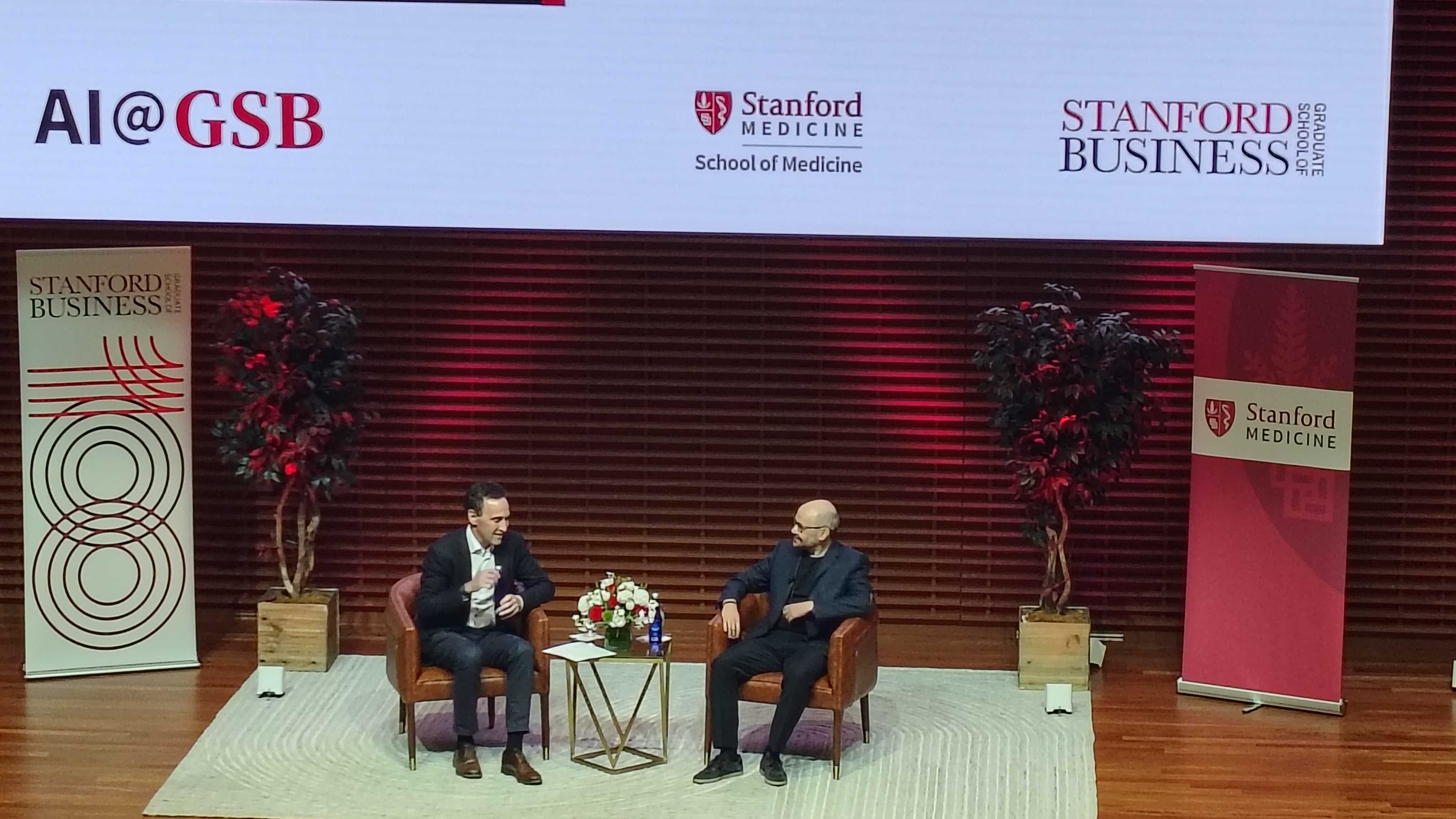
Google DeepMind co-founder and CEO Demis Hassabis said artificial intelligence is entering a period unlike previous technological shifts, calling it a “species-level transition” that leaves humanity with “little margin for error” over the next decade.
During his talk with University President Jonathan Levin ’94 at the Graduate School of Business (GSB) last Friday, Hassabis said AI is currently in the “foothills of the singularity,” with technology is advancing about 10 times faster than the Industrial Revolution, and argued for increasing international coordination on AI regulation within the next five to 10 years.
Hassabis, the 2024 Nobel laureate in chemistry compared AI to global precedents for nuclear weapons and climate change. He said the public is “right to be concerned” about AI safety, disagreeing with industry voices who call the risks overblown. Hassabis described the dual-use nature of frontier models, as they could cure diseases, address climate change or unlock fusion energy, but could also be weaponized to design pathogens or launch cyberattacks.
Hassabis also discussed open-source AI, asking proponents how they plan to deal with the “bad actor problem.” Hassabis said that he supported “smart, targeted” regulatory approaches instead of static rules that will struggle to keep pace with these risks — including period independent evaluations of model capabilities, alongside existing sector regulations for AI implemented in driving, medicine and other areas.
Hassabis said people should not confuse today’s “quite static” question-and-answer chatbots with future iterations, which he expects to progress quickly once feedback loops tighten. Hassabis said that he believes the next era will involve autonomous agents that can string together plans and take real-world actions, like booking a weeklong vacation across 20 websites or executing a drug-development research program.
Hassabis also discussed DeepMind’s business practices. He defended DeepMind’s decision to freely release the predictions of AlphaFold, an AI model that predicted nearly every known protein structure (Hassabis won a Nobel Prize for the model). When Levin asked why the company did not commercialize the tool, Hassabis said the choice matched DeepMind’s mission and the field’s 50-year history of openly sharing crystallography data in the Protein Data Bank.
“We stood on the shoulders of giants,” Hassabis said, adding that the tool would have taken 10,000 Ph.D.s to produce by hand. He believes the “fundamental science layer” shouldn’t be commercialized so it can maximize global scientific benefits. The real commercial opportunity is downstream in drug discovery, he said.
Hassabis connected his current work with other parts of his career. He said that his stint in chess taught him to break ambitious problems into discrete steps, and his time in the video game industry taught him to combine engineering with creativity at scale. Ultimately, Hassabis said his mission is to use artificial general intelligence (AGI) as the “ultimate tool for science.”
Hassabis also described the evolution of DeepMind, which included early struggles with reinforcement learning — there were months when their system couldn’t win a single game of Pong, he said. The ultimate breakthrough was a deep reinforcement learning agent that learned to play directly from raw pixels, which became the foundation for AlphaGo, one of the most prolific goal models. Hassabis called this event “the start of the modern AI era.” Still, DeepMind’s plan remains relatively constant.
“Step one: solve intelligence. Step two: use it to solve everything else,” Hassabis said.
The conversation took place as part of the AI@GSB series, in partnership with the School of Medicine. GSB dean Sarah Soule introduced Hassabis. Soule highlighted the University’s cross-disciplinary ambitions with AI and discussed the GSB’s partnership with the Stanford School of Medicine to reimagine cancer care.
Hassabis said he hopes AI will cure disease, slow aging and crack open the mysteries of Alzheimer’s. However, he believes certain domains should remain strictly human. He said he has no desire for an AI friend, and that empathy, mentorship and the “inspiration part” of teaching are uniquely human work. Hassabis noted that while an AI tutor might get a student “80% there in terms of knowledge,” but it cannot replace the human element.
Hassabis ended the talk by focusing on human agency. “Humans should always maintain their sense of meaning and what they decide to focus their lives on,” he said. “We shouldn’t become this kind of passive recipient of the technology.”
Students attending the talk reflected on their understanding of AI and Hassabis’s points.
Andrea Knoepffler ’26 said, “We don’t necessarily want AI to kind of replace what being a human means. Instead, it should augment human intelligence.” Gia Ancone ’26 enjoyed the event as it “right up her alley” because of her interest in the intersection of health and AI, calling it a “really great talk.”