
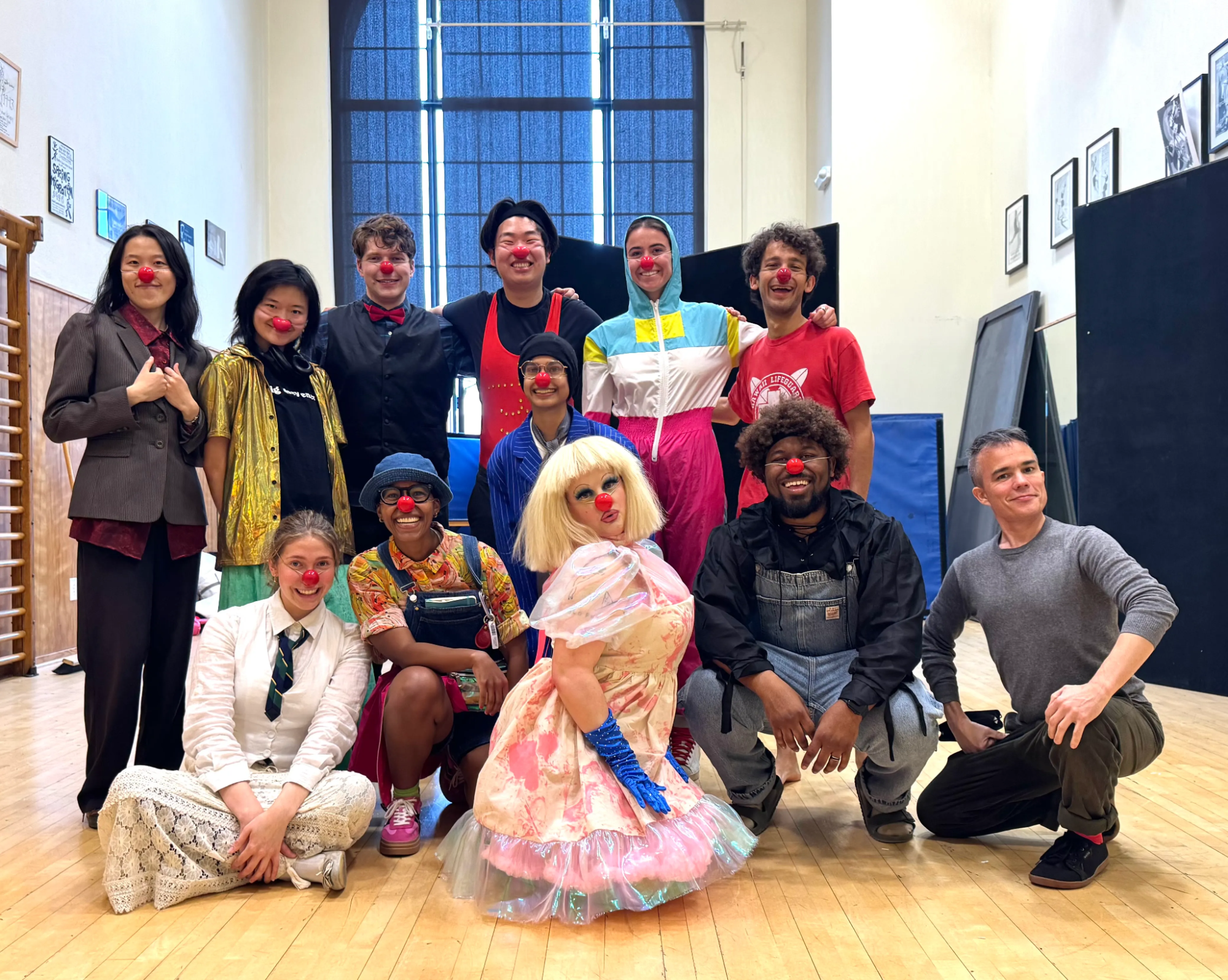
Before theater and performing arts lecturer Matt Chapman tells his class what exercise they’ll do, he asks for a volunteer.
That is how Caleb Benz ’26 ended up in front of the room, trying to act sadness from a level zero to a level 10, from barely visible emotion to uncontrollable crying. Once Benz reached the top of the scale, Chapman told him to switch to hysterical laughter and slowly bring that laughter back down to zero.
The exercise lasted about 1.5 minutes. Benz felt like he had put his heart and soul into it. Chapman told him he had reached about a 6/10.
In TAPS 127W: Introduction to Clown, students do not always get to prepare themselves before stepping into discomfort. The course introduces students to theatrical clowning, a form Chapman describes as almost impossible to pin down.
“Clown is infinite,” Chapman said.
To many people, the word still brings up birthday parties, circus stereotypes or horror movies. But in Chapman’s class, clown is less about face paint and more about vulnerability, failure, physical presence and the parts of a person that emerge when trying to be impressive stops working.
“People get surprised by how focused we get,” Chapman said.
Chapman has performed and taught clown in South Africa, Denmark, Colombia, the Netherlands, Canada, Mexico and England. At Stanford, the class has become one of those courses students hear about before they take it, and it can be difficult to get into.
At Stanford, students are often rewarded for preparation, polish and control. When Chapman first began teaching on campus and saw students’ “great resistance to failing,” he remembered thinking, “These people need clown!”
His goal is not just for students to be okay with failing but to embrace it as a mode of being.
“When you run out of stuff on stage, that’s when the good stuff starts,” Chapman said.
Benz entered the class with some performance experience. A member of Fleet Street, Stanford’s comedy a cappella group, and “the clown of [his] family,” he was used to humor in front of other people, but he wanted to take this class to push himself out of his comfort zone.
“Even though I’m such a goofy guy, there was still a part of me that felt like I was holding back when performing in front of a crowd,” Benz said.
Over the quarter, students develop clown personas. These characters are not random alter egos so much as heightened versions of something already in them. Benz’s clown wore a vest, button-down shirt and black-and-white dress shoes. He described himself as a guy who thought he was super smart but was actually bad at almost everything.
Students do not receive the quintessential clown prop — a red nose — until halfway through the quarter.
“We had to earn it,” Daniel Rashes ’26 said.
Benz said Chapman treated the red nose as a dividing line between the student and the character. “When you don’t have the red nose, you’re Caleb, student of clown,” Benz said. “The moment the nose goes on, I don’t want to know who Caleb Benz is.”
Rashes took the class during his senior fall after hearing about its reputation as one of Stanford’s famously quirky courses. He had done some theater before, but his comedy experience mostly came from screenwriting, where the jokes are written and planned in advance. His own humor, he said, is dry and conversational, so Introduction to Clown was “definitely an adjustment.”
“Being silly just for the sake of exploration didn’t feel as natural to me,” Rashes said.
Still, Rashes appreciated the structure of the class, especially Chapman’s feedback. In other creative classes, he had found that critique could be heavy on praise and light on actual criticism.
“Matt was very blunt, but not in a harsh way,” Rashes said. “I really appreciated his honesty when something wasn’t working. He was a really, really great instructor.”
The work extended beyond class. Students prepared skits with different constraints. Some could not use speech. Others had to repeat in a loop. For the midterm, students performed a “hassle,” an exercise where the clown tries to use an object and struggles with it, letting the problem grow through “clown logic” instead of fixing it.
Bailey Scieszka MFA ’26 arrived with a different relationship to clown. Scieszka, who is working towards his master’s in art practice, studied painting at Cooper Union in New York before coming to Stanford.
“I started doing clown in my 20s because I saw this connection between painting and clown, because you’re painting your face,” Scieszka said.
Scieszka had been performing as Ms. Bailey, a high-femme drag persona built around makeup, jewelry and elaborate decoration. Chapman encouraged him to strip away those visual elements and wear all black instead.
“I couldn’t rely on visual gags anymore,” Scieszka said. “I had to find a character.”
The class made Scieszka reconsider what he had previously called clown. In Chapman’s class, he began to see it as a way to control the power of a room, fail in public and live in discomfort.
“The class was life-changing,” Scieszka said. “I couldn’t stop talking about it.”
The ideas followed him out of Chapman’s classroom and into his own thinking about how art should be taught.
“Schools are predicated on success,” Scieszka said. “In art, there has to be experimentation and failure and play.”
The class draws students from across campus, including CS students, MFAs and GSB students. “This class isn’t just reserved for people in the humanities,” Rashes said.
Next spring, Chapman plans to offer Clown 2 for the first time, an advanced course that would give students a chance to dive even deeper into clown.
For Chapman, studying clown gives students an experience that is alive, unmediated and communal. In a place built on getting things right, Introduction to Clown teaches students the art of getting it wrong.
“It celebrates the parts of being human that do not exist for profitability, optimization or exploitation. It’s countercultural,” Chapman said.