
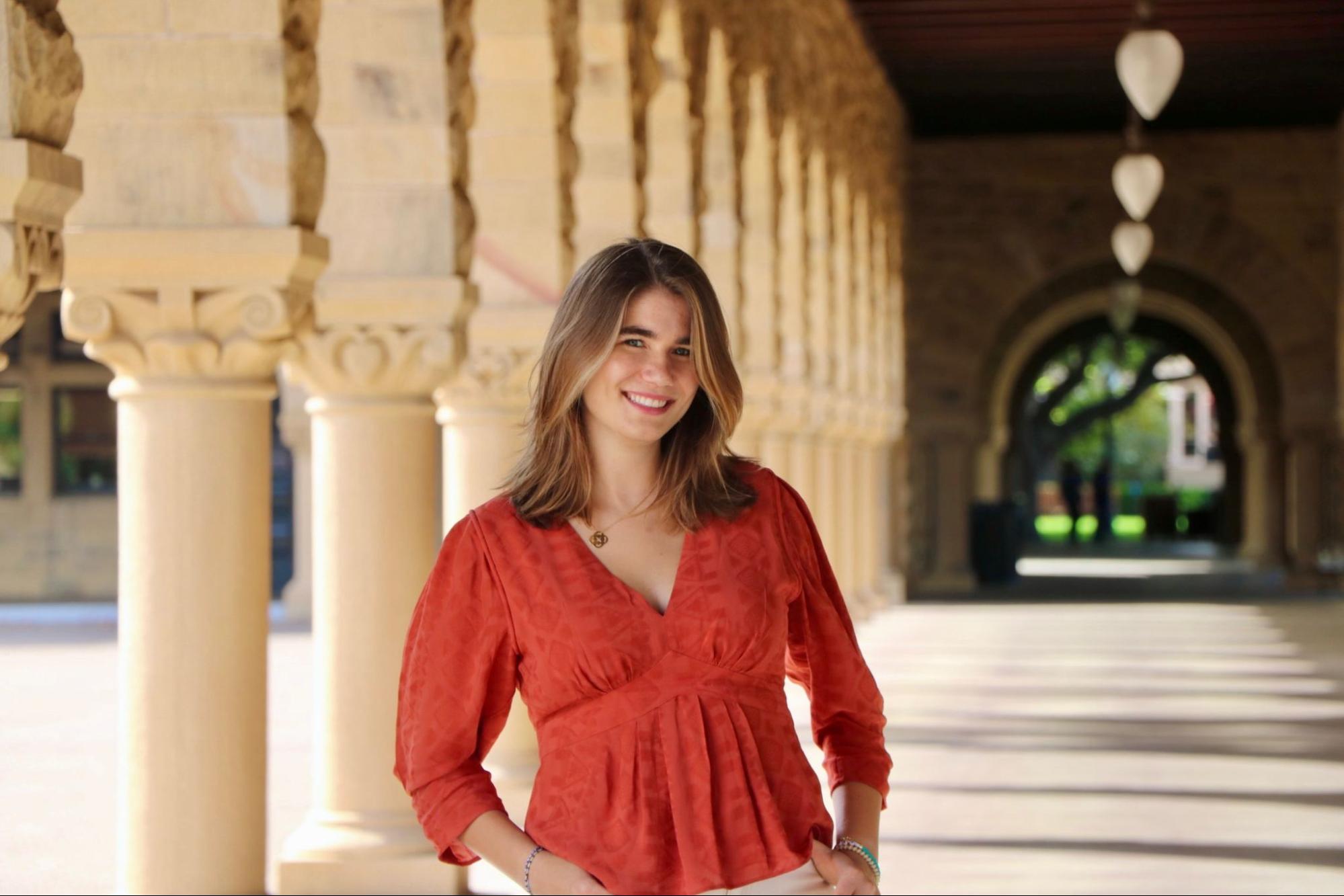
Heloise Hoffmann ’26 watches two clusters of cells, side-by-side, in her lab. One group is growing and living normally. The other is dying.
Cell death happens all the time in the lab; it’s necessary for disease research. And on the surface, culturing these samples might seem mundane: there’s lots of changing media, a nutrient-filled, watery gel that serves as cell food. But watching these particular cells, and their deaths, holds personal stakes for Hoffmann: she has the same diseased cells in her own muscles.
Hoffmann has Facioscapulohumeral Muscular Dystrophy, or FSHD, a disease with currently no cure that causes muscles to become progressively weaker and eventually unable to regenerate or heal. About one in every 8,000 people experience it, with up to one million people experiencing it worldwide.
And, at Stanford, she’s searching for how to cure it.
When Hoffmann was 10 years old, she loved playing sports. She played tennis and soccer, and she rode horses. She skied. At one point, she had plans of going pro in tennis.
One day, she found herself stumbling on the tennis court. At random points in a match, she dropped her racket. As time passed, she would “melt into a puddle in the middle of a tennis match with no explanation.” She walked with her shoulder lopsided for weeks after just an hour of horseback riding.
Living in Texas at the time, she and her parents flew to San Francisco, then to Baltimore, then across the country seeing specialists to find out what was wrong. Three years later, the diagnosis arrived through a phone call. She had FSHD, and because her muscles would no longer be able to heal from heavy use, she would have to stop playing sports immediately.
“I felt like they shattered any vision of what I thought my future life might look like,” she said.
Today, she can only comfortably lift her arm to about chest height.
When Hoffmann arrived at Stanford, she realized that she had access to state-of-the-art genetic engineering tools that might lead to a cure. She majored in bioengineering, and set her sights on the pre-med track. Her chase for an FSHD cure began when she and seven other undergraduates formed a team for the global iGEM (International Genetically Engineered Machine) competition, the largest such competition for undergraduates in the world. There, Hoffmann and her team proposed a way to solve FSHD that won them the gold medal.
The therapy targets DUX4, the gene responsible for FSHD. In normal patients, this gene is inactive; however, in patients with FSHD, the gene is mistakenly turned on. Because DUX4 is a type of gene called a transcription factor, it instructs other genes to begin producing proteins, which then deteriorate muscle. In order to activate genes, DUX4 needs to attach to DNA. So Hoffmann and her team engineered a version of DUX4 that binds to DNA but is inactive, preventing the harmful proteins from being made by outcompeting the mutated DUX4 to attach to DNA.
She and two of her teammates from the iGEM team, Alice Finkelstein ’27 and Michael Liu ’27, later pitched their therapy to the Undergraduate Entrepreneurship Program hosted by Stanford’s Sarafan ChEM-H. They won a $50,000 grant to develop their project.
Hoffmann spends hours of research per day in the Stanley Qi Lab, which specializes in using CRISPR-based technology to engineer medical therapies. When she first approached him to work on treating FSHD, Qi thought, “Okay, you want to research a super complicated topic, almost a medical student or Ph.D. student-type project?”
“How do you have time to do this?”
Then, Hoffmann explained how she had FSHD herself, how she had immersed herself in patient advocacy and research of the disease, how she was lucky enough to have the tools at Stanford to potentially find a cure. “I immediately find this amazing,” Qi, an associate professor of bioengineering, said.
To Qi, Hoffmann represents a unique type of scientist because she combines “scientific literacy with a very precise, urgent personal mission.” Some scientists have the expertise and knowledge to solve biomedical problems, but they lack the full motivation and drive behind their work. Others might have a deep passion for solving their chosen research problems, but don’t have access to the needed knowledge or engineering skills. As a top student at Stanford, Qi said, Hoffmann lacks in neither category. And that’s especially important in Qi and Hoffmann’s field of research, where delays in producing results could mean preventing thousands to millions from accessing life-altering therapies.
“She’s already on the way to become a very promising successful physician-scientist,” Qi said.
Hoffmann, who will celebrate graduation next Sunday, has excelled in academics and research during her time at Stanford: she received a Terman Award, given to the top 30 graduating students from the School of Engineering. But between her bioengineering classes, research and planning to apply for medical school, she finds time for balance through music.
After her FSHD diagnosis sidelined her from sports in high school, Hoffmann picked up musical theater, sang opera and joined a band. In spring 2025, she and her friends started a band called Denim in Distress. They began as an indie alternative rock band, though they’ve since added more crowd pleasers so the audience joins in to sing. As a guitarist, Hoffmann said she can “feel [her] finger strength slipping away little by little,” but performing on stage offers her a place to forget for a while.
On many days, Hoffmann grapples with the heavy weight of studying her own disease. She wakes up tired — physically from the disease eating away at her muscles, emotionally from the urgency of trying to find a cure. Still, she gets out of bed, puts on her lab coat, and tends to her cells. She said she feels a deep sense of responsibility to “push the science forward.” And a good deal of hope, too.
“Although I have FSHD, it does not have me,” she said.
That drive inspires her younger sister, Félicie Hoffmann ’28, who wrote that she is “constantly motivated by [Heloise’s] determination to live fully, follow her passions, and help others do the same.”
In the future, Heloise Hoffmann plans to apply to and attend an MD/Ph.D. program to continue the work she’s started at Stanford. She will spend the coming year working full-time in the Qi Lab, sights set on bringing her FSHD therapies to human trials.
“We’re racing against time,” Qi said about the effort.
In the meantime, Hoffmann looks forward to the day when she can look at two petri dishes and see diseased cells surviving at the same rate as normal cells.
“Maybe they’ll survive even better.”