
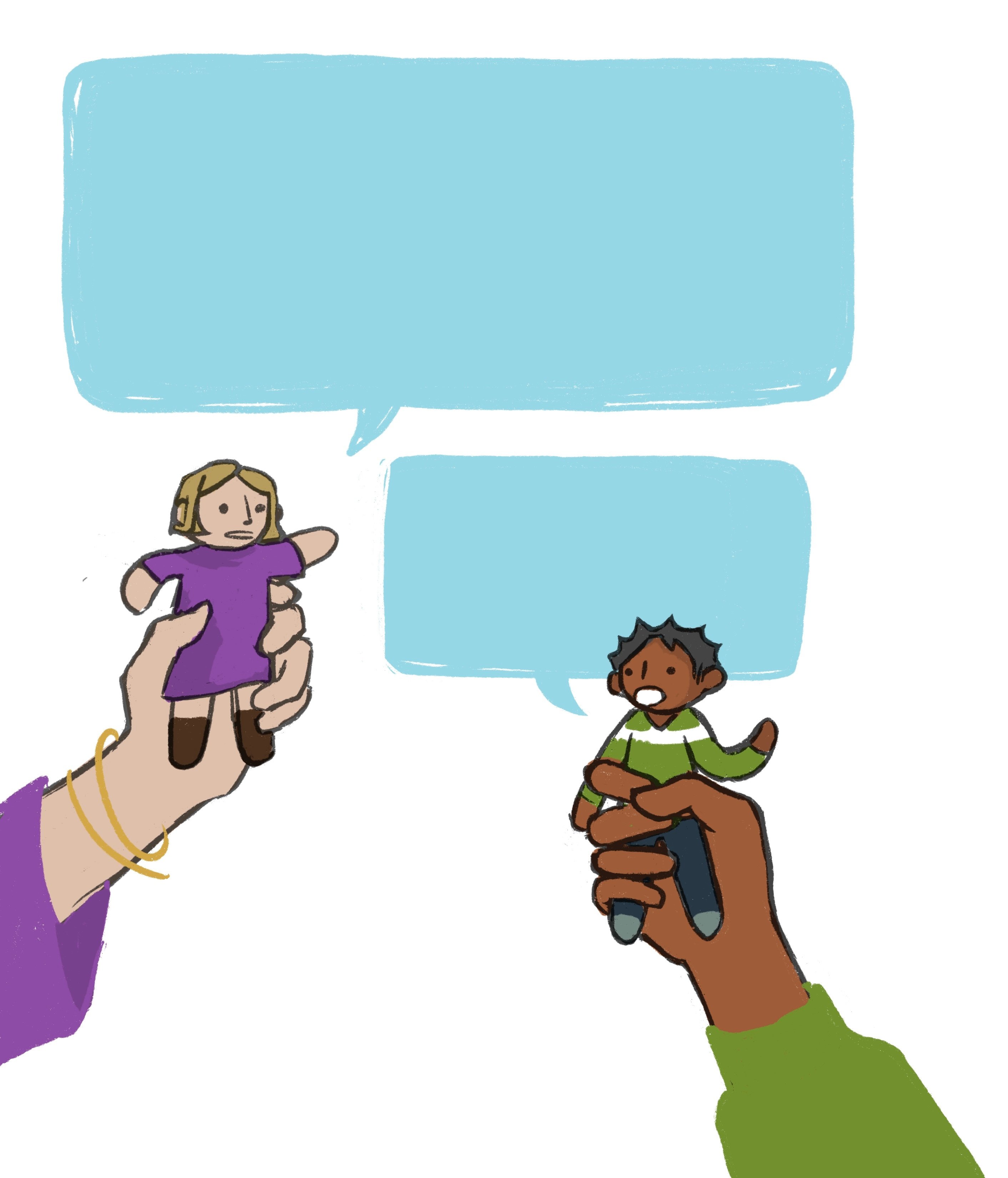
In late 2021, the media company Cut released a YouTube video in which a group of strangers interact in a “lineup” form, asking provocative questions based on their identities. One woman, the oldest in the group, guesses that a fellow participant is gay. She is then instructed to ask the younger man how he identifies his sexuality. The man pauses before saying, “actually, I identify as…” He is interrupted by her remark, “oh, here we go…” The man jokingly says, “wait for it,” and she replies, “I will, let me get a chair.” In a similar video, also by Cut, a Black woman introduces herself as Nancy to her discussion partner, a white woman. The woman comments, “Nancy, that’s my mom’s name!” Nancy replies, “My dad named me after my great aunt, who was a slave.” The white woman sighs and replies, “Okay, I’m sorry.”
These clips went viral on TikTok and similar short-form video platforms as miniature reality television, where characters exist for no more than 30 minutes and are designated as “chair lady” or “ok sorry lady.” These people form caricatures of society’s views on gender, sexuality and race for viewers to laugh at while looking through a singular, deliberately framed window into the ridiculousness of our cultural moment, where identity is the driving force behind our social, political and intellectual interactions.
“Identity politics” is a buzzy phrase that spells death for Democratic politicians in a “post-woke” world. Weak messaging, elitist rhetoric and identity politics serve as main points of disconnect between Democrats and the working class, according to a document that centrist think tank Third Way released in 2025. In short, politicians seem more focused on building their own appearances than on affecting tangible change. Identity politics has largely been blamed for this failure to connect with voters, leading to a shift toward seeing them as a joke, rather than as a legitimate form of discourse.
Full disclosure: if I come across “ok sorry lady” or “chair lady” while scrolling, I’ll send it to at least three friends. I find these types of videos hilarious, and despite publicly supporting causes associated with identity politics, I often indulge in internet clownery making fun of the very ideas with which I align myself. It’s easy to connect with caricatures boiled down to one personality trait. The problem is, watching identity-based interaction play out in a controlled, edited, 30-second format is much easier than engaging with identity politics seriously, and that preference is what short-form content is designed to exploit.
I’m part of this problem. You probably are too. By treating a significant part of American political culture as a punchline, we risk losing our ability to think critically about ourselves and engage thoughtfully with our fellow citizens. We risk losing our ability to live in community. I do not offer an unequivocal defense of identity politics, but it’s worth looking at with more care than people, myself included, currently give it.
Identity politics, at its simplest, offers a new frame of thinking about political engagement. The official term is attributed to the Combahee River Collective, a group of self-described Black lesbian socialist feminists from the 1970s who argued that specific social groups — based on race, gender, sexuality and class — share interests and perspectives, and therefore ought to vote as communities rather than adhere to traditional Western party politics based on belief.
The Collective argued that the personal is political. Marginalized groups’ struggles to fulfill their basic needs of food, water and safety were inherently political due to a governmental failure to provide for the most vulnerable in society. They also acknowledged that the political is personal: how we vote and engage with our government is tied to our identities as a result of how they determine our social, economic and political status.
Hannah Arendt offers a lens to understand identity politics’ role in society in her book “The Human Condition.” According to Arendt, the private realm is where we fulfill basic human necessities — food, shelter, survival — so universal that they are, by definition, beyond debate. The public realm is where plurality and discourse exist. Unlike the private, it depends on differing beliefs and free action.
Arendt argues that a third realm has risen over the past century: the social. The social realm is where the logic of survival begins to take over the space of public action, and expressing your identity begins to occupy the same platform as earning your income. This is where social media thrives: some people see it merely as something to do after their nine-to-five, and others use it to generate a livelihood. This same dynamic shapes identity politics. If people’s basic needs are dependent on the government, and their treatment by the government is dependent on their identity markers, the personal and the political cannot be separated — exactly what identity politics argues.
The difference between the identity politics conceived by the Combahee River Collective and the identity politics performed by individuals in Cut videos, however, is staggering. The Collective wrote in their founding statement: “In the process of consciousness-raising, actually life-sharing, we began to recognize the commonality of our experiences and, from the sharing and growing consciousness, to build a politics that will change our lives and inevitably end our oppression.”
Through ‘life-sharing,’ rather than merely organizing for a product or individual gain, activists produced a durable framework to rethink overlapping oppressions beyond the next political goal. Yet the danger of the social realm is that when survival and political expression share the same space, survival is inevitably prioritized. The “growing consciousness” crucial to identity politics is flattened into content, optimized for engagement rather than action. Consumers absorb identity performance to feel easy emotions like validation and belonging instead of more difficult ones like cognitive dissonance and empathy.
Of course, Cut videos are an obviously inaccurate representation of social interactions. They’re oversaturated with caricatures, edited to remove context and shortened to serve viewers’ minimal attention spans. However, one of the most consistently popular forms of art is one that holds a mirror up to society, albeit in an exaggerated or ridiculous way, to provoke self-reflection or allow the audience to identify with a character, whether they realize their similarities or not.
In Shakespeare’s “Hamlet,” the titular character puts on a play within the play depicting a man who kills his brother, a king, and usurps power. He argues that the purpose of playing is to “hold a mirror up to nature,” allowing virtuous people to see their own beauty and moving the guilty to reveal themselves by reacting to their own reflection. Art and media serve as a mirror to the world, reflecting our reality. This mirror only works under certain conditions. Once media and content is monetized for passive algorithmic engagement, acting in society becomes a way to survive the world, not grow in it.
A creator making content that centers themselves and their various identities for YouTube revenue is laboring for survival, optimizing what the algorithm rewards and producing something consumable. Similarly, a viewer scrolling TikTok is not watching with a critical lens. Often, doom-scrolling is a way to shut off the brain rather than activate it; it is for me. What appears as a public conversation about identity is actually labor dressed up as social interaction. When someone expresses themselves for monetary gain, the viewer receives a product rather than a reflection — and because they are not watching for enlightenment, they are unwilling or unable to identify this farce.
Media and art help us conceive of the world, better understand other people and work through our emotions. Take plays in Ancient Greece, the first western democracy, where, as Greek drama scholar Eleftheria Ioannidou writes, the most cherished aspects of a play were “uniqueness, legitimate interpretation and authenticity.” However, “legitimate interpretation” requires a critical eye: you cannot merely absorb art and laugh, cry or smile in response; you must reflect critically and act accordingly. This is a major discrepancy between art and modern day short-form entertainment. When people fail to engage with content through a critical lens — not necessarily with negativity, but in a thoughtful, personal way — they fail to see it as more than a product for themselves and themselves alone.
We often tell ourselves it doesn’t matter all that much what we consume, or that we’re smart enough to tell the difference between entertainment and reality. Cut videos feel harmless because they’re funny and obviously staged and short, but that’s the point. Even if those videos are for consumption as a product, rather than critical engagement as art, they still matter deeply because they take away from art that generates a critical kind of human connection — namely, casual, incidental affiliations in classrooms, workplaces and bus stops that force us to coexist rather than self-isolate behind a screen. Instead of silently agreeing with trolls in the comments, we ought to openly discuss ideas and disagree with our peers. Without such dialogue, we lose both our ability to have a productive discussion and to connect on the fundamental level of existing side by side.
By constantly mindlessly consuming content that dulls identity to its basest, most entertaining and least productive form, we become less able to productively engage with those of different identities. We have no conception of others’ experience of reality, instead holding only a warped perception of a person diminished into a consumable model rather than a free individual. Identity must be a way for us to better understand ourselves and share experiences with others, not a way to silo ourselves into a lonely existence.
When identity is reduced to something consumable, we — the consumers — push each other and ourselves to perform our various identities rather than speaking freely. We give each other a caricature rather than a genuine encounter. By oversimplifying identity politics, we’ve prevented ourselves and each other from sharing authentic speech, action and identity. In the process, we’ve also isolated ourselves by internalizing a false understanding of those who are different to us rather than truly listening to people we don’t know.
Perhaps the commodified, dramatized version of identity politics we at Stanford know deserves not to be taken so seriously. But for most people, identity is more often than not a matter of life and death. In America, Black men are six times more likely to be incarcerated as their white counterparts. As of 2024, women earn 85% of what men make. The maternal mortality rate for Black women is 44.8 deaths per 100,000 live births, four times higher than the rate for white, Asian and Hispanic women. The individual experience of every person who contributed to those statistics is personal to them, but it must also be understood as political if we ever hope to make this litany of systemic injustices obsolete. Reducing identity politics to labels we can hide behind to avoid self-reflection or manufacture belonging selfishly disregards those who don’t have the freedom to so easily separate their political identity from their existence.
Identity politics cannot afford to become less urgent because it has been partially swallowed by the content economy. Taking identity politics seriously doesn’t mean uncritically consuming every piece of content made in its name. It means learning to distinguish between the commodity and the person behind it. The mirror will only show us an accurate reflection when we stop consuming identity to satisfy our own needs or insecurities and start engaging with it seriously enough to act.
Correction: A previous version of this piece stated that Black men were six times more likely to be arrested than white men. This statistic is actually true of incarceration, not arrests. The Daily regrets this error.