
After waiting for weeks, Dean Liang ’28 was ready to pop the big question.
“Hey,” he said to his friend, Audrey Knowles ’28, “I’ve been meaning to ask for your location.”
Knowles remembers being surprised: not that Liang was asking for access to her whereabouts, but that they didn’t already share locations. “Of course I’ll share with you, Dean, you should have asked sooner,” Knowles recalls telling Liang. “It just made me so happy. It was hilarious,” she said.
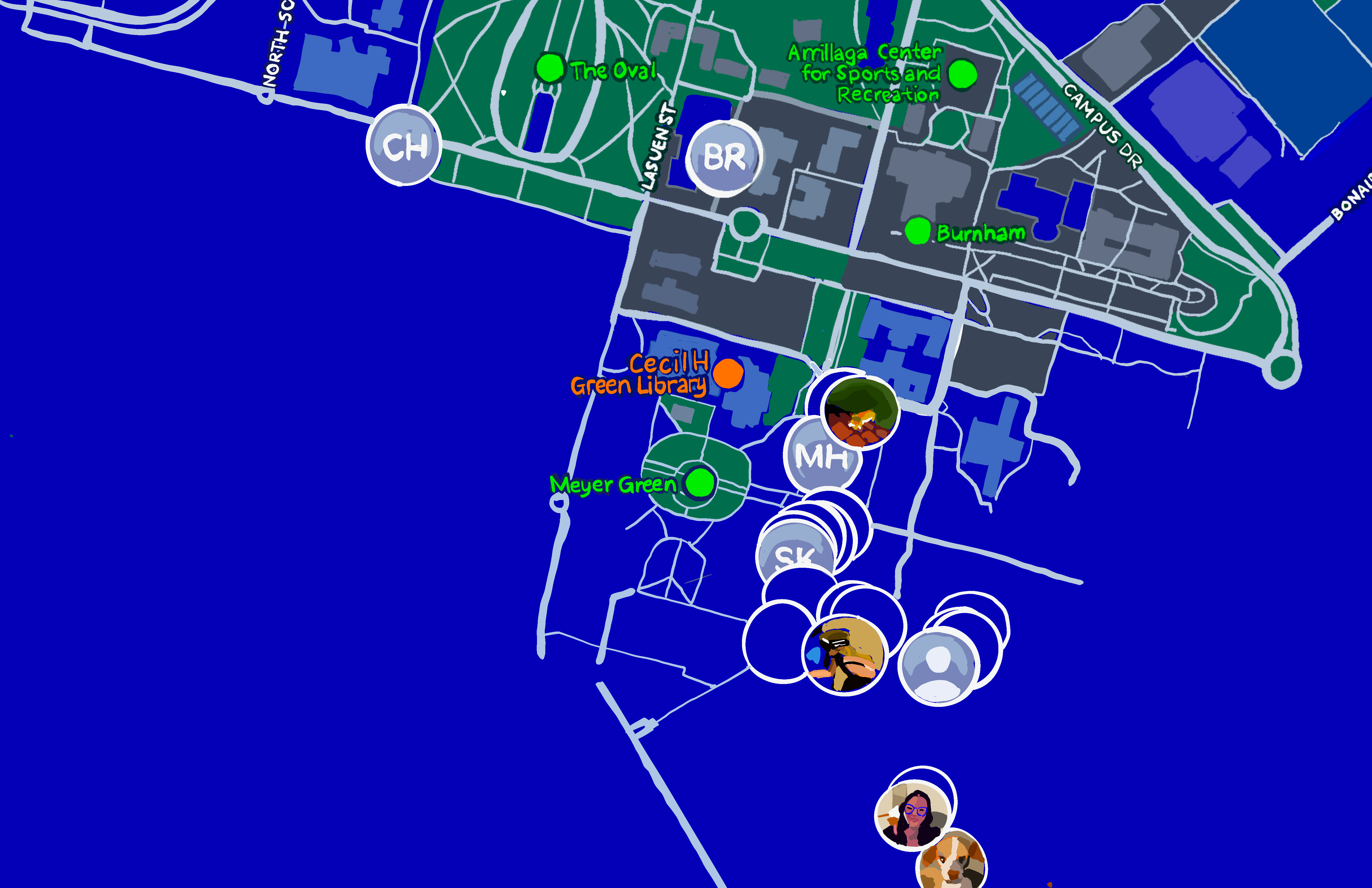
In recent years, location sharing has risen to prominence on campus. Students described the ease of a few finger taps replacing the “where are you?” calls and texts that used to foreshadow in-person interactions. Students report checking Find My Friends, an iPhone app that allows users to selectively grant contacts access to their location, multiple times a day. A few said they share their location with more than 60 people.
For some, the app can resemble a video game: icons, representing friends, move in real time as they change location. “I think it’s so fun to collect people,” Knowles said. For others, it has become an alternative to doom-scrolling. “I sometimes just look at Find My instead of scrolling through reels,” said Cooper Tenney ’28.
Yet, other students expressed apprehension. Some said they don’t share their location with anyone besides family, and others noted deleting the app altogether. “I just don’t want other people to be able to see where I am,” said Sofia Wyatt ’29. “Do you guys not lie about where you are sometimes?”
Students also shared that the app can sometimes be conducive to stalking. A freshman, who asked to remain anonymous due to safety concerns, explained that after asking her to share location early on this year, an acquaintance “kind of stalked me everywhere I went.” After the freshman stopped sharing her location, the acquaintance confronted her, asking if she had removed her access. “I said no, and I deleted the whole app,” she said.
Other students echoed that the app can start to feel like an infringement on privacy. “When people, multiple times, say ‘Oh, I saw you in [blank],’ or ‘I saw you were at [blank], what were you doing there?’ it makes me feel a little weird because, like, why are you watching me?” said Grace McGoran ’28.
“I don’t like when people are checking for no particular reason. Let me live, guys. Let me be mysterious,” said Natalie Hampton ’27.
Students also shared that, as networks begin to grow on Find My, it becomes possible to see who others are with, creating feelings of fear of missing out (FOMO). McGoran remembered how, in high school, “friends came to [her] crying because all their friends were hanging out without them.” Knowles explained how, when she had “a lot of time on [her] hands” freshman year, she would check locations and think “they’re probably having more fun than me.”
Still, many students think that the app’s popularity will prevail. Liang argued that having friends’ locations in a college setting is conducive to social life. Tenney explained that it can be helpful in holding people accountable, especially in settings like Greek life, where location sharing can encourage members to show up to bonding events they may otherwise try to skip. “I think it was good to keep everyone coming to the house and doing all the activities, especially when … we needed to have everyone there,” he said.
After all, it feels easy to see where everyone is with the touch of a button, even if the proximity in distance doesn’t mirror the closeness of the relationship itself.