
When Chaplain Walter Bryen walks into a patient room at Lucile Packard Children’s Hospital Stanford, the center of Stanford Medicine Children’s Health, he might hand a rosary to a devout grandmother, then turn to her grandchild — who believes in nothing at all — and help them feel connected to something larger than themselves. The chaplain’s role, Bryen wrote to The Daily, “is to be present with all the people in the family and affirm and acknowledge their faith or their no faith,” whether the divide runs between a devout grandparent and a secular teenager, or between a Muslim parent and a Christian one, as Bryen sees often.
Father Randy Valenton, another hospital chaplain and a Roman Catholic priest, describes the role as a bridge. “If the child and the parents do not see eye-to-eye on faith, I do not take sides. I respect them both,” he wrote to The Daily. “I connect the child’s inner peace with the parents’ deep traditions.”
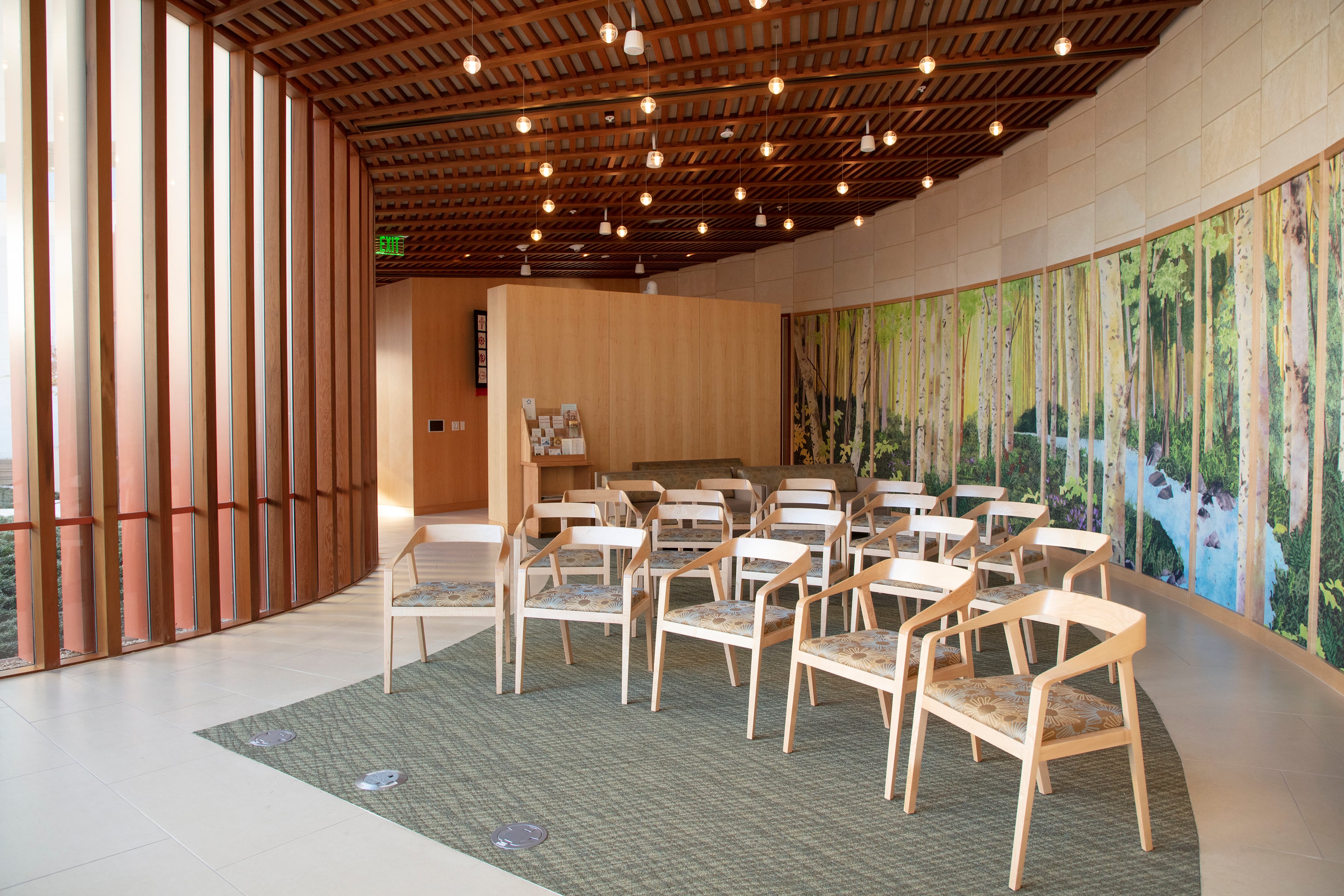
Moments like these are the heart of spiritual care at Lucile Packard Children’s Hospital. The chaplains’ approach — to meet patients and families exactly where they are — is now built into the hospital itself. Located on the first floor between Packard Children’s West building and new Main building, the Sanctuary serves as “a dedicated space for serenity and reflection, and a refuge for patients, families and staff,” said Chaplain Paul Andrews, manager of Spiritual Care Services at Stanford Medicine Children’s Health.
This April, the Sanctuary opened new weekly services during Holy Week — the days leading up to Easter — starting with an inaugural Catholic Mass with confession. The Sanctuary now hosts weekly services across five faiths: Buddhist mindfulness and meditation on Wednesday; Catholic Mass with confession on Thursday; and Jewish Shabbat services, Muslim Jumu’ah prayers and Christian prayers all on Friday.
Outside of the Sanctuary, an outdoor healing garden and meditational labyrinth provide patients and families space for quiet reflection. These areas serve as “an island of quiet peace” for families, Bryen wrote, “away from the chaos and fears of having a sick child in the hospital.”
Spiritual care touches a wide range of medical situations: births, deaths, diagnoses and everything in between. In each, patients carry more than the burden of physical symptoms — moral decisions, fear, grief. Spiritual care by chaplains exists to support the person, not just the patient.
Some days, Andrews is called into a patient room to celebrate a birth, a recovery or good news after a hard diagnosis. On other days, he’s called in for the opposite. Either way, his job stays the same: “to provide specific, relevant support that aids in patients’ ability to work through whatever medical condition is ongoing,” Andrews said.
What makes the Sanctuary’s multi-faith approach possible are the diverse backgrounds of the chaplains who support it.
For Valenton, the calling arrived through personal grief. When Valenton was in third grade, his older brother died, and a nun came to his family’s house to sit with them. Years later, when Valenton’s father died, priests, nuns and seminarians showed up to support the family once more. “Their presence during our grief stayed with me,” Valenton wrote.
After his ordination as a priest, visiting the sick became central to Valenton’s ministry. “It lets me bring God’s presence to people when they feel isolated and vulnerable,” he wrote, “I simply listen without judgment and help them process their grief and find meaning.” At Packard Children’s, Valenton now facilitates the Sanctuary’s new Catholic Mass services.
For Bryen, the calling began not with personal grief, but with a friend’s. In his twenties, estranged from his childhood church, Bryen wandered into a Catholic church to pray for a hospitalized friend. A nun approached, asked why he was there and simply listened when he cried. “Her presence nudged me toward the Divine,” Bryen wrote.
Many years and several careers later, he became a chaplain, now facilitating the Sanctuary’s Christian prayers on Fridays and hoping “to make other people feel the comfort I felt from her.”
Andrews’ path began closer to home. Growing up in Marin County, he followed a general Baptist tradition before shifting to the Southern Baptist Convention. He eventually sought out the nearest seminary that matched his beliefs: the Golden Gate Baptist Theological Seminary. The chaplain has since completed his residency in Clinical Pastoral Education at Stanford Health Care and has practiced at Packard Children’s for nearly three years.
Andrews felt specifically called to pediatrics — a setting that asks for different things from chaplains than adult care does. In a hospital, “As you’re speaking to an adult, they may be a little more guarded,” he said, describing the emotional walls that adults often put up to protect themselves while processing a difficult medical diagnosis. Parents, he found, don’t have that same instinct when it comes to their children. “You’re able to connect to the emotional and spiritual needs without those barriers,” Andrews said.
Meeting those needs takes a team — chaplains working alongside the hospital’s providers and social workers. A single day for a patient and their family can swing from crisis to celebration and back. When things go as planned during a delivery, “We’re there to give thanks and celebrate the expansion of their family,” Andrews said. But the team is just as present when things go the other way. “We’re there to walk alongside, to aid in them having a voice, by lending an ear,” he said. “We’re the only practitioner who doesn’t poke or prod.”
The practitioners who do poke and prod sometimes misread chaplains’ purpose. A common misconception is that chaplains exist only for death, according to Bryen. At times, when the chaplain visits a patient’s room, a hospital staff member will tell him, “‘No, we don’t need you, he’s not dying,’” Bryen said. “I then must explain that we are here for everyone, to be a listening ear.”
Another misconception Bryen hears is that hospital chaplains only support religious families. On the contrary, “Even if they have no religion or identified spirituality,” Bryen wrote, “patients and families still need someone to talk to who can be present to hear their honest struggles and feelings.”
Providers also sometimes view chaplains as visitors handing out blessings, fixing a family’s religious arguments or convincing families to choose religion over medicine, according to Valenton. “But my ministry is not about fixing,” he wrote. “While doctors heal the body, I hold space for the heart and soul so that science and faith can work together.”
Science and faith don’t always work together so easily, though, with some cases old enough to have shaped American law. In Prince v. Massachusetts (1944), the U.S. Supreme Court ruled against a Jehovah’s Witness guardian and held that parents’ religious freedom does not extend to endangering their children’s health.
According to Andrews, these conflicts continue to play out at Packard Children’s. For cases of organ donation, families’ beliefs about brain death often vary across religions. In Buddhist teaching, for example, death is the disintegration of the mind and body as a whole, not of any organ alone. This view has left many Buddhists skeptical of donation after brain death, even as other major religions support donation in principle.
For autopsies, Jewish and Muslim traditions call for burial as soon as possible, often within 24 hours, with the body kept whole. These requirements can clash directly with a medical examiner’s authority to order an autopsy after an unexpected death. This conflict is common enough that seven states, including California, have passed laws allowing families to raise religious objections to autopsies.
Beyond sick patients and grieving families, the chaplains also tend to the hospital’s own workforce — physicians, nurses, staff and everyone in between.
When Chaplain Benji Bonnet, who is Muslim, was setting up for Jumu’ah — the weekly Muslim congregational prayer he facilitates at the Sanctuary — he encountered a medical student on her clinical rotations at Packard Children’s. Due to her program’s schedule, she hadn’t been able to go to the mosque for Jumu’ah all year, which she said had “left her longing for its spiritual nourishment,” Bonnet wrote.
The medical student found it at the Sanctuary’s new Jumu’ah service. After Bonnet delivered the Islamic sermon and prayer, he saw her deep in prayer, tears streaming down her face. “It was such a tender, sacred moment to witness, and a clear proof as to the benefit of the Sanctuary and its weekly services made available to all,” Bonnet wrote.
The Sanctuary will soon expand access to include monthly chanting of sacred Hindu mantras on Tuesdays. The Spiritual Care Services team is also designing bedside visits, in-person Sanctuary attendance and, soon, live-streamed services broadcast directly into patient rooms, alongside a rotating on-demand library for families who miss a live service.
As these services continue to grow, “My hope is that it becomes a warm, living refuge for families and staff, no matter what they believe,” Valenton wrote. “I want everyone to know about our gatherings — whether religious, interfaith, or secular — so that absolutely everyone feels they belong.”