
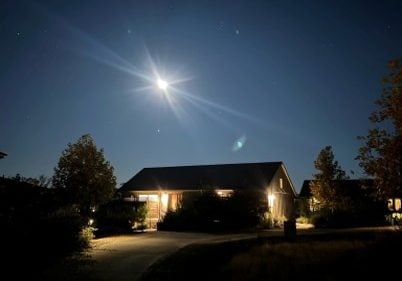
Someone once told me, when I was nine, that some of the stars I was looking at were already dead. The light takes so long to get here, he said, that the star can burn out along the way, and you go on seeing it for years, for centuries, a bright thing in the sky that isn’t there anymore. I remember deciding not to love any particular star, in case it was one of the dead ones, and feeling that I had been let in on the sad mechanics of the universe a little early.
This is the kind of fact that feels too poetic to be false, and so you never check.
It is mostly false.
The stars you can see with your naked eye are, with very few exceptions, still there. Stars live for millions or billions of years, and the ones bright enough to see without a telescope are mostly close — tens, hundreds, a few thousand light-years out. A few thousand years of travel time, against a lifespan of billions, is nothing; it is a held breath. The light is old, yes, but the star almost certainly survived the trip. When you look up at the familiar ones, you are not looking at a graveyard. You are looking at things that are exactly where they appear to be, still burning, indifferent and alive. That person was wrong, in a way that had comforted and frightened me for half my life. When I finally learned the truth, I felt the small vertigo of a consequential belief being removed.
But here is what I have come to think the real fact is, the one underneath his lovely mistake. It is not the stars that are ghosts. It is everything closer.
The thing he got right is that there is no such thing as seeing something now. Light is fast but it is not instant, and so everything you have ever looked at, you looked at late. The sun you squint at is eight minutes old; if it went out you would have eight more minutes of ordinary afternoon before the news arrived. That much, most people know. What they don’t realize is how far down it goes. The face of the person across the dinner table reaches you a few billionths of a second after it leaves them. Trivial, unmeasurable, irrelevant — and absolutely true. You have never once seen another human being in the present tense. By the time their face arrives, by the time the signal climbs your optic nerve and your brain assembles it into a person, the moment it came from is already gone, and they have already moved a little further into a “now” you will never quite reach. We are all, to each other, slightly old light.
This is not a trick of distance. Even setting aside the physics, your brain takes time to build the world — a fraction of a second to turn the incoming signal into the seamless, convincing present you seem to live in. The present you experience is a reconstruction, finished a beat after the fact and handed to you as breaking news. Nobody lives in the moment. Nobody can. We live a hair behind it, always, every one of us, receiving the world the way the Earth recieves starlight.
I find this more consoling than frightening now, though it took me a while to turn it over. If it is true that we never meet anyone in their present — if every face we love is a slightly former edition of itself, already changed by the time it reaches us — then love is not, and never was, the act of seeing someone clearly in the moment. It can’t be. It is the act of remaining faithful to the light that arrives, knowing it is already history, addressing yourself with your whole heart to a person who has, in the strictest sense, already moved on. We do this constantly and call it ordinary. We look at the people we love and we are looking, every time, at who they just were.
Grief, I think, is only this same delay made unbearable. When someone dies, the light does not stop. It keeps arriving. You go on receiving them — a phrase in their cadence rising in your throat, the sense of them in a doorway, the reflex of reaching for the phone. The cruelty is that they keep arriving after they are gone, bright and exact, a signal still in transit from a source that has burned out.
The person described the wrong object. The star wasn’t the dead thing still shining. He was. He has been gone for years, and he is still, by any honest measure, arriving. I am still inside the long travel time of him, still receiving light he sent before I knew it mattered.
I know the stars are mostly alive; I know he had the facts backwards. But he handed a nine-year-old the only true thing: that what reaches us has always already left, that we love and grieve on a delay we cannot close, that the sky is full of old light and so is every room you have ever sat in with another person. To look up is not to look at the dead. It is to keep company with everyone you have ever known, all of them arriving late, all of it old light, and to decide that arriving late is not the same as not arriving, and that you will go on looking anyway.