
Editor’s Note: This story contains references to suicidal ideation and mental illness that may be troubling to some readers. Several sources requested anonymity due to fears of retaliation or discomfort speaking publicly. In those instances, pseudonyms have been used for readability.
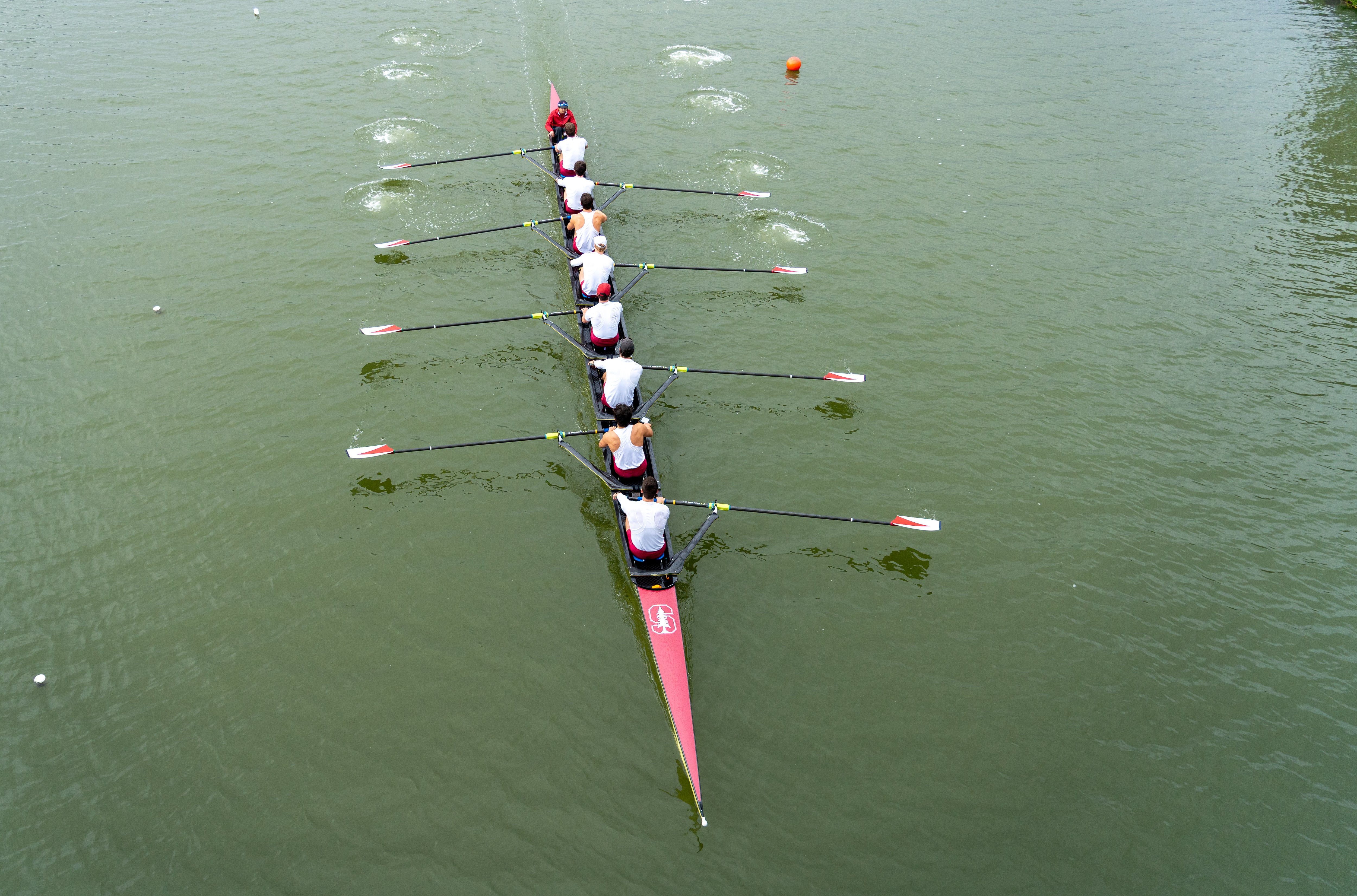
Reclined in the bow of the shell, just inches above the water’s surface, a coxswain steered the four rowers through choppy waters. As the rain came down during a Wednesday practice, the coxed four were in the middle of a 20-minute race when they entered the wake of a nearby research vessel.
The waves from the wake entered the boat, sinking it further into the water and submerging the coxswain. The rowers looked at their coaches in despair. In response, they repeatedly told the team to “endure,” said former rower Arthur Scott ’27.
“It was just so incredible, and such a lack of humanity,” Scott said.
This account is one of many from six former members of the Stanford men’s rowing team who spoke to The Daily.
Together, they alleged that head coach Ted Sobolewski and assistant coach John Pojednic cultivated an environment in which rowers felt pressured to train even while seriously ill or injured, going against explicit medical advice.
The Daily requested comment from Sobolewski and Pojednic via an Athletics Department sports information director, per department policy.
“We are unable to comment on personnel matters due to legal and privacy considerations,” Stanford Athletics replied in a statement to The Daily. “We take all matters related to student-athlete health and safety seriously.”
Former rower Wilder Fulford ’26 said that multiple current rowers admitted in confidence to him that they “were considering hurting themselves and committing suicide” as a result of “feeling trapped in the environment.”
Ethan — who requested to use a pseudonym due to discomfort discussing the subject publicly — said he dealt with recurring colds and eight fevers during one school year.
Pierce — whose name has been changed due to his fear of retaliation from the coaches — said he battled two bulging discs and was forced by Sobolewski to complete a one hour maximal test while recovering from pneumonia against written doctor’s orders. Following the test, Pierce said he was shaking and vomiting through the night.
Brady — whose name has also been changed due to his fear of retaliation from the coaches — said that he experienced recurring nerve pain in his back and legs, leaving him crying in pain on the floor.
Finn Stäblein ’26, a former rower, said the team culture focused on “grind[ing] down the athlete and then see[ing] who survives.” Some of the former rowers directly blamed the coaches for this environment.
“They seem to have such a twisted idea of what success means and how to achieve success,” Scott said.
Sobolewski and Pojednic have trained the team since 2019 and 2023, respectively. By the end of the 2025-2026 academic year — three years since the pair began running the program together — at least 12 recruited rowers had left the team.
In response to an initial report of the allegations by The Stanford Review, current members of Stanford men’s rowing published a statement via Instagram on June 8. The Review’s article described injuries, lack of instruction and abrasive behavior from the coaching staff.
“We reject the suggestion that the challenges faced by Stanford rowers are unique to this program or that our athletes are left to navigate them alone,” the statement read. “Navigating those challenges through a strong team culture, under the guidance of our coaching staff is what has made our success rewarding.”
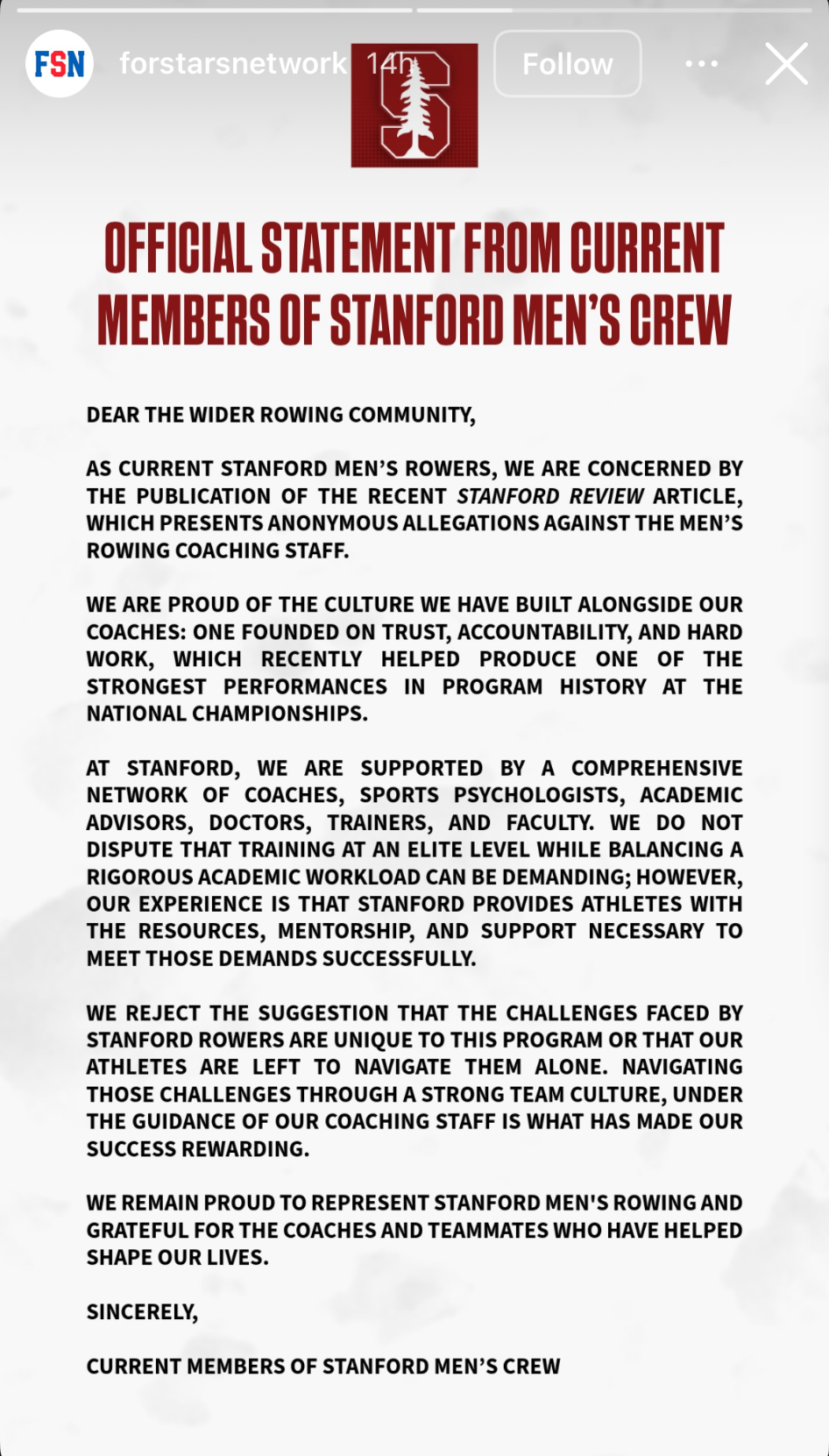
Courtesy of @thefourstarsnetwork on Instagram
In interviews with six former team members, The Daily gathered further allegations of undue injuries, neglect and an abusive team culture. Two additional former team members defended Sobolewski and Pojednic. They framed the allegations as isolated incidents and stressed the role of team resource constraints. Current team members did not respond to requests for comment.
‘100-day cough’
Multiple former rowers said that Sobolewski and Pojednic popularized the term “baby cough,” using it in team meetings during the winter when a rower was ill and unable to fully engage in training.
“The coaches don’t really believe the rowers are actually sick,” Fulford said.
According to Scott, Sobolewski often asked the rowers, “Are you going to stop coughing now?” and would call displays of sickness “performative.”
In 2023, a COVID-19 outbreak spread throughout the team, according to former rower Schuyler Audley-Williams ’27. Rowers were encouraged not to test and to “will themselves out of illness,” Audley-Williams said. “I was told exercising would make me better because I’d cough it up.”
He added that rowers coined the term “100 day cough” to refer to the illnesses afflicting the team, as rowers seemed to be wheezing, coughing and unable to breathe for months due to incessant training.
In addition to recurring illnesses, multiple rowers described sustaining intense injuries. These included recurrent back spasms, nerve pain and bulging discs that were repeatedly aggravated by premature returns to full training.
According to Brady, to avoid the excruciating pains associated with their injuries, several athletes were “advised by [Sobolewski and Pojednic] to take Advil every day” before morning practices.
A contested team culture
In contrast to the six rowers who blamed Sobolewski and Pojednic for a lack of training and neglect, other former rowers, Grayson and Ethan — who requested to use pseudonyms due to discomfort discussing the subject publicly — described Sobolewski and Pojednic as “very caring people” and emphasized that the team culture was shaped by resource constraints.
The team was nearly cut in 2020 before Stanford reversed its decision, and has been building back ever since. According to Grayson, with a smaller roster, the coaches needed every person in the boat to run a full practice and heavily encouraged all athletes to attend. Pushed by the desire to win, Grayson said that the coaches were doing their jobs and the underlying issue was a lack of student-athlete self-advocacy.
Grayson described the relationship with the coaches as an “employee-boss” dynamic. “Your boss will try to celebrate you and support you, but that doesn’t mean they’re not going to make mistakes,” Grayson said.
Given this dynamic, Grayson said the rowers should have spoken up more about their medical needs. “People don’t realize how much they’re going to have to advocate for themselves because they came from environments where they didn’t have to,” Grayson added.
Ethan acknowledged that he had “grievances” with Pojednic, but described him as a “fantastic coach.”
Multiple rowers countered this position, saying there was no open line of communication between the team and the coaches.
“There is no clarity to how you are doing in terms of your rowing, or in terms of how you’re doing in terms of your relationship with the coaches, which leads to a culture of fear,” Audley-Williams said.
According to Fulford, some current members of the team “explicitly want the coaches gone” but fear retaliation.
‘More like cattle’
According to multiple former rowers, training on the team could be merciless.
In Pierce’s view, “[Sobolewski] thinks of the guys as being more like cattle.” He recalled the coaches saying, “‘people don’t like to see how sausage gets made, but they like sausage.’”
Multiple former rowers said that issues also stemmed from a lack of development opportunities.
As a first-year student at Stanford, Stäblein transitioned from sculling, rowing with two oars, to sweeping, rowing with a single oar, to compete in the eight. The transition process requires time and meticulous technical training. Yet Stäblein said that he received neither, leading to a rib stress injury.
Stäblein added that he was not taught how to sweep well due to the coaches’ lack of training and technical expertise. “They’ve gotten some of the best people recruited and still, the program is not performing well.”
In 2026, the team completed one of its most successful seasons in recent years and won the Chapman Trophy for Most Improved as the team with the greatest year-over-year point increase in the Ten Eyck standings.
Scott said the team routinely trained beyond the NCAA’s 20-hour weekly limit, and that some rowers declined to complete NCAA practice-verification forms rather than attest to compliant hours. The Daily could not independently verify this claim.
With four-hour training six out of seven days of the week, rowing consumes most of their lives, which can come at the cost of isolation, Audley-Williams said.
Those who did not follow the coaches’ instructions were ostracized or “banned to the shadow realm,” Scott said.
A mental toll
The training wore on a number of rowers, including Lucas Johnson ’26, who was in the top boat in his freshman year. Johnson dealt with repeated illnesses and depression and struggled with academics during his sophomore year.
In text messages from Oct. 13, 2024, obtained by The Daily, Johnson requested to miss the team run and practice due to illness and advice from a team trainer.
Sobolewski texted back, “…unless you have a fever or are currently unable to hold food down, I think you should run. I know there are other guys who also aren’t 100% but they’re going to find a way to get it done.”
He then added, “For the record you’re the only guy so far this year that’s texted the coaches about not being able to practice and by my count it’s twice that this has happened now.”
Johnson declined to comment.
According to Pierce, the coaches continuously pushed Johnson to prematurely return to training while battling illness. Johnson later quit the team and unenrolled from Stanford.
Multiple former rowers said that the team culture instilled by the coaches negatively altered their mental health.
At the beginning of sophomore year, Audley-Williams was diagnosed with depression and anxiety, which he described as “exacerbated by the culture of rowing.”
Prior to attending Stanford, Scott said that he had never received psychological help. After his freshman year, he began seeing a psychiatrist and continued for the rest of his time on the team.
‘Just a slap on the wrist’
Following Johnson’s leave, Pierce said he raised concerns about the team culture to the coaches. In response, Pojednic replied that some people were not cut out for the rowing team, Pierce said.
Pierce then went to the administration, speaking with his academic advisor and administrator Meredith Basil. He was also scheduled to meet with the rowing associate athletic director, but said he faced retaliation before he could.
During the following race weekend, the coaches discovered that Pierce was speaking to someone in the administration. Pierce said that Pojednic pressed his finger into his chest, yelled expletives and called him a “cancer.”
Pierce told The Daily that he was put on leave from the team by Sobolewski that same afternoon, who said that if he were to bring the incident up with the administration, “it would be his word against mine.”
Stanford Athletics investigated Sobolewski and Pojednic in November 2024 following Pierce’s meetings with administrators.
On a Saturday night, just days before the investigation concluded, Pojednic texted Fulford that the situation had “already dumbed down enough of my attempts to actually coach you guys. Overall, a said [sic] situation where we need to pretend that we might be able to succeed with nothing to back that up.” These texts were obtained by The Daily.
The Stanford investigation found no substantiating evidence, and concluded with Sobolewski and Pojednic staying on as coaches.
“The coaches actually just received a slap on the wrist,” said Fulford. “Following on from that, we had two more years of the same sort of physical harming.”
While some write off intense training as inherent to the sport, others say that Stanford men’s rowing culture has surpassed the standard of Division I athletics.
“Everywhere else, suffering is the thing you must do in order to improve, whereas here it is the task. The task is to endure suffering,” Audley-Williams said.
Though they have left the team, many former rowers said they were speaking publicly out of a desire to change the culture for future generations.
“Many excellent men and women are suffering…I would find it very difficult to not help,” Audley-Williams said.
The Sport Psychology and Psychiatry Program offers expedited access to mental health care and sport performance services for actively enrolled Stanford University Student Athletes.
If you have thoughts of suicide or are concerned about the well-being of another, contact the 988 Suicide & Crisis Lifeline by calling or texting 988, or Stanford’s Counseling and Psychological Services (CAPS) at 650-723-3785.
Correction: A previous version of this article erroneously cited Pierce and Hugo under separate pseudonyms. The article has been updated to reflect them under the same pseudonym of Pierce.