
Editor’s Note: This article is a review and includes subjective thoughts, opinions and critiques.
Oftentimes, the horror genre exists as a subset of fantasy. While terrifying, comfort lies in the fact that such terrors cannot be realized, for the monsters are simply too otherworldly.
In recent times, the horror film has devolved from attempting to tell a story to trying to amass the biggest shock factor, often through extensive gore aided by the ease of killing unintelligent characters. As such, I was surprised to hear that what “Obsession” was being commended on the most, beyond the stellar performance of Inde Navarrette as Nikki, was phenomenal writing.
The film starts with Bear struggling to confess his feelings to Nikki, ultimately making a hasty wish for Nikki to “love him more than anything in the f—ing world.” Bear then pursues a relationship with an increasingly irrational Nikki, struggling between his desire to be with her and to fathom that she is no longer the person he wanted to be with.
“Obsession” is truly a class act showcase of what a horror film should be. Beyond providing a monster one can encounter in everyday life (which I must clarify, I do not think is a requirement for good horror, though I do think good horror requires a connection to reality), it feels like an art project rather than a commercial product.
Nowadays, especially with bigger production companies like Netflix, movies have turned more into a lousy cash grab, with lacking storylines, characterization and videography. Characters make dumb decisions while faced by dumb problems all while looking like someone turned the saturation up to one-hundred percent. If not this, then all colors are completely muted, as if all the film’s lifesource had been sucked out.
“Obsession” was a breath of fresh air, where the film actually feels like an artform. I found the lighting to be particularly powerful, such as the frequent shadow over Nikki’s face — with occasional choices to either showcase half her face or just a glint in her eyes, creating an eerie feeling but also highlighting how it was no longer actually Nikki.
Returning to the narrative, the writing flourishes within the character of Bear and the horrors he displays towards Nikki.
Bear is an expression of evil that deviates from the classic villain archetype. He is not cruel because he actively pursues his corrupt desires; he is cruel because he exists passively. Whereas others disrupt existing structures, he abuses them.
Though it is not until the midway point of the film that many Youtube reactors characterized Bear as anything other than a guy who made a bad choice, I believe director and writer, Curry Baker, shows you just who Bear is from the very beginning.
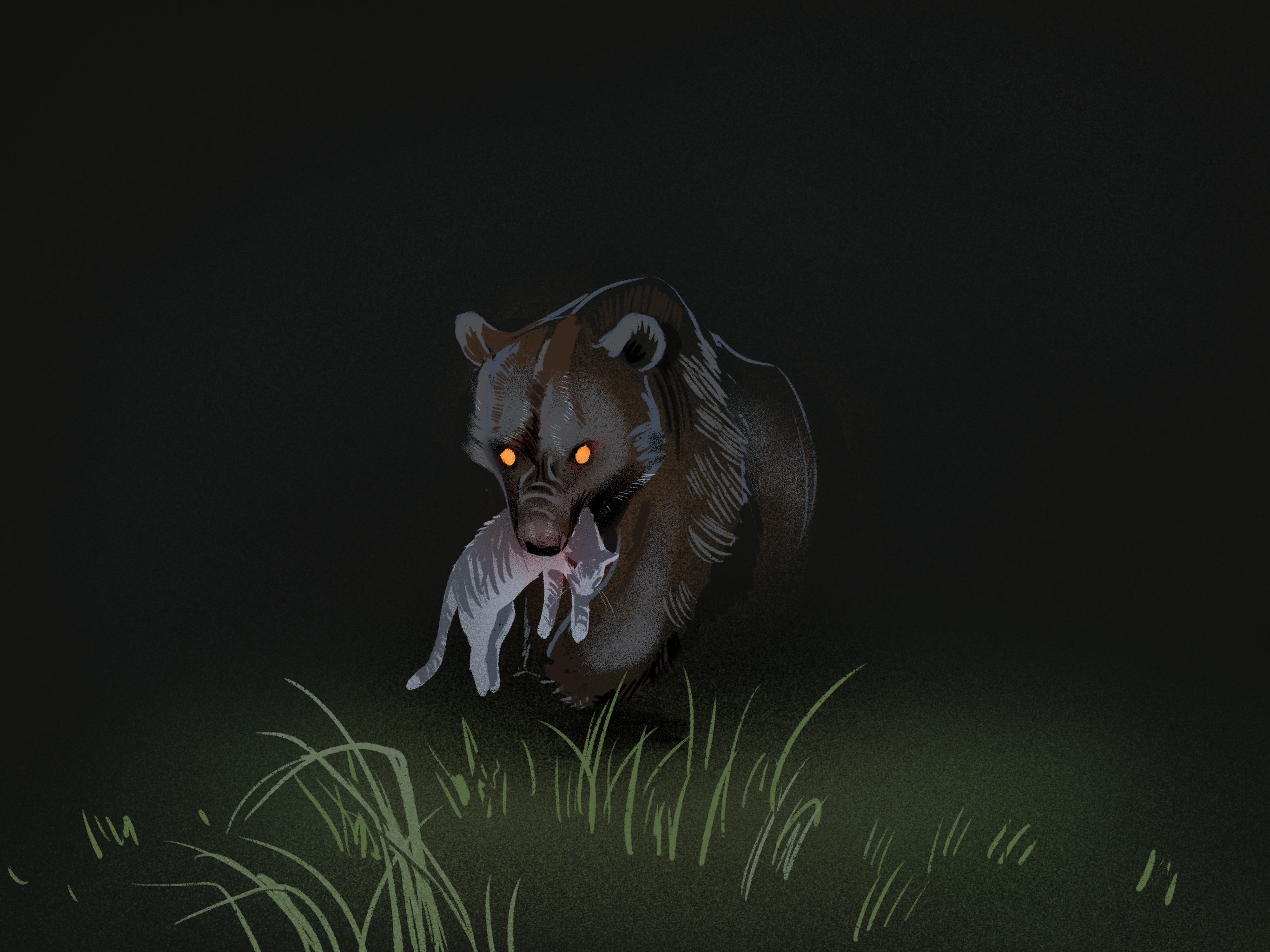
Bear is the type of guy who leaves pill bottles open in his house, fully aware that he has a cat, Sandy, who could die by ingesting them. Bear is the type of guy who finds Sandy dead after taking said pills and feels no blame, instead asking in disbelief how she got into the bottle. Bear is the type of guy who kisses Nikki, a woman he supposedly cares for, when she is unable to properly consent: drunk, supposedly emotionally unstable due to her dad’s situation and acting totally unlike herself. Bear is the type of guy who pursues a relationship with Nikki despite her concerning behavior. He lacks care for both his own well-being and others’ so long as he is getting what he believes he wants. He is the type of guy who does not think when what he might discover might not serve him.
He displays a type of cruelty perhaps more terrifying than being purely vile, for it is one borne of convenience — one that flourishes solely because existing structures support its presence. For Bear, this structure is the One Wish Willow. The One Wish Willow allows everyone to make one singular wish, and acts upon the user’s intention — not searching for any way to twist the wisher’s desires.
I will give Bear one pass: he had no clue that his wish, said in frustration at his cowardly nature would actually be realized — though I can barely grant even this, because I have watched one too many movies and read one too many books to ever take a magical or haunted object lightly.
In a way, the willow mimics the many patriarchal practices at play in modern society — systems that can be taken advantage of … but also needn’t be if you have even the smallest amount of human decency.
Bear exists within this structure and only finds a fault with it when he isn’t granted exactly what he wants: a Nikki who submits to him entirely, who acts exactly as he wishes she would.
He does not have a single moment in this film where he does not solely consider himself. Even when the real Nikki asks him to kill her, his only response is: “What would be so wrong about being with me?”
He cannot place any person above himself, because in his mind he will always be the victim. His lack of action makes him a person things happen to, not someone who sets things in motion. Bear is a reminder that sometimes evil is stillness. Sometimes inaction is action — the acceptance of predisposed evil is still evil.
Nonetheless, he dies. He escapes. And the real Nikki finally awakes, her three friends dead at her feet and a jail sentence likely on its way.
She is robbed of her life simply because a man couldn’t find the courage to confess.