
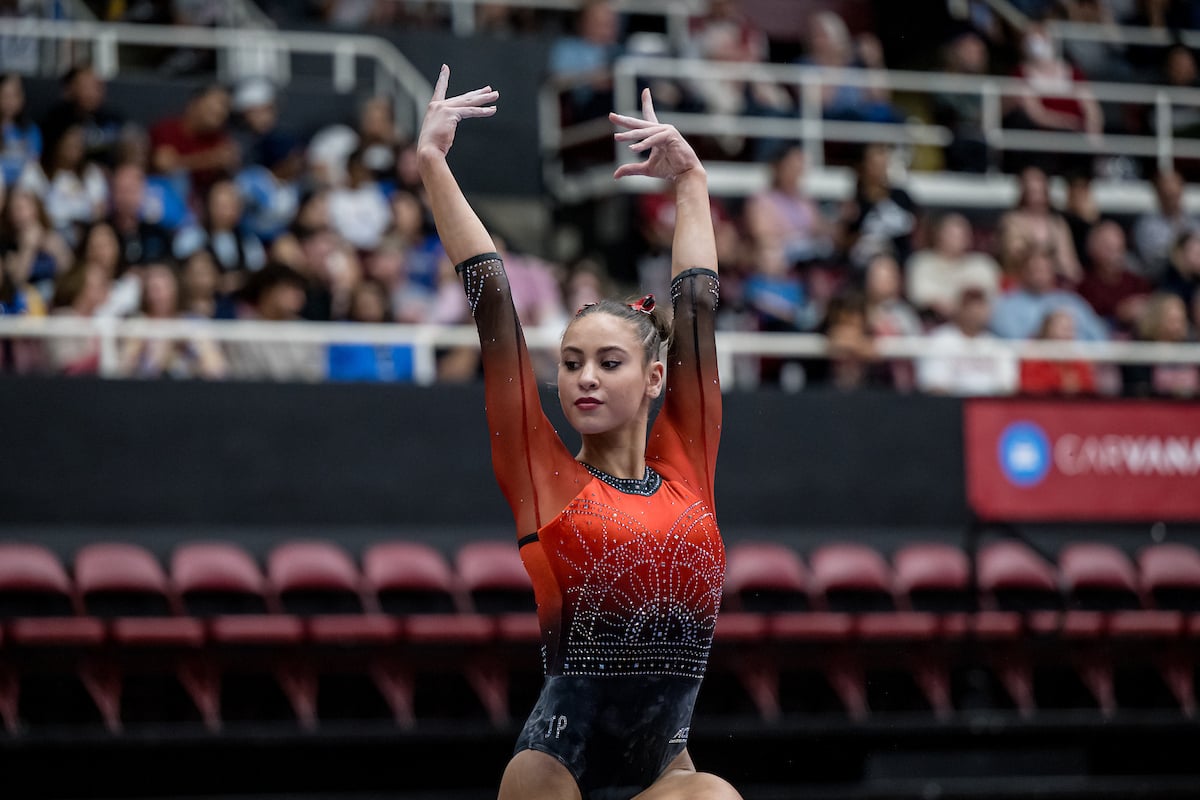
Levi Jung-Ruivivar ’28, an athlete on the women’s gymnastics team, returned to elite gymnastics this week while representing the Philippines at the Asian Games in Aichi-Nagoya, Japan. Jung-Ruivivar placed 10th in the women’s all-around final and sixth in the team event alongside her Philippines teammates.
After competing at the 2024 Paris Olympic Games as a member of the Philippines gymnastics team, Jung-Ruivivar took a five-month break from the sport to recover from an eating disorder. She began competing again during the 2026 collegiate season, where she earned three NCAA All-American titles as a redshirt freshman.
“I feel like I’m in a very different place now than the last time I talked to The Stanford Daily,” Jung-Ruivivar said. “[Taking a break] has allowed me to feel so strong, both mentally and physically. So at this Asian Games, I’m easing myself back into doing elite. I’m just getting my feet wet.”
Jung-Ruivivar began feeling pulled back to elite gymnastics during the 2026 collegiate season.
“The collegiate season was first and foremost [in my priorities]. I have a commitment to … my team and my coaches, so I was focusing on that,” she said. “But I was finishing my assignments pretty early, so I was asking my coaches if I could throw some elite skills in there for fun.”
Jung-Ruivivar was surprised to find that her strength and endurance were on par with her pre-Olympics conditioning. Realizing her new level of fitness made her consider returning to the elite stage.
“I love college gymnastics, but elite has always been where my heart is at. … So I started to think about maybe possibly going back to elite. But I really wanted to make sure that I was pacing myself, doing it in a healthy way, not putting too much pressure on myself and taking care of my mental health,” she said.
This year’s Asian Games are just one step towards Jung-Ruivivar’s larger goal of qualifying for the 2028 Olympic Games in Los Angeles. In addition to competing in her second year of collegiate gymnastics, Jung-Ruivivar plans to attend next year’s Asian Championships before aiming for Olympic qualification at the 2027 World Artistic Gymnastics Championships in Chengdu, China.
“It’s really important for me to get a few competitions under my belt in elite before I go for the most important ones for my Olympic [qualification],” Jung-Ruivivar said. “Representing the Philippines again, building my relationships with the team, and seeing where I stand with my current skill level and [my] current preparation, I can use it as information for me to go back and work on where my weaknesses are and build upon my strengths.”
Alongside physical conditioning, much of Jung-Ruivivar’s preparation will involve training the mental aspect of gymnastics.
“I am in a place now where I can trust myself a little bit more because I’ve done the preparation for it. I think my eating disorder was holding me back a lot from being able to have that … consistent trust with myself,” she said. “Now, it’s about finding my rhythm and my confidence and letting loose a little bit more.”
Also key to Jung-Ruivivar’s training will be challenging herself with more difficult skills in the gym.
“I’m really excited to try new skills and connections and put together some pretty difficult routines, because I’ve always loved the feeling of pushing myself,” she said. “I really want to test my limits this cycle, but in a way that’s enjoyable for me.”
Jung-Ruivivar believes her newfound mental and physical strength combined with hard work both inside and outside the gym will help her achieve her best results at her upcoming competitions.
“I really do have a lot of big goals for [the 2028 Olympics], and I genuinely believe in myself and my ability to achieve those goals,” she said. “I really want to work on pushing myself and giving myself the best opportunity to not only go to 2028, but potentially medal.”