
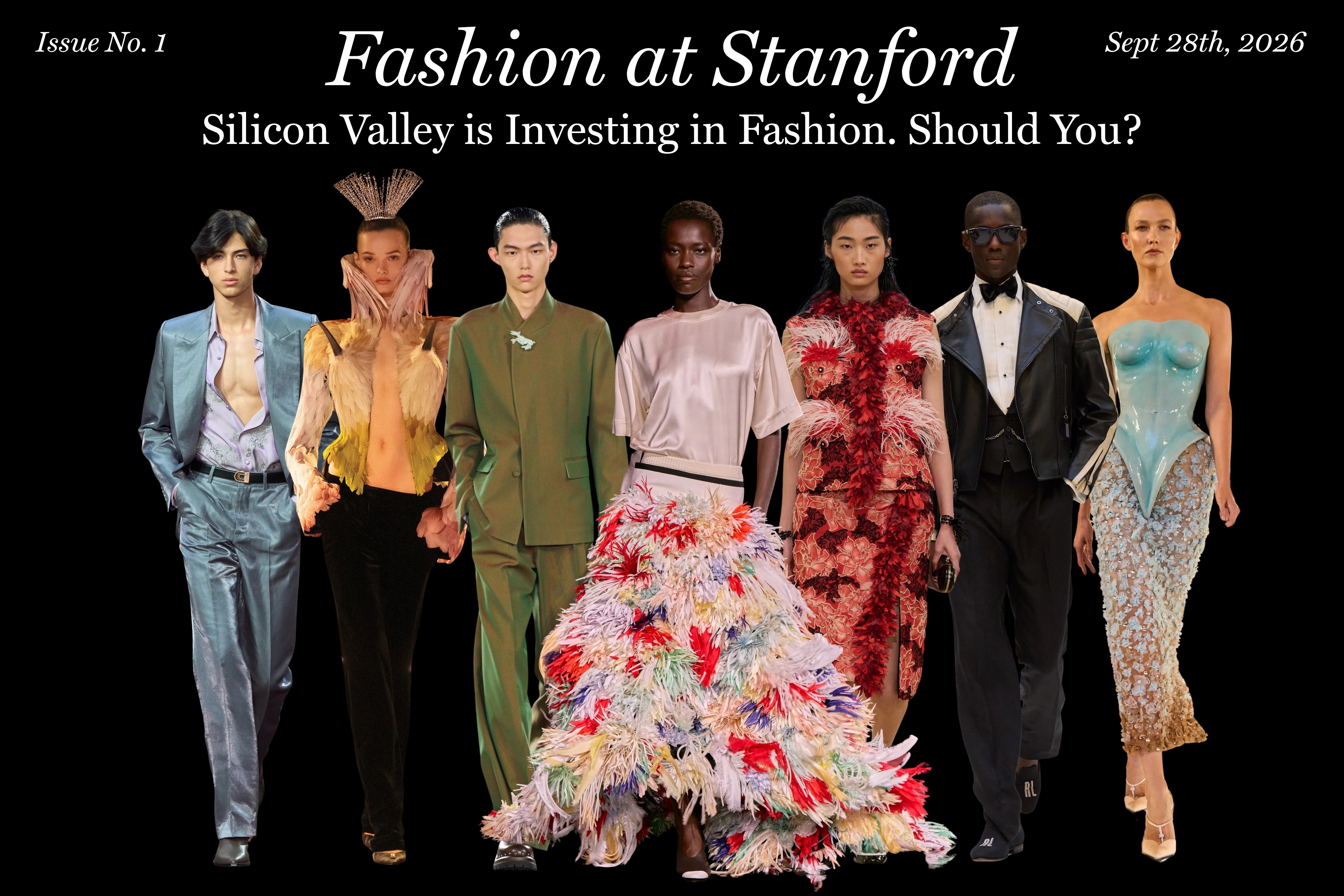
In a now-viral moment during last Tuesday’s Vogue World show in Milan, four humanoid robots made by Chinese tech company UniTree walked the runway, waved their arms in the air and beckoned applause from the crowd. The result was mixed: while some front row figures like Donatella Versace clapped, others like former Gucci creative director Alessandro Michele stayed visibly quiet, illustrating that perhaps the fashion industry itself is unsure about how tech fits into its future.
Like tech, fashion is in a constant pursuit of newness, a trait best embodied by the commonly held belief that the mark of a talented designer is one who can design a completely new silhouette. But at the same time, many worry that the newness offered by technology could erase fashion’s other essential trait: human creativity.
When I think of fashion in Silicon Valley, I’m brought back to Steve Jobs, who famously wore the same outfit every day: a black turtleneck and blue Levi’s jeans. In many ways, Jobs’ iconic style was the predecessor to the modern tech bro uniform, whose resistance to traditional workplace dress codes reflected the techno-libertarian ideals of an emerging Silicon Valley. But on the other hand, Job’s uniform actually placed him in an important fashion lineage — one that suggests the relationship between Silicon Valley and the fashion industry may run far deeper than it seems.
Job’s black turtleneck was designed by legendary Japanese fashion designer Issey Miyake, most known for his “Pleats, Please” line, which uses a patented technique to create rows of sharp, but flowy pleats in his clothing. Job’s blue jeans told a fashion story too: Levi Strauss came to San Francisco during the Gold Rush but didn’t lift a pickaxe once. Instead, noticing that workers’ pants were tearing at the seams, Strauss and his colleague invented a pair of denim work pants reinforced with rivets, birthing the Levi’s jean! While few actually made money mining for gold, Strauss amassed one of the largest fortunes from the Gold Rush period — a time that is often compared to the AI boom we are living through now. Levi’s has since grown into an eight billion dollar company, just a fraction of the two trillion dollar fashion industry, one which we all participate in every day!
Like Jobs, many modern tech titans have been making their forays into the fashion world. Recall when Mark Zuckerberg hired a stylist back in 2024 — the entire internet noticed when he suddenly traded his grey zip-up hoodies for boxy black designer T-shirts and chunky gold chains. More recently, he was spotted front row in Milan at the Prada Fall Winter 2026 show, where he was the last to enter alongside none other than Anna Wintour herself.
Why does Zuckerberg suddenly care about what they’re sending down the runways in Milan? Some argue that what Zuckerberg actually wants is “cultural capital”, a term coined by the internet’s favorite sociologist Pierre Bourdieu: non-financial, social assets that confer status. Fashion, having a long history with class and status, is a vehicle for the new wealth of silicon valley to gain the respect of the elites.
It was recently announced that Vogue World 2027 will take place in…San Francisco? This left fashion industry insiders with many questions, and perhaps booking their first ever flight to our city. Is Wintour trying to replicate Levi Strauss’ success by dressing the new millionaires of the AI boom? Are Silicon Valley elites trying to put San Francisco on the map as a center of cultural capital? Could technology be the metaphorical “new silhouette” of a seemingly exhausted modern fashion? Or perhaps has San Francisco indeed had a history with fashion all along? Each of our era-spanning tech titans illustrated these different roles that fashion can play: Strauss proved that the fashion industry is an enormously profitable, and often ignored, business; Jobs showed that clothing plays a role in creating and communicating identity; and Zuckerberg is illustrating in real time that fashion is an extremely important arbiter of cultural capital.
Perhaps nowhere is this convergence more important than here at Stanford, where future artists, entrepreneurs, designers and tech titans are sitting in the same classrooms and living just down the hall. So, over the course of the next nine months, I will take you on a journey from London, to New York, to Paris and to Milan, all without leaving campus. Whether you are fashion obsessed, a sworn skeptic or even just curious, there will be something for everyone. Quickly, pack your bags, because our first fashion week is just around the corner! First stop: Paris!