
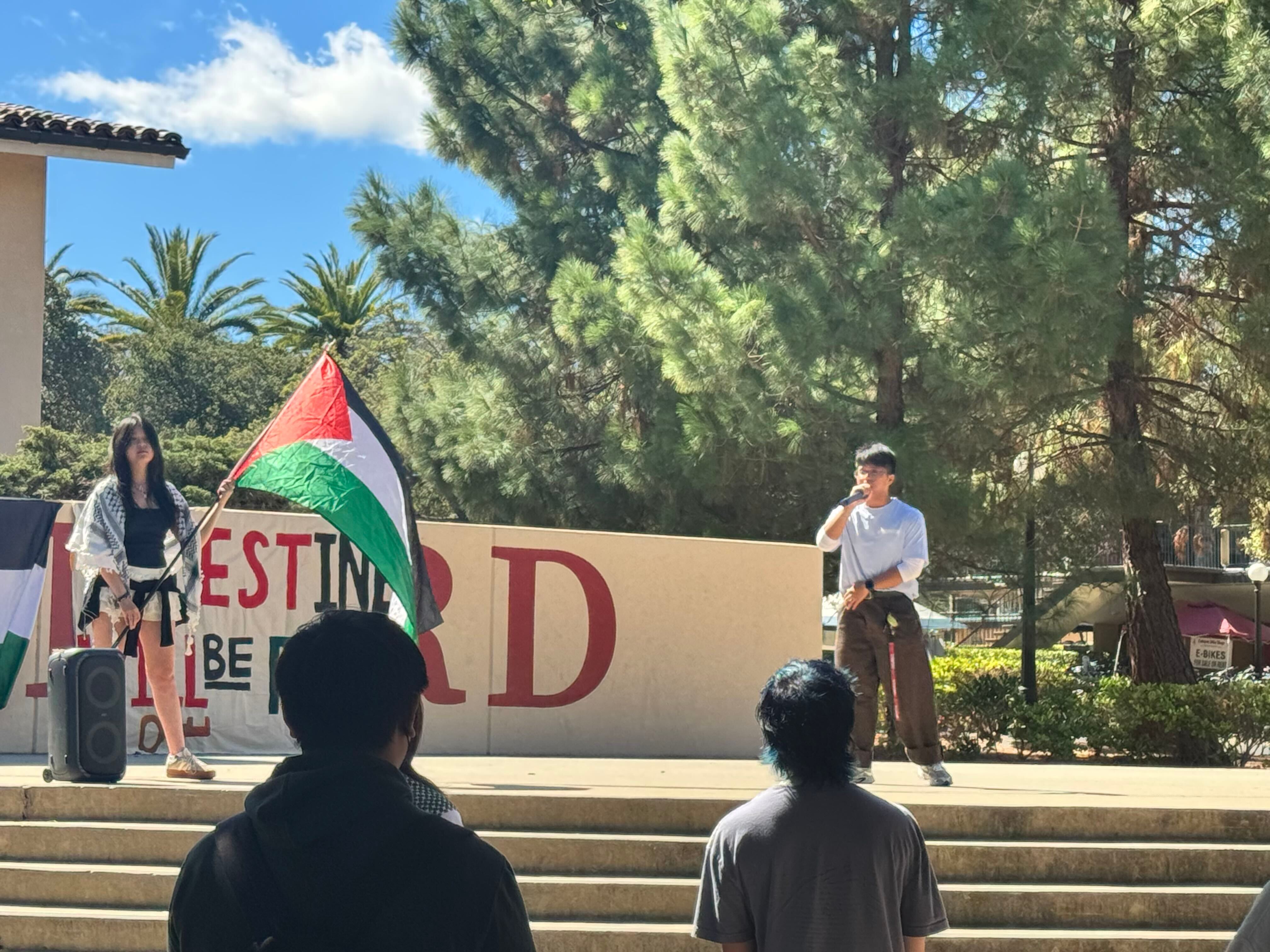
A conglomerate of campus activism organizations, including Stanford Students for Justice in Palestine (SJP), Stanford Asian American Action Committee (SAAAC) and Stanford Tech for Liberation (T4L), hosted a rally last Friday to protest America’s role in Iran, Palestine and elsewhere. The ‘(Dis)orientation’ rally intended to criticize Stanford’s image as a positive institution, and drew a crowd of about 30.
Representatives from each club addressed an aspect of what they described as American imperialism relevant to their organization.
In between speeches, event organizers led chants and passed out small papers to attendees to encourage their participation. Chants included “When we fight / we win,” “no boots on the ground, no bombs in the air, / U.S. out of everywhere” and “not another nickel, not another dime / no more money for U.S. crime.”
Jacob Roe ’27, a member of the Stanford Native Action Coalition, spoke about the struggles of American indigenous peoples and Stanford students’ obligations to the Muwekma Ohlone people. Roe closed his address with a traditional song to “ground the rally” through connection to native peoples in America, according to a statement he wrote to The Daily.
Andrew Chen ’26 represented the SAAAC, which he described as “an anti-imperialist collective of diasporic Asian American students who stand against American capitalists, lining their pockets through the exploitation of people of color around the world.” He opened his speech with frustration, saying that in his early time at Stanford, he felt disgusted with American involvement abroad and expected “solidarity” from his peers — but found only “complacence” instead.
He called for Stanford students to organize against “U.S. intervention” abroad, citing historical Stanford protests against South African apartheid and the recent pro-Palestine sit-in. “From Iran to Iraq, Libya, Venezuela, Afghanistan, Palestine, Vietnam and the Philippines, we stand in solidarity […] with all people resisting the U.S. empire” he said.
Jenny Ballutay ’28, the Managing Editor of the Daily’s humor section, spoke on behalf of the League of Filipino Students (LFS). As a Filipino student, she focused on American involvement in the Philippines, including both historical and present-day exploitation of resources and dependence on America, particularly criticizing recent American movements to obtain land sovereignty in the nation. Ballutay cited current U.S. intentions to obtain land grants in the nation as an example of land abuse, and the pardoning of transwoman Jennifer Laude’s killer, to “keep the peace,” as an example of U.S. dependence.
“Now, America wants to bring data centers to the Philippines, to pillage and dirty the water further. They want three-hundred-thousand gallons of our water daily. […] They want nickel, they want copper, they want cobalt, they want to rip apart ancestral land with the same indifference in which they poisoned it,” said Ballutay, referencing both past and present American industry in the Philippines.
In a statement to The Daily, Ballutay said that LFS, while new to Stanford, has chapters around the world, all dedicated to “fight off the institution of corruption in the Philippines.” She hopes that the club at Stanford can focus more attention from the western world onto “our brothers and sisters in the Philippines.”
Club co-president Allana Moore ’27 spoke on behalf of Tech for Liberation (T4L). In a statement to The Daily, Moore described the club as a resistance effort against the use of technology as weapons of war and oppression. She cited the numerous technologies developed initially for war, including the radar and internet and criticized the University’s involvement with war technology.
“Stanford’s been at the center of that. We are the incubator, the hotspot,” she said.
She opened her speech by contrasting what she described as Stanford’s projected image with its reality: “NSO is over, and we’re here to hold up a mirror to the ugly truth of what Stanford actually is,” Moore said as she began her speech. She claimed that Stanford’s presentation as an “altruistic accelerator for positive social change” was false.
“[While] our planet burns, our cities sink, and our fellow humans face deaths and despair […] Stanford exists to develop the tools and train the professional managerial class who will carry out the dirty work of the western empire,” she said.
She said that Stanford funnels students into careers which support war profiteering and imperial capitalist agendas. In a statement to The Daily, she wrote that she hopes her peers will take an alternative route and opt to follow their values over their money.
The final speaker, who was not publicly identified, read a statement on behalf of the Stanford 11 and Stanford Justice for Palestine (SJP). The statement celebrated the recent conclusion to the Stanford 11 trial, in which the California Attorney General’s Office dropped charges against the five remaining defendants.
“After months of tireless student protests, the president and provost refused to call for a ceasefire and an end to scholasticide in Gaza. We watch Stanford leaders refuse to do the very minimum of leading the university responsibly by calling for a ceasefire,” the protestors wrote in their statement, which was read out at the rally by an unidentified speaker.
The Stanford 11 echoed Moore’s criticism of Stanford in their statement. “This year at Stanford, you are often going to be encouraged to take the easy way up. […] You are going to be encouraged to take that internship with a defense contractor or an AI startup,” the Stanford 11 wrote. “But there is so much more that you can do.”
Reid Smith ’28, an attendee of the rally and co-president of the Jewish Voice for Peace (JVP) club, said he resonated deeply with this sentiment.
“The victory of the Stanford 11 shows that the people do not accept the status quo, the deeply unethical decisions and…the pipelines for really terrible industries that exist on campus,” Smith said. “We will fight against that way of thinking and that repressive structure.”