
On Sept. 28, the Senate passed the Protect College Sports Act (PCSA), a bill that aims to standardize and stabilize college athletics but has received pushback from current and former Stanford football players.
In summary, the PCSA codifies athlete compensation rules, standardizes a one-time transfer window with a five-year eligibility clock, bans midseason coach departures, caps agent fees at 5% and caps conference expansion by penalizing schools moving between power conferences, requiring three years as an independent.
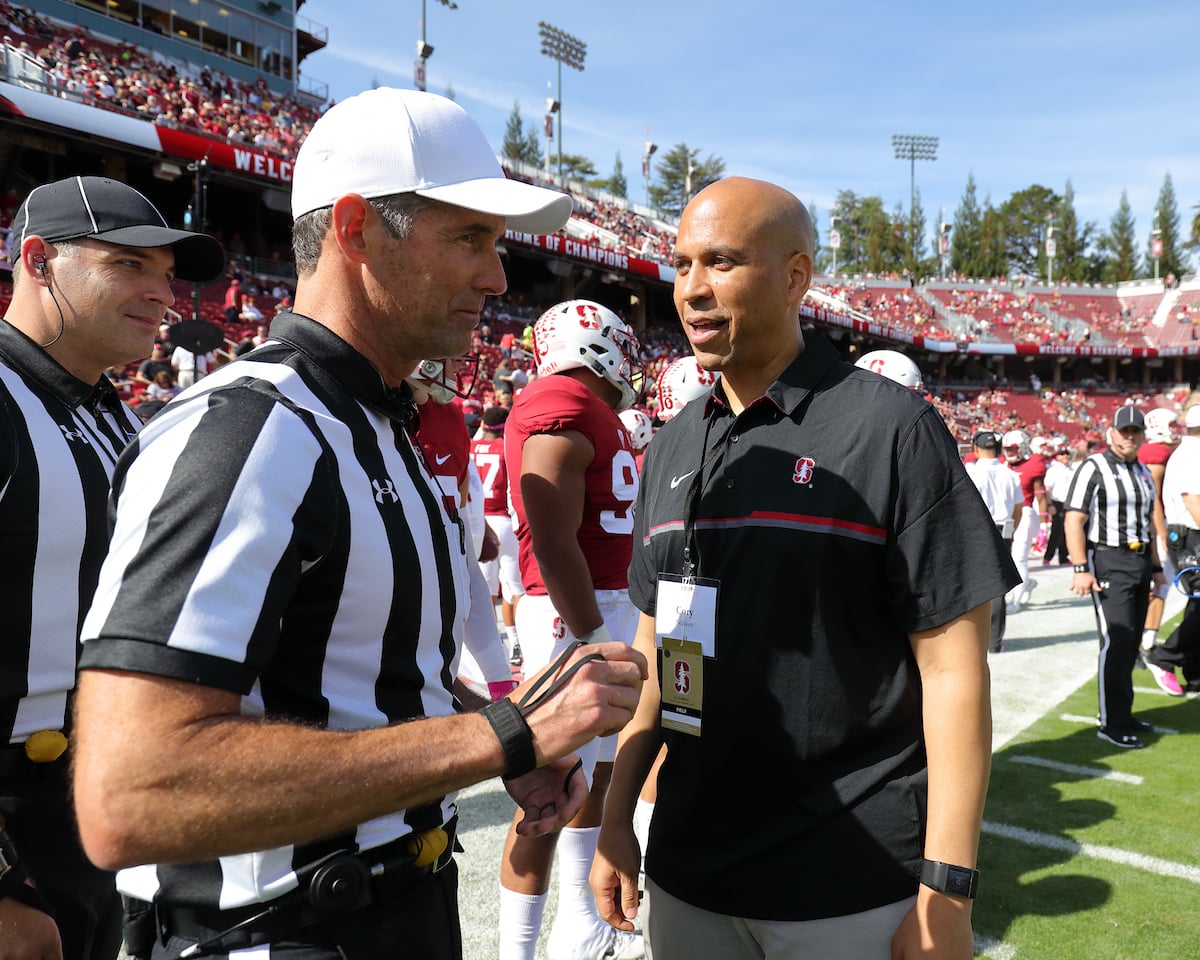
Cory Booker ’91, M.A. ’92, former tight end for Stanford football and current Senator of New Jersey, strongly opposes the bill, claiming that the changes disfavor college players.
“This is a bill not about student-athletes. It’s about wealthy coaches and wealthy institutions and an NCAA who has enjoyed unbridled power for decades as we watch discrimination and hardships [of student-athletes],” Booker said during a floor speech on Sept. 28. “This body rushes in to say we’re protecting college athletes. Well, that is not true.”
The bill, brought to the floor by Rep. Senator Ted Cruz of Texas, Dem. Senator Maria Cantwell of Washington, Rep. Senator Eric Schmitt of Missouri and Dem. Senator Chris Coons of Delaware, has notable bipartisan support and is expected to arrive in the House of Representatives after Nov. 9.
In July, Stanford football players formed a campus chapter of the first-ever College Football Players Association (CFBPA), an organization pushing to establish collective bargaining within college football and eventually unionize college athletes. Senior offensive lineman Fisher Anderson and redshirt senior linebacker Ernest Cooper are spearheading Stanford’s chapter of the CFBPA.
It could be years before the players are able to bargain with ACC officials, but they hope their actions will spread to other teams across conferences.
The PCSA would impose hard salary caps on players and restrict third-party booster and NIL deals. The CFBPA, however, is advocating for open-market revenue generation, believing compensation caps are arbitrary limits designed by management without player input to suppress the fair market value of high-revenue athletes.
The bill also doesn’t address private equity’s pursuit of the sport, but it has gained support from Amazon, Paramount and Disney.
“That isn’t exactly conducive to making the best environment for college football players,” said Anderson in a video by More Perfect Union, an advocacy journalism nonprofit that aims to “[build] power for the working class.”
In the midst of the Senate debate over the PCSA, Booker wrote on X on Sept. 25 that members of Stanford’s CFBPA are “using their voice and their power to fight for a better deal.”
Both the PCSA and CFBPA are advocating for the health of student-athletes. The CFBPA hopes to secure independent health and safety protections, whereas the PCSA would mandate that schools cover medical bills during college and up to five years post-grad. However, the PCSA offers “loopholes” that athletic programs may take advantage of, such as a 30-day “cure period” for programs to fix any violation, allowing schools to bypass direct lawsuits for injuries.
Passing the PCSA would directly cut off the path for the CFBPA to establish legal employee status and collective bargaining. The PCSA would also deprive independent player associations of the leverage necessary to negotiate. The legislation gives the NCAA antitrust protection, just like the NFL and NBA, but in those leagues, players are allowed to collectively bargain.
Cooper is strongly opposed to the bill for a number of reasons, but primarily, “if it doesn’t include the college football athlete, I just find it hard to try and advocate to push something that is going to govern people they don’t have a spot at the table for.”
If the PCSA is not passed in the House of Representatives before January of 2027, the legislative process will restart, and the bill can be reintroduced next term. If the House introduces major revisions, the PCSA will be sent to a committee before reaching President Donald Trump’s desk for his signature.