
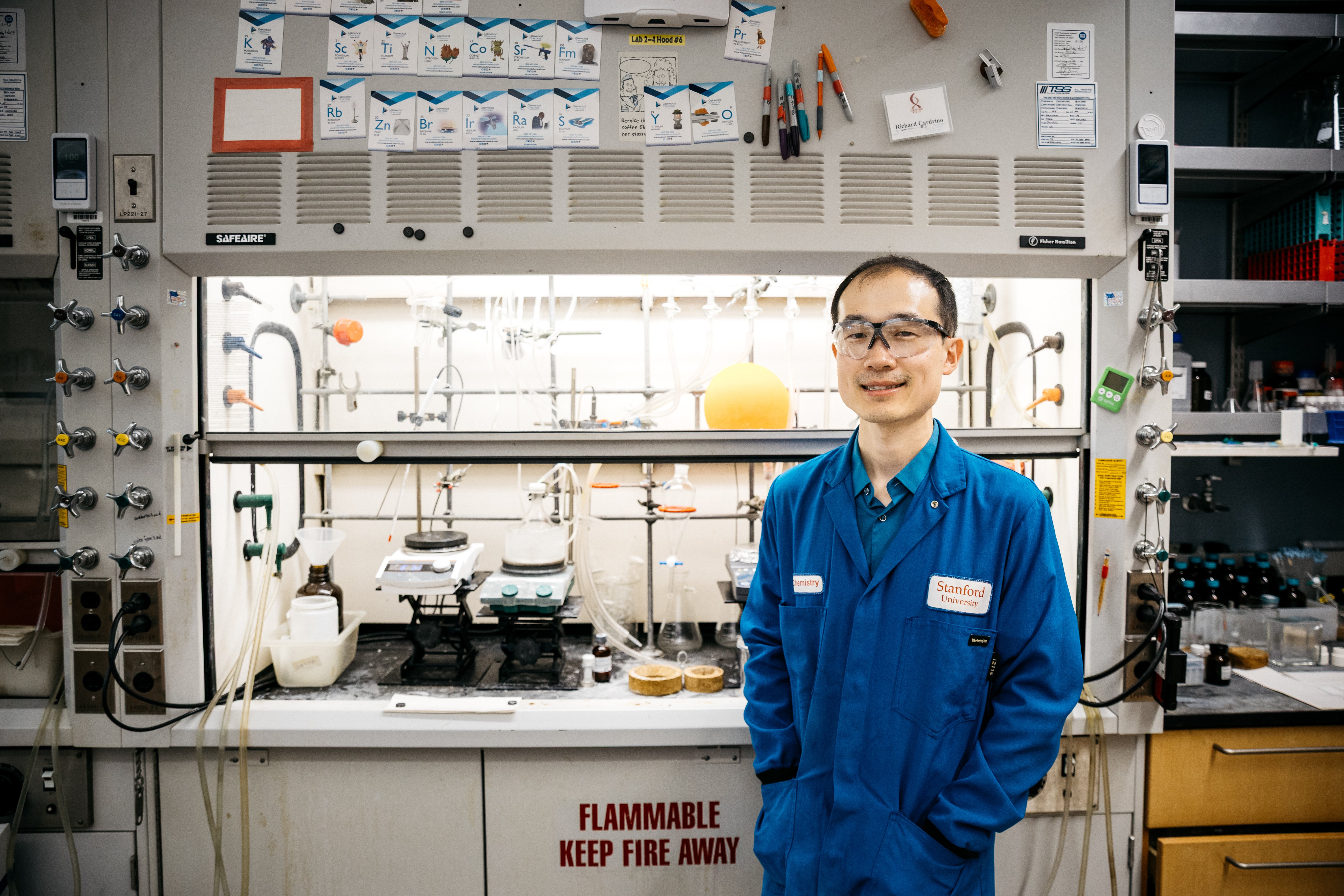
Professor of chemistry Song Lin, who joined the Stanford faculty this year, was named a 2026 MacArthur Fellow on Tuesday. The foundation recognized him for developing electrochemical methods that construct complex organic molecules more efficiently and sustainably. He is among one of 20 people selected for this year’s class.
“I am honored and humbled to have received this MacArthur award,” Lin told the Stanford Report. “The award is not about just me; it’s a group effort.”
The fellowship carries an $800,000 award, paid in equal quarterly installments over five years. The MacArthur Foundation attaches no conditions to the funds and requires no reports or products from recipients. The program does not accept applications. Instead, invited nominators submit candidates, and an independent selection committee evaluates them on three criteria: exceptional creativity, a track record suggesting important advances to come and the potential for the fellowship to enable further creative work.
Many chemical reactions need a push to get started. Chemists have long supplied that push with expensive metals and hazardous chemicals, which often leave toxic waste behind. Lin’s research rests on a simpler premise: electricity can do the same job. Using an electrical current makes reactions safer and cleaner and gives chemists more control over what they produce. The molecules Lin’s lab builds are used in medicines and in materials such as polymers, the long chainlike molecules that make up plastics.
In one early project, Lin found a cheaper and simpler way to attach two nitrogen-containing groups to neighboring carbon atoms, an arrangement found in many medicines. Similar reactions often depend on rare and costly metals, whereas Lin’s method used manganese (Mn), a common metal, and ran off two AA batteries.
Many molecules also come in two versions which have opposite chirality, much like a left and a right hand. The two versions can have different effects in the body, and a medicine often needs just one, but standard reactions tend to produce both. Lin and his colleagues combined two reactions, one using cobalt (Co) and one using copper (Cu), in a single electrically powered setup that produces only the version they want.
His recent work addresses a long-standing problem in chemistry: changing one specific carbon-hydrogen bond on a molecule that contains many similar ones. Lin’s group designed pairs of highly reactive molecules that are too bulky to react with each other, but can still work together. Using electricity, the researchers can then activate the pairs and steer them to the exact bonds they want to change, the foundation said.
Lin’s lab, working with Cornell physicist Paul McEuen’s group, has also built wireless devices that use light to power these reactions, allowing researchers to run hundreds of experiments at once. His research has been published in Nature, Science, Nature Chemistry and the Journal of the American Chemical Society.
Lin received his bachelor’s degree from Peking University in 2008 and his Ph.D. from Harvard University in 2013. He completed a postdoctoral fellowship at UC Berkeley from 2013 to 2016. He then spent a decade in the Department of Chemistry and Chemical Biology at Cornell University before joining Stanford. He is 40 years old.
Lin is the second Stanford faculty member in consecutive years to receive the fellowship for work in electrochemistry. Assistant professor of chemical engineering William Tarpeh ‘12 was named a 2025 fellow for developing methods that recover useful products from pollutants in wastewater.